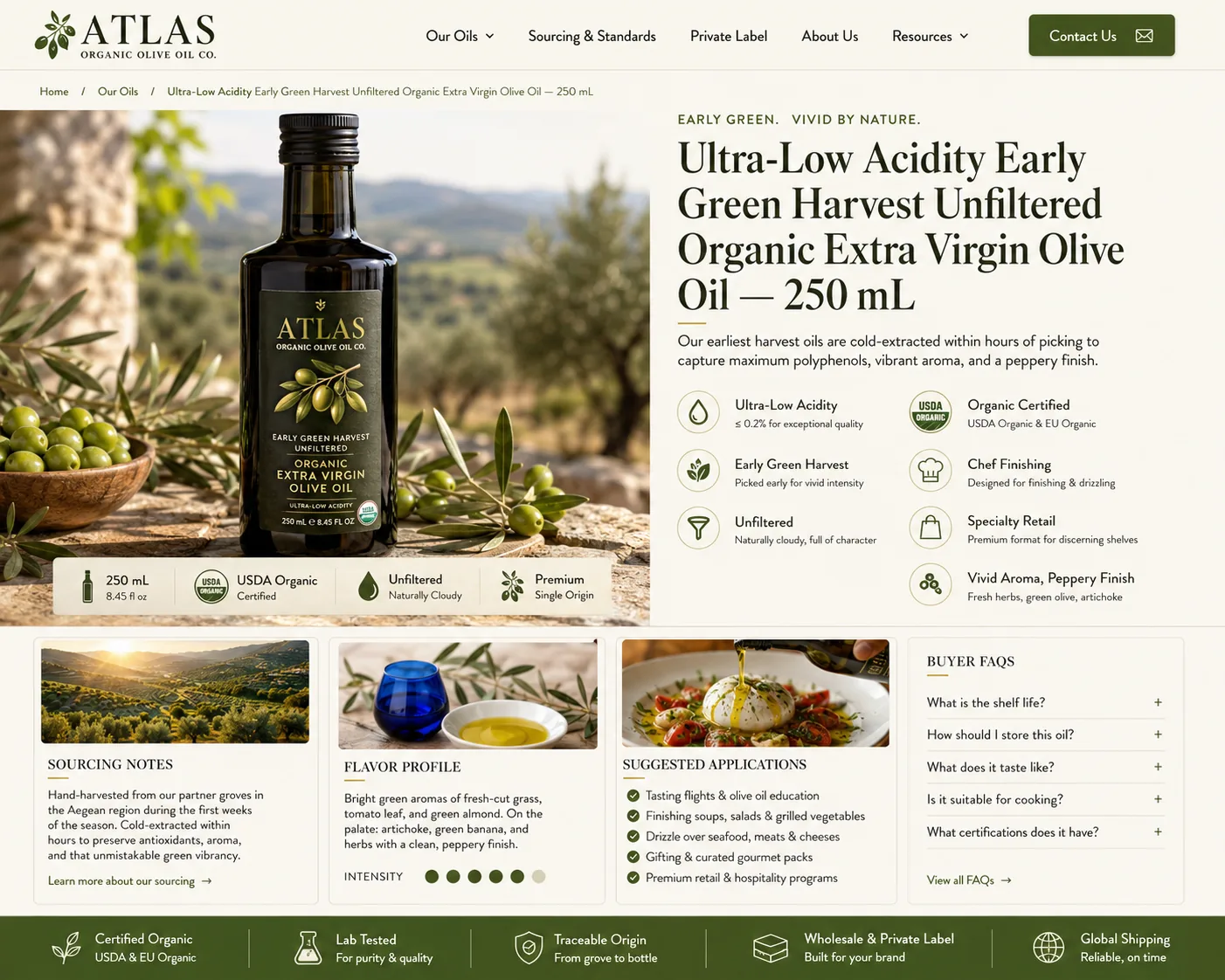
Designed around harvest intensity, natural presentation and commercial use.
This format combines very early green harvest positioning with an unfiltered presentation intended to preserve the visual character of a minimally clarified seasonal oil.
Very early harvested olives are typically selected when the commercial objective emphasizes pronounced green-fruit character rather than maximizing oil yield. The resulting sourcing brief can target a more assertive sensory profile, while the unfiltered presentation may retain suspended micro-particles and small amounts of moisture that contribute to natural haze or sediment.
Atlas treats this format as a sourcing specification rather than a fixed agricultural formula. Cultivar, climate, grove conditions, fruit maturity, harvest timing, milling conditions and storage all influence the final lot. Commercial approval should therefore use current documentation and sensory condition rather than relying on the product name or one analytical measurement alone.
Applications for this format.
The strongest use cases are those where the visual and sensory character of an unfiltered very-early-harvest oil can be appreciated, while inventory and storage can be managed carefully.
Seasonal specialty retail
Suitable for gourmet retailers and curated seasonal assortments that can explain the unfiltered appearance and manage inventory around freshness, lot identity and controlled turnover.
Chef finishing and tasting
The compact 250 mL format is well suited to tableside tasting, finishing applications and chef-led programs where the oil is used primarily for sensory contribution rather than as a neutral cooking fat.
Restaurant groups
Can support premium restaurant concepts, tasting menus and selected front-of-house applications when storage, replenishment and open-bottle handling are standardized across locations.
Freshness-led limited releases
Particularly appropriate for short-run seasonal launches, gift sets, gourmet subscriptions and limited releases built around harvest timing, freshness and a distinctive unfiltered presentation.
Natural character requires disciplined handling.
Unfiltered olive oil is commercially different from a highly clarified presentation. Buyers should account for appearance, storage, inventory turnover and customer communication before launch.
Expect natural variation.
Fine suspended material can create haze, and small amounts of sediment may settle over time. This appearance should not automatically be interpreted as a defect, but it should be anticipated in merchandising and customer communication.
Protect the oil after packing.
Store the product away from unnecessary heat and direct light, keep closures secure and minimize prolonged exposure to air after opening. Distribution and warehouse practices should support the intended premium positioning of the oil.
Plan inventory conservatively.
Unfiltered programs generally benefit from disciplined lot rotation and realistic sales forecasts. Buyers should align order size, warehouse dwell time and retail turnover with the desired sensory and visual profile.
Qualify the lot, not just the label.
A commercial release should connect category status, organoleptic condition, analytical results, organic integrity, packaging and traceability.
Very low free acidity can be an attractive sourcing target, but it should sit inside a complete specification. The purchasing decision should reflect the current lot, intended application and the quality expectations of the destination market.
Before purchase approval
- Confirm current organic certification and chain-of-custody requirements.
- Review the current lot certificate of analysis against the agreed specification.
- Confirm that extra-virgin classification is supported by applicable analytical and sensory criteria.
- Define sensory acceptance criteria and, where required, relevant panel or organoleptic documentation.
- Confirm the expected natural haze or sediment profile for the unfiltered presentation.
- Confirm bottle, closure, lot coding, case marking and shipping configuration.
- Review warehouse, transit and retail storage expectations.
- Define expected inventory turnover and lot-transition procedures before repeat ordering.
Technical guides for confident buying.
Use these guides to evaluate the product beyond the headline specification and build stronger receiving, storage and purchasing criteria.
Read a certificate of analysis
Understand how free acidity, peroxide value, UV measurements and other analytical fields fit into a broader quality and receiving specification.
Read guideFiltered vs. unfiltered
Compare clarity, suspended material, sediment, storage considerations, turnover expectations and the commercial positioning of filtered and unfiltered oils.
Read guideProtect from light and oxygen
Use bottle selection, closure integrity, headspace management, warehouse storage and inventory practices to help preserve quality through distribution.
Read guideAbout Ultra-Low Acidity Early Green Harvest Unfiltered Organic Extra Virgin Olive Oil — 250 mL
Ultra-Low Acidity Early Green Harvest Unfiltered Organic Extra Virgin Olive Oil — 250 mL is positioned for seasonal specialty retail, premium gifting, chef finishing, tasting programs, restaurant groups and freshness-led limited releases. The compact format is particularly useful where the oil is intended to be tasted or used as a premium finishing ingredient. Final suitability depends on the buyer’s sensory expectations, handling practices, turnover and desired shelf life.
The page shows Target ≤0.2% free acidity as a partner-origin sourcing target or reference where stated. Free acidity is one analytical parameter used in olive-oil evaluation, but it does not by itself prove freshness, sensory quality or extra-virgin classification. Final category status should be verified for the current lot using all applicable chemical and sensory criteria.
Natural haze or fine sediment can occur because suspended material remains in the oil. Buyers should use conservative storage and turnover practices, protect bottles from excessive heat and direct light, minimize unnecessary oxygen exposure and validate the desired shelf life for the actual package and distribution cycle. Retail and hospitality teams should also understand that some visual variation is normal for this type of presentation.
Request current organic certification information, lot traceability, a certificate of analysis, relevant sensory or classification information, bottle and case specifications and any destination-specific documents required by your quality, import or retail program. Documentation should correspond to the actual lot being purchased whenever possible.
Yes. Depending on volume, destination and commercial feasibility, Atlas can develop private-label, case-pack, wholesale, bulk, sensory-target, packaging and documentation requirements around the buyer’s brief. Share the target market, expected annual volume, pack concept, organic requirements and desired delivery schedule so the sourcing program can be reviewed in detail.
From a first sample to a repeatable global supply program.
Share your target sensory profile, annual volume, destination, packaging requirement, organic documentation needs and timing to discuss the most appropriate commercial program.