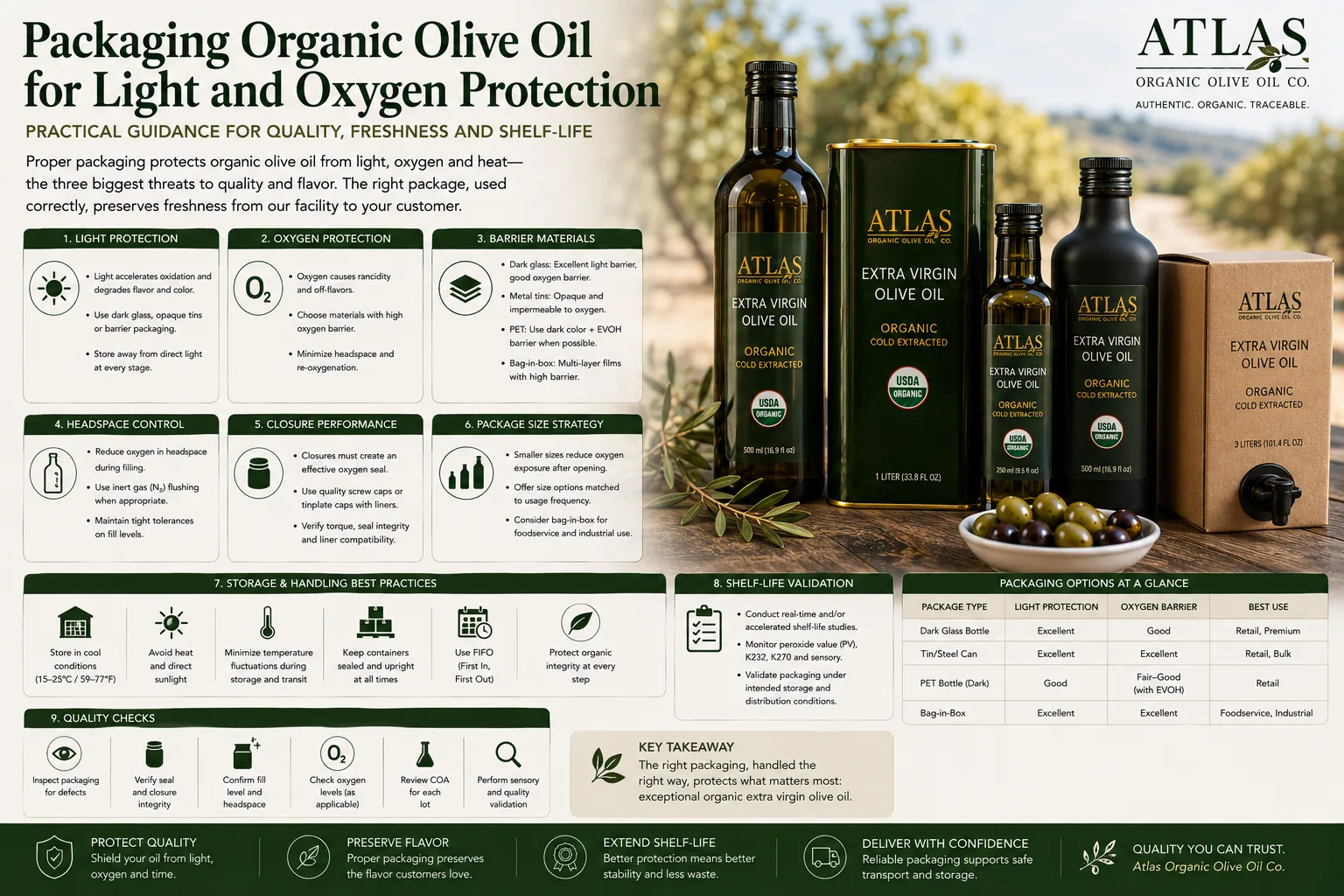
Packaging is a quality-control system. Dark or opaque materials reduce light exposure, and headspace, closure performance and package permeability influence how much oxygen can contact the oil over time.
Packaging must protect the oil while fitting channel, cost, filling capability, handling and end-of-life objectives. Light, oxygen, closure performance, package size and turnover are core quality variables, not simply design choices. A strong incoming oil can lose quality if the commercial pack exposes it unnecessarily during storage or after opening.
The practical objective is not to select one universally “best” package. It is to define the oil, barrier system, closure and use pattern that remain fit for the intended channel and shelf life. Retail, foodservice and bulk applications can require very different balances between protection, convenience, logistics and cost.
1. Start with the decision framework
Before requesting samples, write down the commercial job the oil must perform. That brief should state the finished product or service application, target market, annual and trial volumes, expected pack format, sensory role, process exposure, storage conditions and required organic documentation. If the oil will be named prominently on the label, the sensory target deserves even more attention.
Add the expected packaging environment to the brief. Consider retail-light exposure, time in warehouse, freight conditions, opening frequency, dispensing method and how quickly the customer is likely to consume the oil after opening. The package that performs well for a fast-moving foodservice kitchen may not be the same package needed for a slower-turning retail product.
- Choose dark glass, metal, bag-in-box or another fit-for-purpose barrier based on channel and shelf-life target.
- Consider both light protection and oxygen exposure rather than evaluating package appearance alone.
- Control headspace oxygen at filling where practical and validate closure integrity.
- Confirm that seals, liners, taps or dispensing systems remain effective during expected storage and use.
- Size the pack so the customer can consume the oil within a reasonable period after opening.
A useful specification separates the legal or category baseline from tighter internal targets. It also makes clear which packaging characteristics are mandatory, which alternatives require approval and which performance attributes are validated only for a particular pack configuration.
2. Practical workflow
Move from package concept to commercial approval in controlled steps. First, define the oil and channel. Second, shortlist barrier systems that fit the expected exposure. Third, test the package under realistic filling, storage and distribution conditions. Finally, define receiving and production checks so future components are judged consistently.
- Write a one-page brief. Include category, organic status, harvest or filtration preference if relevant, sensory profile, pack size, volume, destination, expected shelf life and timing.
- Map the exposure. Consider light on the retail shelf, warehouse storage, transport temperature, oxygen at filling, headspace after opening and expected consumer or foodservice turnover.
- Shortlist package formats. Compare dark glass, metal, bag-in-box or other approved materials against protection, line compatibility, breakage risk, handling, cost and channel requirements.
- Review documents. Confirm lot identity, analytical results, organic status, traceability and any food-contact, packaging, import or label records required by the market.
- Validate closure performance. Confirm that the selected closure, liner, seal, tap or dispensing system fits the package correctly and remains suitable through expected distribution and use.
- Pilot the filling system. Use commercial-equivalent transfer, filling, headspace, capping, sealing and coding conditions rather than relying only on empty-package testing.
- Test the packed product. Evaluate the actual oil in the commercial package under realistic storage conditions and include opened-life behavior where repeated use is part of the application.
- Define release and change control. Decide who approves a new bottle, closure, liner, label material, supplier, pack size or other component change that could affect product protection.
Package testing is strongest when the full system is evaluated together. A high-barrier container can still perform poorly if closure fit is inconsistent, headspace is excessive or the filling process introduces unnecessary oxygen. Conversely, a well-controlled filling process cannot compensate indefinitely for weak protection during a long retail or distribution period.
3. Quality controls that belong in the conversation
Extra virgin olive oil is defined through more than free acidity. Buyers should use the current applicable category standard, appropriate laboratory methods and—where required—organoleptic assessment. For commercial programs, add internal criteria that describe the sensory style your brand or formulation actually needs.
Packaging quality controls should support those incoming-oil requirements. The buyer should know which container, closure and filling conditions were used when shelf life was established and should treat material changes to that system as controlled changes rather than routine substitutions.
- Set appropriate light-protection and oxygen-barrier requirements for the intended channel.
- Validate closure, seal and headspace performance under commercial filling conditions.
- Check package integrity, leakage and code readability during production and receiving.
- Match package size to realistic use after opening and expected turnover.
- Retain finished packed units where they support shelf-life trending or complaint investigation.
For storage and distribution, protect oil from direct light, unnecessary heat and repeated oxygen exposure. A premium incoming lot can deteriorate if it is held too warm, transferred turbulently, stored in a partly empty container for too long or packed in a format that does not suit turnover.
Secondary packaging and distribution also matter. Cases, dividers, pallet patterns and warehouse practices can influence breakage, leakage and exposure. A package should therefore be assessed not only on the filling line but also through the handling conditions it will encounter before reaching the customer.
4. Common failure modes
Most packaging failures are not caused by the absence of a premium container. They arise when one component is optimized in isolation or when the commercial package is not tested against the actual shelf-life and use pattern.
- Choosing clear packaging mainly for shelf appearance without considering expected light exposure.
- Ignoring closure, liner or dispensing-system oxygen ingress.
- Assuming an opaque container automatically solves headspace or closure problems.
- Using a protective bulk pack but exposing oil unnecessarily during transfer and repacking.
- Approving empty components without testing the filled and sealed commercial unit.
- Using an oversized pack that remains open for too long after first use.
- Changing bottle or closure suppliers without reviewing the original protection and shelf-life assumptions.
Another common weakness is treating package material as the only barrier variable. Oxygen can enter or remain in the system through headspace, closure interfaces, dispensing systems or repeated opening. The complete package and use pattern should therefore be evaluated rather than relying on one material property alone.
Build corrective-action triggers around objective evidence: leaking closures, damaged seals, excessive headspace, package deformation, coding problems, broken traceability, sensory deterioration, temperature excursions or other documented process deviations. This gives quality and packaging teams a clearer basis for hold and release decisions.
5. What to put in the purchase specification
The purchase specification should describe the oil and the protective role of the package clearly enough that equivalent commercial performance can be maintained from one production run to the next.
6. Reference framework
For category definitions, analytical methods and organoleptic assessment, use the current International Olive Council trade standard and methods together with destination-market rules. Packaging requirements should then be validated against the actual commercial pack, filling process and expected distribution environment.
Packaging and storage literature consistently emphasizes limiting light, oxygen and unnecessary heat. Commercial shelf life still requires lot- and package-specific validation because barrier performance, closure integrity, headspace, storage and use conditions interact over time.
Next step
Turn this guide into a sourcing brief by listing your application, annual volume, destination, desired package size, target launch date and the quality attributes that matter most. Add expected light exposure, opened-life pattern, closure requirements and any barrier characteristics your shelf-life work has identified.
Atlas can then compare suitable organic olive-oil programs on the same commercial basis, aligning oil quality, package format, closure system, storage assumptions, documentation and logistics rather than evaluating the container independently from the product it is expected to protect.