
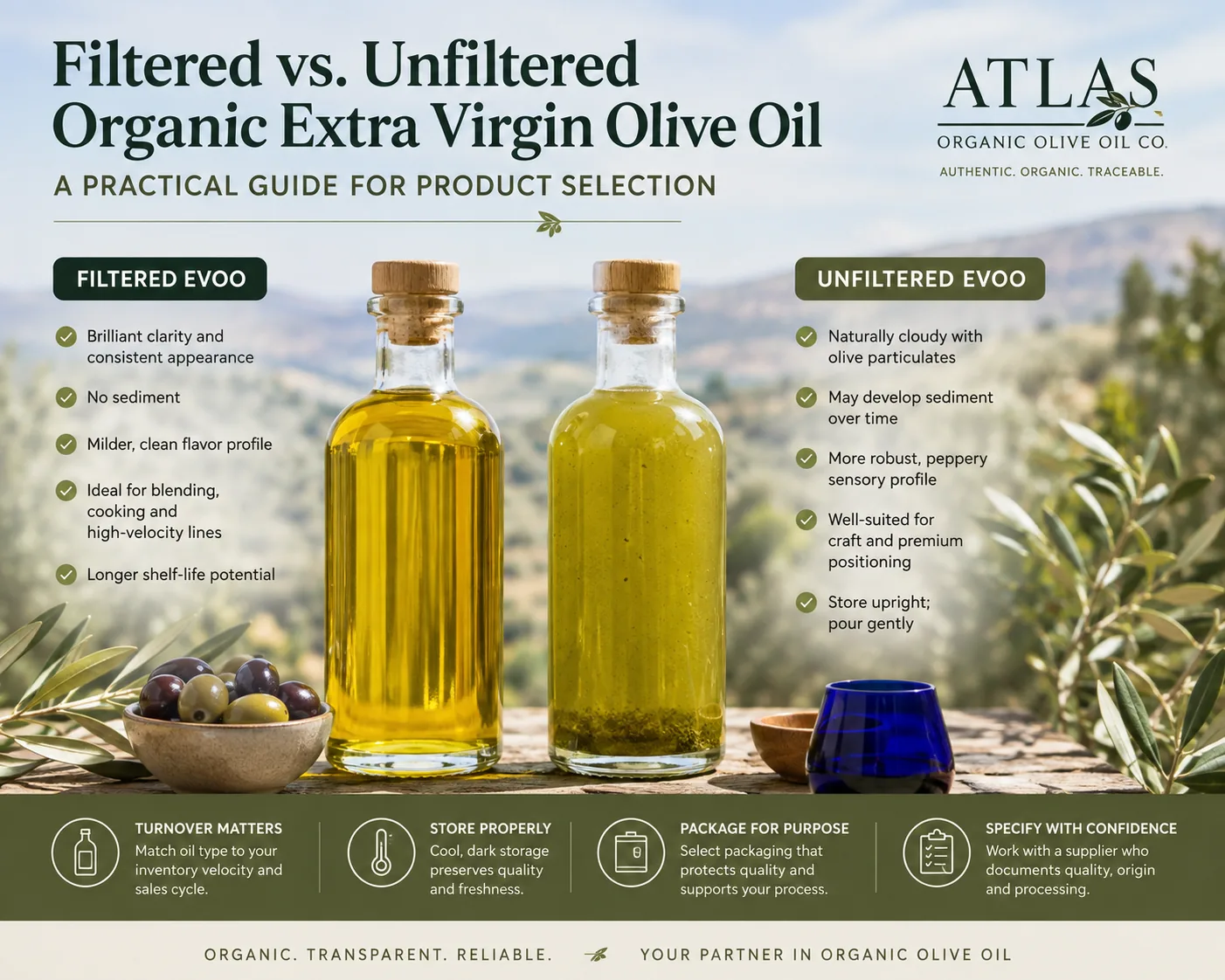
Filtration removes suspended water and fine solids; unfiltered oil retains more of them and may appear cloudy. The choice is a product-style and stability decision, not a simple quality hierarchy.
Product style is a trade-off among sensory target, visual appearance, clarity, distribution length, shelf-life plan, channel and turnover. A filtered oil can be the stronger commercial choice for a broad distribution program, while an intentionally unfiltered oil may suit a seasonal or short-turnover concept where haze and settling are part of the expected presentation.
The practical objective is not to decide that one filtration style is always superior. It is to define the oil, packaging and handling system that remain fit for the intended food, channel, visual presentation and shelf-life expectation.
1. Start with the decision framework
Before requesting samples, define the commercial job the oil must perform. The sourcing brief should state the intended application, target market, trial and annual volumes, filtered or unfiltered preference, acceptable visual appearance, sensory role, distribution length, storage conditions, pack format and required organic documentation.
- Use filtered oil when clarity, broader distribution and more predictable visual stability are priorities.
- Use unfiltered oil when a cloudy, seasonal or minimally clarified presentation is intentional and inventory turnover can be tightly managed.
- Define acceptable haze, sediment and appearance before commercial launch.
- Match pack size and distribution length to the expected stability of the selected filtration style.
If olive oil is a visible premium product on shelf, appearance becomes part of the commercial specification. Retailers and consumers may interpret haze or sediment differently, so the brand should decide in advance whether those characteristics are intentional and how they will be managed.
A useful specification separates extra-virgin category requirements from the buyer's filtration and appearance targets. Filtration status is a product-style choice; it does not replace the chemical and organoleptic criteria required for the olive-oil category.
2. What filtration changes
Freshly produced olive oil can contain small amounts of suspended water droplets and fine olive-derived solids. Filtration reduces those suspended materials and generally produces a clearer appearance.
The exact filtration system and degree of clarification can differ among producers. Commercial buyers should therefore avoid treating “filtered” as though it describes one identical process across every supplier.
When filtration status matters to the finished product, the supplier specification should state the agreed presentation and any practical appearance expectations rather than relying only on a marketing description.
3. What unfiltered oil retains
Unfiltered olive oil retains more suspended water and fine solids. As a result, the oil may look hazy or cloudy, particularly when recently produced.
Some of these suspended materials can settle during storage, creating visible sediment at the bottom of a tank or retail package. That visual change should not automatically be described as spoilage.
At the same time, the presence of suspended material means unfiltered oil should be managed as a deliberate product style with its own storage, turnover and shelf-life plan rather than simply as filtered oil that happens to be cloudy.
4. Define appearance before launch
Appearance is one of the most obvious differences between filtered and unfiltered oils. A buyer should define what level of clarity, haze and sediment is acceptable when the product is released and throughout the intended commercial period.
This becomes especially important in transparent retail packaging because even normal settling can generate complaints if the consumer has been led to expect a consistently bright, clear product.
For deliberately unfiltered products, brand communication and customer-service teams should understand the intended appearance so that normal haze or settling is not automatically treated as a defect.
5. Treat stability as a system decision
Filtration choice should be evaluated alongside storage temperature, light exposure, oxygen management, package format and distribution time. No single processing step guarantees shelf life.
Filtered oil is often selected when predictable appearance and longer commercial distribution are priorities. Unfiltered programs typically deserve more careful attention to turnover and validation because the retained water and solids are part of the product system.
The finished commercial program should therefore be validated with the actual oil, package, warehouse conditions, transport route and intended shelf life rather than using filtration status as a substitute for shelf-life testing.
6. Practical workflow
Move from sample selection to commercial approval in controlled stages. First, define the desired product style. Second, compare candidate oils under the actual intended storage and presentation conditions. Third, confirm packaging and turnover. Finally, establish receiving and change-control requirements.
- Write a one-page brief. Include category, organic status, filtration preference, sensory profile, desired appearance, pack, volume, destination and timing.
- Sample side by side. Compare filtered and unfiltered candidates for aroma, flavor, clarity, haze and sediment behavior.
- Evaluate in context. Test the oil in the actual retail, foodservice or ingredient application rather than judging only from a tasting glass.
- Review documents. Confirm lot identity, analytical results, organic status, filtration status, traceability and required market documentation.
- Test the intended package. Evaluate how the oil looks and performs in the actual bottle, tin or bulk format.
- Model realistic turnover. Consider warehouse time, retail distribution, opened-container use and expected inventory rotation.
- Validate shelf life. Use the actual commercial format and storage conditions rather than assuming filtration alone determines stability.
- Define release and change control. Decide who approves a change in filtration practice, harvest, appearance, sensory profile or packaging.
7. Evaluate sensory differences in the finished use
Filtration status can be associated with differences in product style, but buyers should avoid assuming that one style will always taste stronger, fresher or better. The actual sensory result depends on cultivar, harvest timing, processing, storage and the individual commercial lot.
Candidate oils should therefore be tasted both neat and in the intended finished application. A retail oil intended for dipping may have a different target from an oil used in sauces, bakery, foodservice or ingredient manufacturing.
The buyer can define a practical range for fruitiness, bitterness and pungency while keeping filtration status as a separate specification field.
8. Match turnover to the product style
Inventory planning matters for both filtered and unfiltered oil, but it becomes especially important when the commercial concept depends on a fresh, seasonal or minimally clarified presentation.
Order quantities should reflect realistic sales or production use. A format that is economical per liter may not be commercially efficient if it leaves partly used containers or slow-moving retail inventory in storage longer than intended.
Buyers can align delivery frequency, pack size and warehouse stock levels with expected consumption so the product does not depend on long storage merely to achieve purchasing efficiency.
9. Choose packaging around appearance and protection
Packaging should support both the quality of the oil and the intended visual presentation. Light protection, oxygen exposure, closure integrity and package size remain important regardless of filtration status.
Transparent packaging can make haze and sediment more visible, which may be desirable for an intentionally unfiltered product or undesirable for a brand positioned around visual clarity.
Package selection should therefore be coordinated with branding and shelf-life validation instead of being treated as a separate procurement decision.
10. Quality controls that belong in the conversation
Extra virgin olive oil is defined through more than filtration status or free acidity. Buyers should use the current applicable category standard, appropriate laboratory methods and, where required, organoleptic assessment.
- Taste candidate oils against the finished use case.
- Define acceptable clarity, haze, sediment and sensory range.
- Link filtration status and analytical documentation to the commercial lot.
- Align selection with distribution length, storage conditions and pack turnover.
- Keep organic certification, olive-oil category and filtration status as separate but connected specification elements.
An unfiltered oil still has to satisfy the applicable category requirements, just as a filtered oil does. Cloudiness is not proof of superior authenticity, and visual clarity is not proof of extra-virgin quality.
11. Protect both styles during storage
Filtered and unfiltered oils should both be protected from unnecessary heat, direct light and repeated oxygen exposure. Filtration does not make poor storage harmless.
Storage tanks and containers should also preserve lot identity. When oil is transferred, the new tank or internal lot should remain linked to the supplier lot and relevant analytical and organic documentation.
For unfiltered oils, the operation should also understand how settling will be handled. Procedures should be consistent with the intended product style rather than changing from lot to lot without control.
12. Do not treat all sediment as the same issue
Sediment can arise because suspended solids settle from an intentionally unfiltered oil. That alone does not establish that the oil is spoiled.
At the same time, unexpected appearance changes should still be investigated against the agreed product specification, storage history and sensory condition. The buyer should distinguish normal product-style variation from a genuine defect.
A retained sample and documented appearance standard can make these investigations more objective, especially in private-label or retail programs.
13. Common failure modes
Problems often arise when filtration status is turned into a marketing hierarchy instead of being managed as a technical product choice.
- Claiming unfiltered oil is automatically more authentic or superior.
- Treating all sediment as proof of spoilage.
- Assuming filtered oil no longer requires strong storage controls.
- Sending unfiltered oil through long, warm distribution without validation.
- Launching a cloudy product without defining acceptable haze and settling.
- Selecting filtration style without considering package transparency.
- Using an oversized format that remains open or in inventory too long.
- Changing filtration practice without buyer notification or reapproval.
Corrective-action triggers should be based on objective evidence: unexpected appearance, sensory defects, out-of-specification analytical results, damaged seals, broken traceability, excessive age, temperature excursions or documented packaging and handling deviations.
The quality program should also define who places a lot on hold, what evidence is reviewed and when a new sample, retained sample or supplier investigation is required.
14. What to put in the purchase specification
A practical purchasing specification should make filtration status explicit and connect it to appearance, sensory, shelf-life and handling expectations.
15. Questions to ask a potential olive-oil supplier
Supplier discussions should cover the actual filtration program and expected commercial behavior rather than relying on broad labels such as “natural” or “traditional.”
- Is the commercial lot filtered, unfiltered or otherwise clarified?
- What appearance should the buyer expect at packing and later in storage?
- How consistent is the filtration approach from harvest to harvest?
- Which analytical and sensory documents accompany each lot?
- What storage and turnover conditions are recommended for the selected style?
- Which pack formats are available for the intended distribution length?
- Are retained samples available to support appearance or sensory investigations?
- How are filtration, harvest, origin or processing changes communicated?
The objective is a repeatable product program rather than a one-time preference for clear or cloudy oil. Defined appearance, lot-specific documentation and agreed change control make future shipments easier to approve.
16. Reference framework
For olive-oil category definitions, analytical methods and organoleptic assessment, use the current International Olive Council trade standard and methods together with applicable destination-market requirements.
Filtration style should be evaluated alongside actual packaging, storage, distribution and turnover conditions. Commercial shelf life should be validated with the selected oil and finished package rather than inferred from filtration alone.
Next step
Turn this guide into a sourcing brief by listing your required olive-oil category, filtered or unfiltered preference, desired appearance, sensory profile, annual volume, destination, pack format, expected distribution length and organic documentation needs.
Atlas can then compare suitable organic extra virgin olive-oil programs on the same commercial basis and help align filtration style, sensory profile, appearance, packaging, traceability and supplier documentation with your product strategy.