
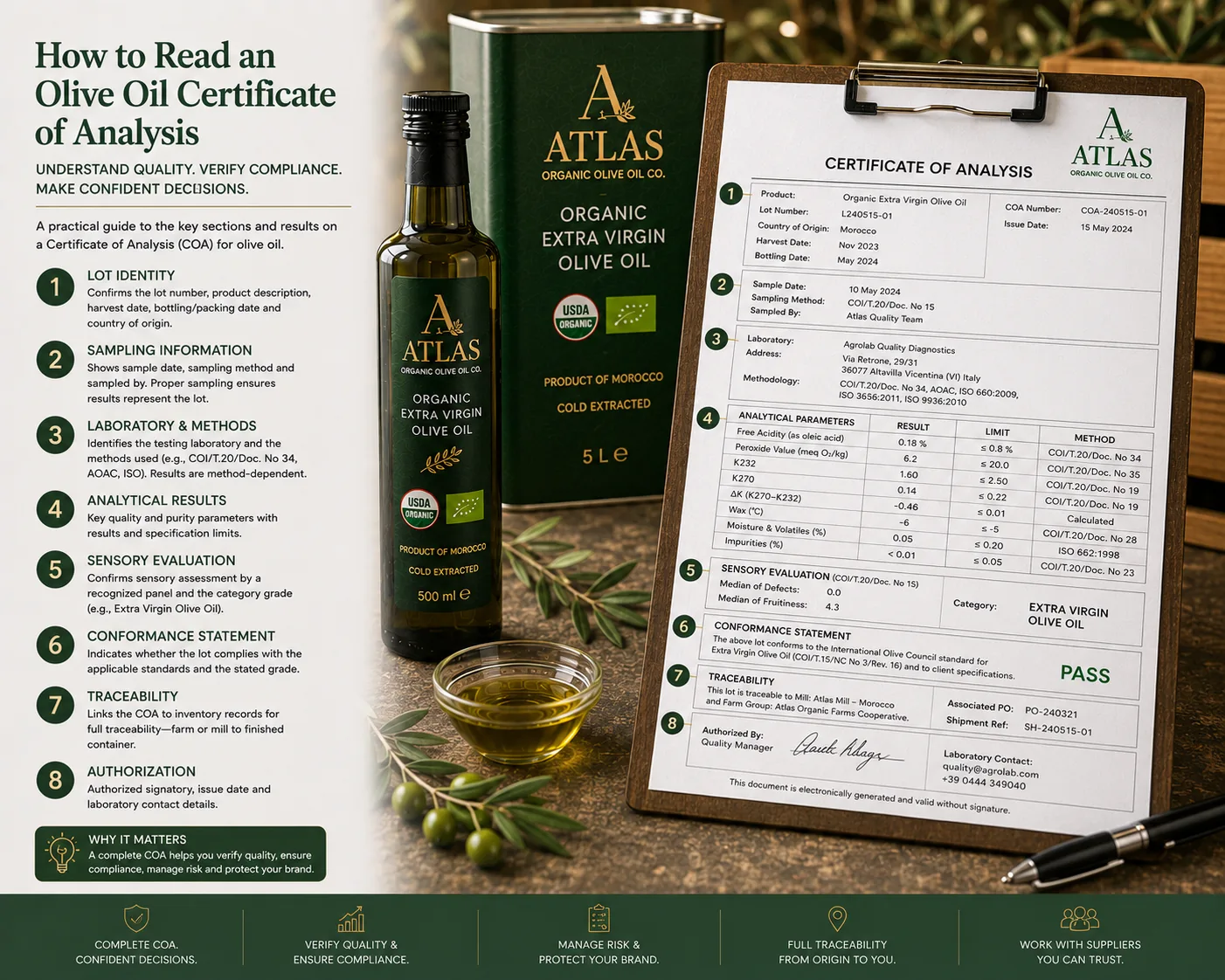
A certificate of analysis is a snapshot of measured characteristics for a sample or lot. It is useful only when the lot identity, test methods, laboratory competence, specification and sampling basis are understood.
Analytical numbers are meaningful only in context: lot identity, sampling, method, category standard, sensory condition, test date and storage history. A polished certificate with many parameters can still be commercially weak if the buyer cannot determine which lot was tested or whether the results correspond to the shipment being purchased.
The practical objective is not to find the certificate with the lowest numbers. It is to establish whether a particular commercial lot meets the applicable olive-oil category, buyer specification, organic documentation requirements and intended application needs at the time of release.
1. Start with the decision framework
Before comparing supplier certificates, define the decision the COA must support. The purchasing brief should state the required olive-oil category, destination market, trial and annual volume, expected pack format, internal analytical targets, sensory profile, organic status and lot-release requirements.
- Confirm sample or lot ID, test date, laboratory and analytical method before reading individual numbers.
- Interpret free acidity, peroxide value and UV absorbance together with the other category or authenticity parameters required by the governing standard.
- Pair chemistry with organoleptic assessment where the commercial category requires sensory conformity.
- Separate legal or category limits from tighter internal purchasing targets.
The COA should be compared with a defined specification rather than judged from memory or from another supplier's historical certificate. The governing standard, destination market and contract determine which parameters and limits matter.
A useful specification also distinguishes between results guaranteed at release, internal commercial targets, typical values and reference information associated with a particular origin or harvest.
2. Confirm what sample the certificate actually describes
The first question is not “What is the acidity?” It is “What exactly was tested?” A COA should contain enough identifying information to connect the analytical sample to a defined production, tank, packing or shipment lot.
The supplier lot number on the certificate should correspond with the lot shown on relevant commercial documents and, where applicable, on the physical container. If the buyer assigns an internal lot after receipt, the supplier lot should remain cross-referenced in the traceability system.
When one bulk lot is split into several packed lots, or several approved lots are consolidated, the relationship between the tested material and the shipped product should remain understandable.
A certificate that cannot be tied confidently to the delivered oil should not be treated as complete evidence for that shipment simply because the analytical values themselves appear acceptable.
3. Check when the sample was tested
A COA represents a point in time. Test date, production date, packing date, harvest information where relevant and shipment timing can help the buyer understand how current the result is.
A historical certificate may demonstrate what an oil looked like months earlier, but it does not automatically describe its current condition after additional storage, transfer or repacking.
This does not mean older test data are useless. Historical data can be valuable for trend analysis, but the buyer should distinguish historical reference data from current-lot release evidence.
4. Understand the sampling basis
The laboratory tests a sample, not an abstract commercial lot. The value of the result therefore depends partly on how that sample was collected and identified.
For packaged material, the sampling basis may be straightforward. Bulk tanks, flexitanks, tankers or large storage systems can require more deliberate sampling because one poorly chosen sample point may not represent the entire commercial volume.
Buyers should understand who collected the sample, when it was collected and how it was connected to the lot. For higher-risk or disputed decisions, a documented sampling procedure can become an important part of the evidence.
Retained samples can also support later comparison if buyer and supplier results disagree or if the quality of the stored oil changes unexpectedly.
5. Read the test method, not only the result
Analytical numbers should be interpreted using the method that produced them. A specification that lists parameters without identifying the governing analytical framework can create ambiguity when laboratories or suppliers use different procedures.
Current recognized methods appropriate to the commercial category should be used for release decisions. Method references also make historical comparison more meaningful because they help determine whether apparent changes reflect the oil or a change in analytical procedure.
Buyers should be cautious when comparing results from different laboratories if the methods, sample preparation, reporting units or timing are not equivalent.
6. Read analytical parameters as a group
Extra virgin olive oil is not defined by one number. A certificate should be reviewed as a set of complementary indicators together with the sensory requirements of the applicable category.
Free acidity is one important parameter, but it should not be described as a complete freshness or flavor score. Peroxide value provides different information, while UV absorbance parameters such as K232 and K270 contribute another part of the analytical picture.
Other category and authenticity parameters may also be required depending on the governing standard, destination market and supplier-risk program. The COA should therefore be compared against the actual purchasing specification rather than against a simplified shortlist of familiar values.
7. Put free acidity in the correct context
Free acidity is widely discussed because it is easy to communicate numerically, but buyers should resist treating the lowest acidity as proof of the “best” tasting or highest-value oil.
It is a category and quality-control parameter that should be interpreted alongside processing history, sensory condition and other chemical criteria. A low value does not cancel a sensory defect or automatically establish complete extra-virgin conformity.
Internal purchasing targets may be set below the applicable category maximum, but those tighter targets should be described clearly as contractual buyer criteria.
8. Review oxidation-related indicators together
Peroxide value and UV absorbance parameters provide different information about oxidative and related chemical changes. They should be assessed together with sample age, storage history and other required analytical parameters.
A single acceptable result does not prove that oxidation has never occurred, just as one elevated trend does not automatically identify the root cause. Investigation may need to consider storage temperature, oxygen exposure, packaging and the time between original production and testing.
Trend data across several lots can be especially useful because they reveal whether a supplier's normal analytical profile is changing even before a contractual limit is exceeded.
9. Chemistry does not replace sensory conformity
Where organoleptic assessment forms part of the applicable olive-oil category, a chemical certificate alone is not the complete category story.
Sensory assessment can identify defects and characterize positive attributes that are not represented by free acidity, peroxide value or UV absorbance. A buyer should therefore distinguish between chemical compliance and the complete category or brand sensory requirement.
Commercial programs may also set a preferred sensory range for fruitiness, bitterness and pungency so future lots remain consistent with the intended formulation or consumer profile.
10. Practical COA review workflow
A repeatable review process makes supplier comparisons faster and reduces the chance that important context is missed. Start with identity and method before moving to the individual analytical values.
- Confirm product identity. Check olive-oil category, organic status, supplier and intended commercial program.
- Confirm the lot. Match the certificate lot number to shipment, packing or production documentation.
- Check timing. Review sample date, test date and relevant production or packing dates.
- Check the laboratory and methods. Confirm that the methods and laboratory are appropriate for the commercial decision.
- Review all required parameters. Compare the complete result set with the current category and purchase specification.
- Review sensory evidence. Confirm organoleptic conformity where required and any buyer-specific sensory targets.
- Check organic and traceability records. Keep certification and analytical documents connected through the commercial lot.
- Approve, hold or investigate. Apply a defined release decision rather than relying on informal judgment.
11. Consider laboratory competence and consistency
A COA is stronger when the buyer understands who performed the analysis and which quality system supports the laboratory's work. The required level of laboratory oversight depends on the category, market, contract and commercial risk.
For routine supplier monitoring, consistency of method and laboratory can make trend data easier to interpret. When an unusual or disputed result occurs, independent or confirmatory testing may be appropriate under the buyer's agreed procedure.
Laboratory identity should remain visible on the certificate or supporting documentation so buyers know where the reported data originated.
12. Quality controls that belong in the conversation
Extra virgin olive oil is defined through more than free acidity. Buyers should use the current applicable category standard, appropriate laboratory methods and, where required, organoleptic assessment.
- Link every result to the actual shipped or stored lot.
- Use recognized current methods and laboratories appropriate to the decision.
- Trend multiple quality indicators instead of relying on one number.
- Maintain retained samples where commercially justified.
- Separate analytical category limits from tighter internal purchasing targets.
- Keep organic, analytical, sensory and traceability evidence connected through the same lot-control system.
For storage and distribution, protect oil from direct light, unnecessary heat and repeated oxygen exposure. A premium incoming lot can deteriorate after the COA is issued if downstream handling is poor.
13. Use COAs for trend analysis, not only pass or fail
A good supplier-quality program can use successive COAs to understand lot-to-lot consistency. Trends may reveal gradual movement in oxidation-related values, supplier processing, storage conditions or harvest characteristics.
Trending should use comparable methods and clearly identified lots. If the laboratory or method changes, that event should be documented so it is not mistaken for a change in the oil itself.
Trend limits and release limits should also be distinguished. A result can still meet specification while moving far enough from the supplier's normal profile to justify investigation.
14. A historical COA does not freeze quality in time
The quality of the oil can continue to change after testing. Heat, oxygen, light, long storage and repeated transfer can affect the condition of the commercial lot.
If the certificate is several months old, buyers should consider what happened between sampling and shipment. Storage location, tank headspace, packaging, transfer conditions and inventory age may become relevant to the release decision.
Retained samples from receipt can be useful when later testing suggests that the oil changed during storage or when a customer complaint must be investigated.
15. Common failure modes
Most COA problems are not caused by a lack of analytical data. They arise when the data are separated from lot identity, method, sensory context or the decision they are supposed to support.
- Reading one parameter in isolation.
- Accepting a COA that cannot be linked to the shipped lot.
- Assuming a historical COA represents the current storage condition.
- Comparing certificates that use different methods without recognizing the difference.
- Treating low free acidity as proof of complete extra-virgin conformity.
- Ignoring sensory assessment when the category requires it.
- Averaging several analytical results in a way that hides a questionable lot.
- Failing to investigate results that move sharply from the supplier's established trend.
Corrective-action triggers should be based on objective evidence: out-of-specification analytical results, sensory defects, broken lot linkage, inconsistent methods, missing documentation, temperature excursions or documented sampling and handling deviations.
The quality system should also define who places a lot on hold, when repeat sampling is appropriate, when an independent laboratory is used and what evidence is required for final disposition.
16. What to put in the purchase specification
A strong purchase specification should tell the supplier exactly which COA information is required for each commercial lot and how those results will be judged.
17. Define how conflicting test results will be handled
Buyer and supplier laboratories can occasionally report materially different results. A predefined dispute process is more useful than deciding the procedure only after a shipment has already been placed on hold.
The first review should confirm that both laboratories tested the same commercial lot using comparable samples and appropriate methods. Sampling date, storage history and laboratory timing should also be compared.
Depending on the commercial agreement, the parties may use retained samples, repeat testing or an agreed independent laboratory to support final disposition.
The procedure should preserve evidence and lot traceability so the investigation focuses on facts rather than on whichever certificate was issued first.
18. Reference framework
For olive-oil category definitions, analytical parameters, test methods and organoleptic assessment, use the current International Olive Council trade standard and methods together with applicable destination-market requirements.
Buyers should confirm the current rules applicable to the commercial destination before approving specification limits. Historical certificates and old internal specifications should not be assumed to reflect the current category framework.
19. Questions to ask a potential olive-oil supplier
Supplier qualification should cover the analytical system behind the COA as well as the numbers printed on it. A repeatable program depends on lot linkage, method consistency, documentation and responsive investigation.
- Is a current certificate of analysis supplied for every commercial lot?
- How is the COA linked to the production, tank or shipment lot?
- Which laboratory performs routine release testing?
- Which methods are used for the required olive-oil parameters?
- How and when are commercial samples collected?
- Are retained samples maintained for shipped lots?
- How are out-of-trend or conflicting analytical results investigated?
- How are laboratory, method, harvest, origin or specification changes communicated?
The objective is a repeatable quality-control program rather than a one-time document review. Clear lot identity, current methods, sensory evidence, retained samples and agreed change control make future shipments easier to evaluate.
Next step
Turn this guide into a sourcing and COA brief by listing your required olive-oil category, destination market, application, annual volume, pack format, analytical parameters, internal targets, sensory requirements and organic documentation.
Atlas can then compare suitable organic extra virgin olive-oil programs on the same commercial basis and help align lot-specific certificates of analysis, sensory style, traceability, packaging and supplier documentation with your quality-control requirements.