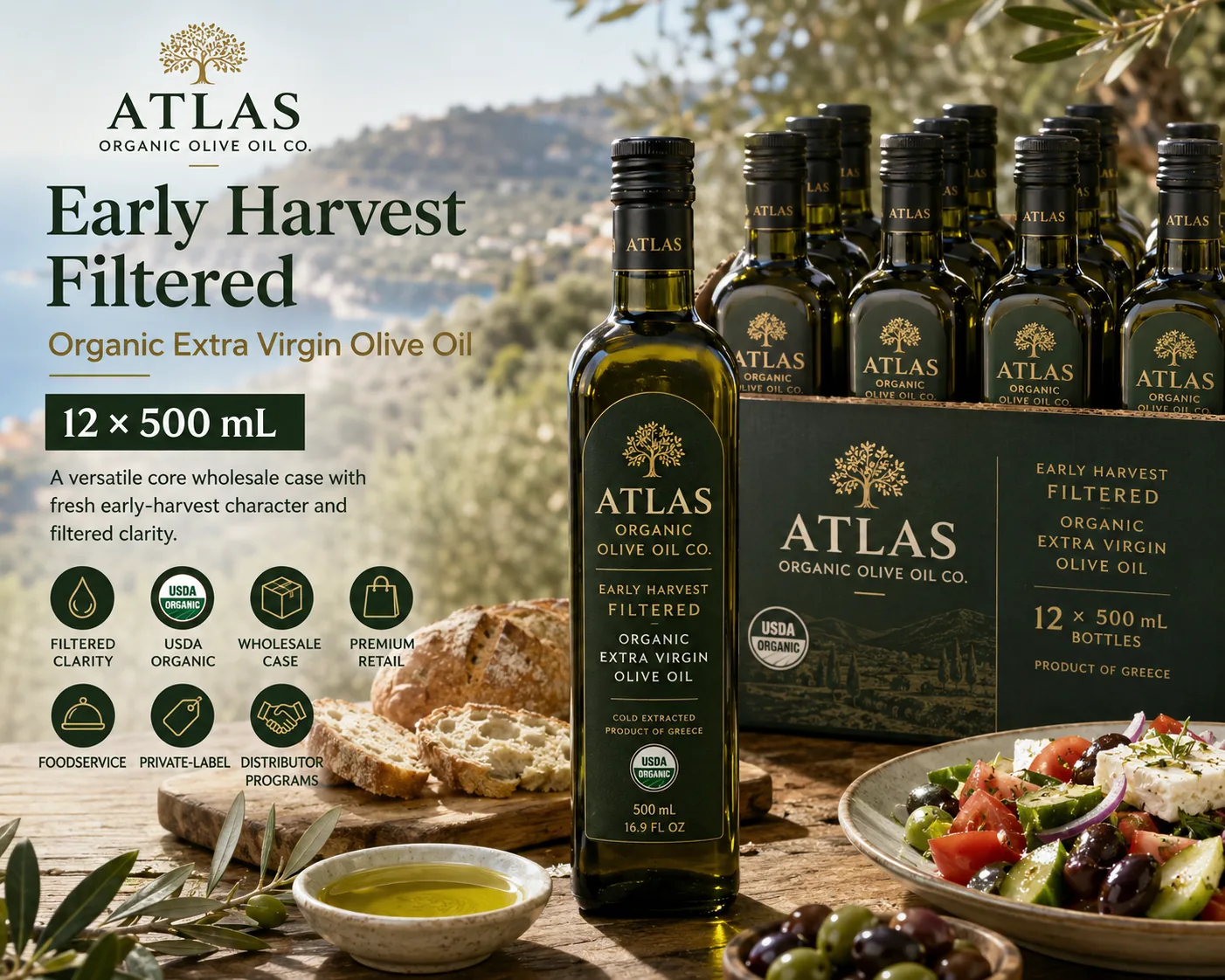
Designed around early-harvest character, filtered clarity and repeatable commercial use.
This 12 × 500 mL case is designed for buyers who want a versatile organic extra virgin olive oil specification in a familiar bottle size that can move efficiently through retail, foodservice and distribution.
Early harvesting generally places greater emphasis on green-fruit character, freshness and structure than mature-harvest programs. Depending on cultivar and current lot, the sensory profile may be herbaceous, fresh or moderately assertive, allowing the oil to work across finishing, dressings, sauces and everyday culinary applications.
Filtration removes suspended moisture and fine olive solids after extraction. This creates greater visual clarity and can simplify stability and shelf-presentation management compared with an unfiltered format, particularly for recurring retail and distributor programs where bottle appearance should remain consistent.
The 500 mL bottle provides enough volume for regular household, restaurant and hospitality use while remaining manageable after opening. At case level, twelve bottles create a defined ordering unit that can be coordinated with shelf allocation, restaurant replenishment, palletization and regional distribution.
Atlas treats this format as a sourcing specification rather than a fixed agricultural formula. Cultivar, climate, fruit maturity, harvest timing, milling conditions and storage all influence the final lot. Commercial approval should therefore rely on current analytical, sensory and organic documentation rather than the product name or one headline measurement alone.
Commercial applications for this core wholesale format.
The combination of a familiar bottle size, filtered clarity and versatile early-harvest sensory direction makes this case suitable for both consumer-facing and professional channels.
Premium retail and private label
Suitable for supermarkets, gourmet retailers, organic-specialty shelves and private-label programs seeking a recognizable 500 mL format with fresh positioning and a polished filtered appearance.
Foodservice and hospitality
Useful for restaurants, premium catering, boutique hotels and hospitality groups that need a versatile extra virgin olive oil for finishing, tableside service and selected kitchen applications.
Dressings, sauces and finishing
Can be evaluated for dressings, marinades, sauces and finishing where a fresh olive-oil profile should remain perceptible without dominating the finished recipe. Final formulations should be validated under their actual process and shelf-life conditions.
Distributor and importer programs
The twelve-bottle case provides a practical wholesale unit for distributors and importers that need predictable ordering, standard retail presentation and repeatable documentation across regional programs.
Case configuration should support the full commercial program.
For recurring wholesale supply, bottle size, case quantity, inventory turnover and lot continuity should be planned together rather than treated as separate decisions.
Six liters in a defined wholesale unit.
Twelve 500 mL bottles create a straightforward case quantity for purchasing, warehouse receiving and replenishment. Buyers can align case orders with pallet design, shelf capacity and anticipated demand.
Match stock levels to sell-through.
Filtered oil still benefits from disciplined stock rotation. Order quantities should reflect realistic retail or foodservice turnover, with first-in-first-out practices used to limit unnecessary warehouse dwell time.
Manage new lots against the agreed brief.
Repeat programs should define how incoming lots or new harvests are reviewed for sensory profile, analytical results, organic documentation, bottle configuration and lot coding before commercial release.
Qualify the lot, the case and the recurring supply plan.
A commercial wholesale release should connect category status, sensory condition, analytical results, organic integrity, filtration, bottle format, case packing, traceability and logistics.
The early-harvest positioning and ≤0.3% free-acidity target can form part of a premium specification, but professional approval should be based on the complete current-lot profile and the requirements of the intended retail or foodservice channel.
Before purchase approval
- Confirm current organic certification and applicable chain-of-custody requirements.
- Review the current lot certificate of analysis against the agreed specification.
- Confirm that extra-virgin classification is supported by applicable chemical and sensory criteria.
- Define the desired early-harvest sensory direction rather than relying on harvest terminology alone.
- Establish sensory acceptance criteria and, where required, relevant organoleptic documentation.
- Confirm filtration requirements and the desired visual clarity of the finished bottle.
- Confirm 500 mL bottle size, closure, label requirements and lot coding.
- Confirm 12-bottle case count, case marking, carton strength and shipping configuration.
- Review palletization, warehouse conditions, transit expectations and destination-market logistics.
- Match purchase quantities to realistic retail, distributor or foodservice turnover.
- Establish lot-transition and replenishment procedures for recurring supply.
Technical guides for confident wholesale buying.
Use these guides to interpret analytical documentation, compare filtration choices and manage packaging and inventory controls across recurring supply.
Read a certificate of analysis
Understand how free acidity, peroxide value, UV measurements and other analytical fields fit into a complete current-lot purchasing and receiving specification.
Read guideFiltered vs. unfiltered
Compare clarity, suspended material, sediment, stability management, storage and turnover implications before selecting the presentation that best fits the commercial program.
Read guideProtect from light and oxygen
Use dark-glass bottles, dependable closures, suitable warehouse conditions and disciplined stock rotation to help protect quality from packing through wholesale distribution.
Read guideAbout Early Harvest Filtered Organic Extra Virgin Olive Oil — 12 × 500 mL
Early Harvest Filtered Organic Extra Virgin Olive Oil — 12 × 500 mL is positioned for premium retail, private-label programs, foodservice, hospitality, distributor portfolios, dressings, sauces, finishing and versatile everyday culinary use. The twelve-bottle case provides a practical wholesale ordering unit while each 500 mL bottle remains familiar for consumer and professional use. Final suitability depends on the buyer’s sensory, process, storage and shelf-life requirements.
The page shows Target ≤0.3% free acidity as a partner-origin sourcing target or reference where stated. Free acidity is one analytical parameter used in olive-oil evaluation, but it does not by itself establish sensory quality, freshness or extra-virgin classification. Final category status should be verified for the current lot using all applicable chemical and sensory criteria.
Filtration removes suspended moisture and fine olive solids, normally producing greater visual clarity and less visible sediment. This can simplify retail presentation and stability management across recurring wholesale programs. Filtration does not eliminate oxidation, so protection from excessive heat, direct light, oxygen and unnecessarily long storage remains important.
Protect unopened cases and bottles from direct sunlight, unnecessary heat and unsuitable warehouse conditions. Keep cases clean and dry and use disciplined first-in-first-out inventory practices. After opening, close the bottle securely, minimize unnecessary oxygen exposure and use the 500 mL format within a realistic consumption cycle.
The 12 × 500 mL configuration provides six liters of nominal packed volume in a familiar bottle size. It can simplify wholesale ordering, retail shelf planning, restaurant replenishment and distributor inventory management while keeping the consumer or professional unit smaller than a bulk or foodservice container.
Request current organic certification information, lot traceability, a certificate of analysis, relevant sensory or classification information, bottle specifications, case configuration, lot coding details and any destination-specific documentation required by your quality, import, retail, private-label or foodservice program. Documentation should correspond to the actual commercial lot wherever possible.
Yes. Depending on volume, destination and commercial feasibility, Atlas can develop private-label, wholesale case-pack, sensory, packaging, documentation and logistics requirements around the buyer’s brief. Share the target market, expected annual case volume, desired sensory direction, packaging requirements, organic documentation needs and delivery timing so the program can be reviewed in detail.
From a first sample to a repeatable global supply program.
Share your target market, annual case volume, sensory requirements, packaging needs, destination, organic documentation requirements and timing to discuss an early-harvest filtered wholesale program.