Built around the purchasing specification, receiving system and end use.
Bulk organic extra virgin olive oil is not one fixed product. It is a commercial supply program defined around the buyer’s application, required quality profile, volume, handling system and destination.
Harvest timing can be selected according to the desired sensory direction and commercial brief. Some programs may prioritize a greener, more structured early-harvest profile, while others may need a rounder and broadly applicable style for manufacturing, bottling or high-volume foodservice use.
Filtration is likewise program-specific. Filtered oil can simplify bulk storage and transfer by reducing suspended solids and residual moisture, while other applications may have different requirements. The intended use, storage duration and receiving equipment should be considered before finalizing the specification.
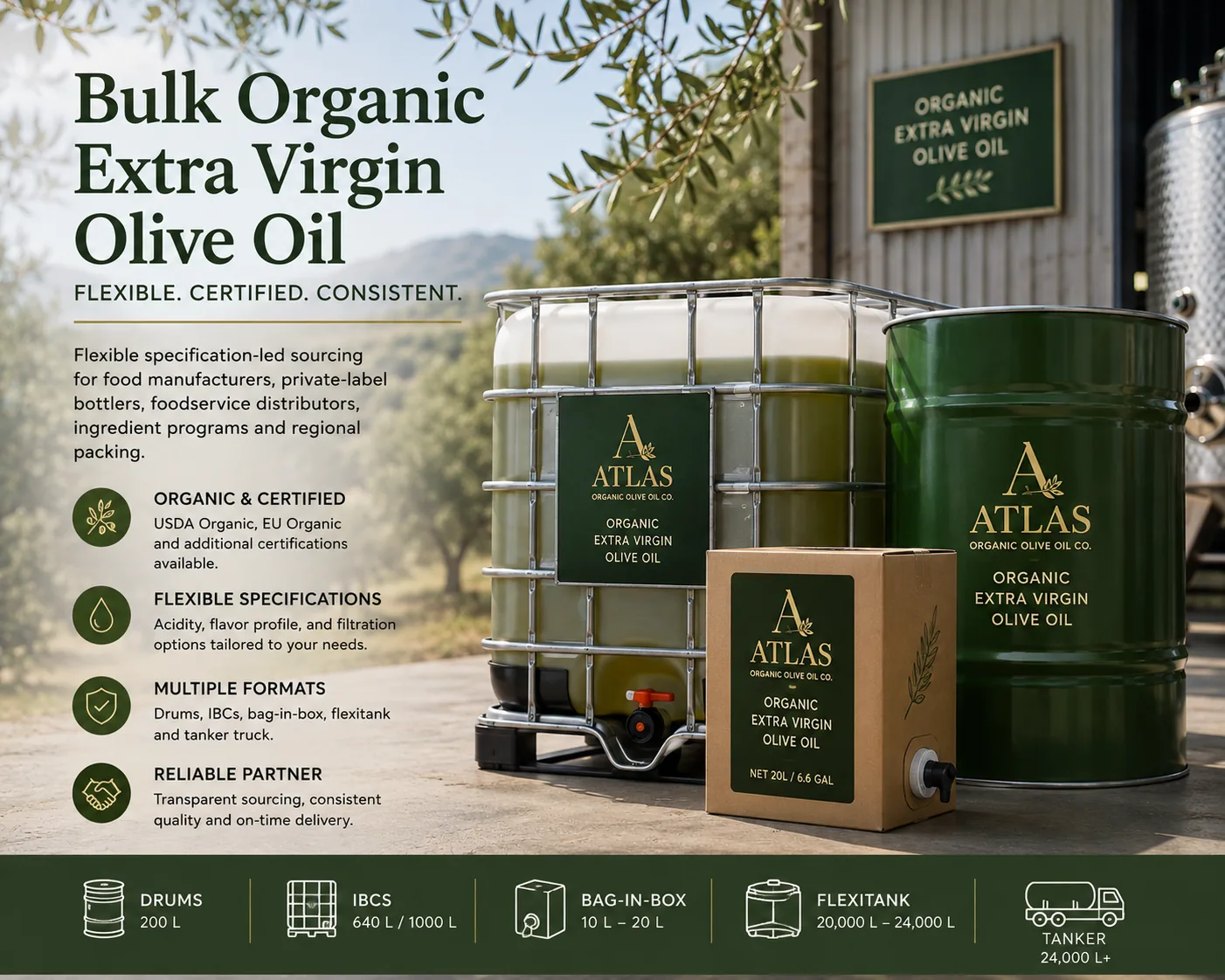
Packaging and logistics are central to a bulk program. Drums and IBCs can suit moderate industrial volumes and facilities that need discrete lot control, while flexitank or tanker solutions may be considered for larger projects where the receiving infrastructure and shipment economics support them.
Atlas treats every bulk format as a sourcing specification rather than a fixed agricultural formula. Cultivar, climate, fruit maturity, milling conditions, storage and transfer practices all influence the final lot. Commercial approval should therefore use current analytical, sensory, organic and traceability documentation.
Applications for bulk organic extra virgin olive oil.
Bulk supply is most effective when the oil specification, container, receiving process and expected turnover are designed around the actual downstream operation.
Food manufacturing
Suitable for manufacturers using organic extra virgin olive oil in dressings, sauces, prepared foods, bakery, dips and other formulations. The purchasing brief should define flavor contribution, process exposure, annual volume and finished-product shelf-life requirements.
Private-label bottling
Bulk supply can support regional or destination-market bottling where the customer controls final bottle format, labels and packing. The incoming oil specification should align with the intended retail positioning and organic chain of custody.
Foodservice distribution
Larger formats can support distributors and high-volume culinary operations where the focus is reliable replenishment, documented quality, manageable handling and packaging appropriate to professional kitchens.
Ingredient supply and regional packing
Bulk programs can serve ingredient traders, industrial users and regional packers that require traceable organic oil for onward processing, repacking or distribution under an agreed technical and commercial specification.
Choose the container around volume, protection and receiving capability.
The largest container is not automatically the best solution. Format selection should consider shipment size, warehouse infrastructure, transfer method, lot control and realistic consumption.
Flexible industrial handling.
Drums and intermediate bulk containers can provide discrete, traceable units for manufacturers, bottlers and foodservice programs. They may be practical where facilities need manageable batch sizes, controlled receiving or separation between lots.
Larger-volume logistics.
Larger transport solutions may support high-volume programs when the buyer has suitable unloading, storage and transfer infrastructure. Shipment planning should address cleanliness, compatibility, transit conditions, destination handling and receiving capacity.
Match package size to consumption.
Bulk containers should not be oversized relative to actual use. Longer dwell times and repeated transfers can increase quality-management demands, so volume planning should reflect manufacturing schedules, tank capacity and normal replenishment frequency.
Qualify the oil, container and handling plan as one system.
A bulk commercial release should connect category status, sensory condition, analytical results, organic integrity, container specification, traceability, storage and transfer practices.
Bulk procurement works best when the technical specification and the physical supply chain are developed together. The oil can meet the agreed specification at loading yet still require disciplined handling after dispatch and during receiving.
Before purchase approval
- Confirm current organic certification and applicable chain-of-custody requirements.
- Review the current lot certificate of analysis against the agreed purchasing specification.
- Confirm that extra-virgin classification is supported by applicable chemical and sensory criteria.
- Define sensory acceptance criteria for the intended manufacturing, bottling or foodservice application.
- Confirm harvest profile and filtration requirements where they are commercially relevant.
- Confirm container type, capacity, construction, cleanliness requirements and closure system.
- Define lot coding, seals, shipping marks and traceability information for each bulk unit or shipment.
- Review headspace, oxygen-management and transfer procedures where required by the program.
- Confirm receiving equipment, unloading method, storage tanks and product-contact surfaces at destination.
- Review warehouse or tank temperature, protection from light and expected inventory turnover.
- Establish receiving inspection, sampling and acceptance procedures before first commercial shipment.
Technical guides for bulk procurement.
Use these guides to strengthen analytical review, packaging decisions and quality protection from dispatch through receiving and storage.
Read a certificate of analysis
Understand how free acidity, peroxide value, UV measurements and other analytical fields fit into a complete current-lot purchasing, receiving and acceptance specification.
Read guideFiltered vs. unfiltered
Compare suspended material, moisture, stability management, storage duration and downstream processing before defining filtration requirements for a bulk program.
Read guideProtect from light and oxygen
Use container selection, headspace control, appropriate transfer practices and disciplined storage to help protect oil quality through bulk transportation and destination handling.
Read guideAbout Bulk Organic Extra Virgin Olive Oil
Typical buyers include food manufacturers, private-label operators, foodservice distributors, ingredient traders, regional bottlers and other commercial users that need larger-volume organic extra virgin olive oil under a defined purchasing specification. The best program depends on the application, annual volume, receiving system, destination and required documentation.
For bulk programs, the free-acidity target is specification-defined according to the buyer’s brief and current-lot requirements. Free acidity is one analytical parameter used in olive-oil evaluation, but it does not by itself establish sensory quality, freshness or extra-virgin classification. Final category status should be verified against all applicable chemical and sensory criteria.
Bulk programs should control excessive heat, direct light, oxygen pickup, container cleanliness, headspace, transfer practices and tank or package turnover through a documented quality plan. Receiving and storage procedures should also be designed around the selected container, destination equipment and expected consumption cycle.
Depending on volume, route, destination and project requirements, bulk programs may use drums, IBCs, bag-in-box systems, flexitanks or tanker solutions. The final choice should consider product protection, handling, traceability, receiving infrastructure, shipment economics and how quickly the buyer expects to use the oil after delivery.
Request current organic certification information, lot traceability, a certificate of analysis, relevant sensory or classification information, bulk-container specifications and any destination-specific documentation required by your quality, import, manufacturing or bottling program. Documentation should correspond to the actual commercial lot and shipment wherever possible.
Yes. Depending on volume, destination and commercial feasibility, Atlas can develop harvest, filtration, analytical, sensory, organic-documentation, bulk-format, logistics and replenishment requirements around the buyer’s brief. Share the intended application, annual volume, destination, receiving capability, preferred container and delivery timing so the program can be reviewed in detail.
From qualification samples to repeatable bulk supply.
Share your intended application, annual volume, analytical and sensory requirements, destination, preferred bulk format, organic documentation needs and receiving capability to discuss a suitable supply program.