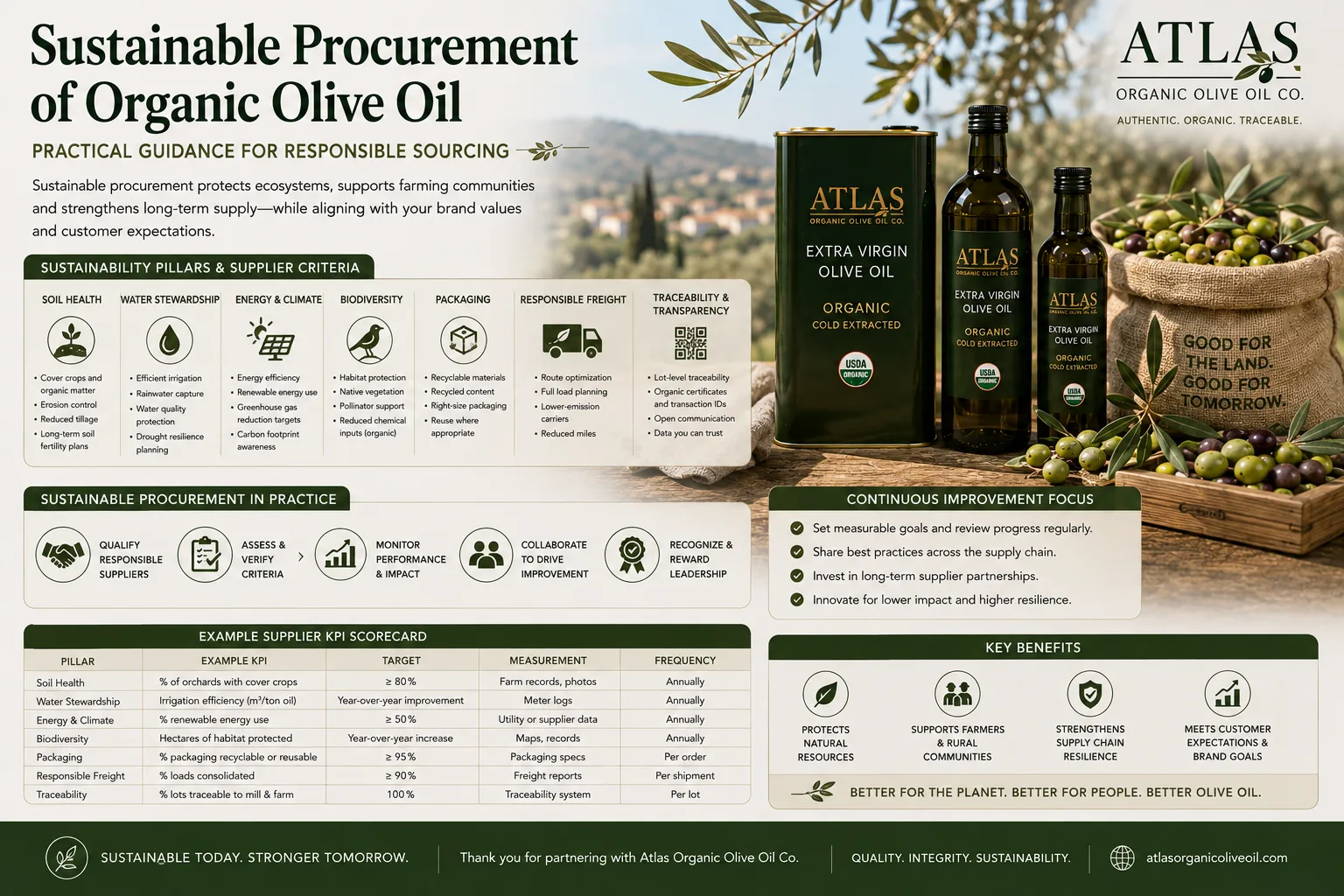
Sustainable procurement works best when broad values become measurable questions. Organic certification is an important foundation, but buyers can also examine soil, water, energy, biodiversity, by-products, packaging, freight and supplier-development practices.
Responsible sourcing is stronger when environmental and social ambitions become practical supplier criteria while product quality and loss prevention remain part of the same decision. Sustainability should not be treated as a separate checklist that ignores whether the oil reaches the customer in good condition. Product that is damaged, oxidized, rejected or unnecessarily discarded also carries an environmental and commercial cost.
The practical objective is not to identify an abstract “most sustainable” oil. It is to define a sourcing program that combines credible organic status, appropriate environmental and supply-chain practices, fit-for-purpose packaging, dependable quality and commercially realistic continuous improvement.
1. Start with the decision framework
Before requesting samples, write down the commercial job the oil must perform. That brief should state the finished product or service application, target market, annual and trial volumes, expected pack format, sensory role, process exposure, storage conditions and required organic documentation. If the oil will be named prominently on the label, the sensory target deserves even more attention.
Add a short sustainability section to the same sourcing brief. Rather than asking suppliers to describe everything they consider sustainable, identify the themes that genuinely matter to the program. Depending on the supply chain, these may include organic certification, soil management, irrigation practices, energy use, mill by-product management, biodiversity, packaging efficiency, freight planning or supplier improvement targets.
- Prioritize a small set of indicators that suppliers can document consistently rather than collecting dozens of unverifiable claims.
- Distinguish required conditions from preferred practices and longer-term improvement goals.
- Consider product protection and loss prevention when comparing packaging footprint; damaged or oxidized oil also carries an environmental cost.
- Ask where each sustainability claim applies: farm, mill, packing site, warehouse, transport or the complete supply chain.
- Build improvement goals into multi-year supplier relationships and review them alongside quality, service and cost performance.
A useful specification separates the legal or category baseline from tighter internal targets. It also makes clear which values are guaranteed, which are measured periodically and which are descriptive supplier information. This distinction helps prevent broad environmental statements from being treated as if they were verified product-level metrics.
2. Practical workflow
Move from supplier screening to commercial approval in controlled steps. First, establish the required product and certification baseline. Second, identify the sustainability indicators that matter to the program. Third, review supporting evidence and test the oil in its real commercial application. Finally, create a review cycle that considers sustainability together with quality, traceability, cost and service.
- Write a one-page brief. Include category, organic status, harvest or filtration preference if relevant, sensory profile, pack, volume, destination, timing and the sustainability themes that matter to the program.
- Sample in context. Taste neat for defects and style, then evaluate the oil in the actual food, process or service condition. Sustainable procurement still depends on selecting an oil that performs correctly and avoids unnecessary waste.
- Review documents. Confirm lot identity, analytical results, organic status, traceability and any import or label records required by the market. Review sustainability evidence at the appropriate farm, mill, packing or logistics level.
- Ask comparable questions. Use the same core supplier questionnaire wherever possible so answers on water, energy, packaging, by-products or improvement plans can be compared on a consistent basis.
- Pilot the system. Use commercial-equivalent processing, transfer, filling, storage or service conditions rather than relying only on laboratory handling. Confirm that lower-impact packaging or logistics choices still protect product quality.
- Define a baseline. Record current supplier practices before setting improvement targets. A clear baseline makes future progress easier to evaluate than relying on broad statements such as “more sustainable.”
- Define release and change control. Decide who approves a new harvest, new lot, new pack component, production-site change or material specification change that could affect quality, organic status or sustainability performance.
For strategic suppliers, periodic review can be more useful than a one-time questionnaire. The buyer can revisit the same indicators annually or at another agreed interval and focus on material changes, corrective actions and realistic improvements rather than repeatedly collecting the same descriptive information.
3. Quality controls that belong in the conversation
Extra virgin olive oil is defined through more than free acidity. Buyers should use the current applicable category standard, appropriate laboratory methods and—where required—organoleptic assessment. For commercial programs, add internal criteria that describe the sensory style your brand or formulation actually needs.
Sustainability requirements should complement these controls rather than replace them. An oil does not become commercially suitable solely because a supplier has strong environmental practices. The shipped lot must still meet the agreed category, analytical, sensory, organic, traceability and packaging requirements.
- Ask for evidence at farm, mill, packaging and logistics level where those stages are relevant to the program.
- Choose a manageable set of comparable indicators rather than a long list that cannot be verified consistently.
- Define the unit or boundary behind quantitative information so numbers from different suppliers are not compared incorrectly.
- Keep lot-specific quality documentation separate from broader site-level sustainability information.
- Review sustainability progress alongside quality, service, traceability and cost.
For storage and distribution, protect oil from direct light, unnecessary heat and repeated oxygen exposure. A premium incoming lot can deteriorate if it is held too warm, transferred turbulently, stored in a partly empty container for too long or packed in a format that does not suit turnover.
Packaging comparisons should therefore consider more than material weight. The pack must also provide appropriate light and oxygen protection, survive the expected logistics route and suit the rate at which the customer will use the oil. A lighter pack that causes leakage, damage or premature quality loss may not produce the intended overall improvement.
4. Common failure modes
Most sustainable-procurement problems are not caused by a lack of ambition. They arise when claims are too broad, supplier information is not comparable or a change that appears environmentally beneficial creates a new quality, logistics or waste problem elsewhere in the system.
- Treating organic certification as proof of every sustainability outcome.
- Collecting many supplier claims without defining what evidence or reporting boundary supports them.
- Choosing lightweight packaging that does not adequately protect the product.
- Comparing sustainability figures that use different units, time periods or operational boundaries.
- Focusing only on primary packaging while ignoring secondary packaging, pallets, freight or product loss.
- Publishing environmental claims before the supporting evidence and boundaries are clear.
- Setting improvement targets without first documenting the supplier's current baseline.
Another common weakness is treating sustainability as a supplier-selection exercise only. Many meaningful improvements occur after the relationship begins, when buyer and supplier can examine packaging, order frequency, shipment consolidation, product loss or data quality together. A stable commercial relationship can therefore create opportunities that are difficult to capture in a one-time tender.
Build corrective-action triggers around objective evidence: out-of-spec results, sensory defects, damaged seals, broken traceability, temperature excursions, packaging failures, unsupported claims or documented process deviations. This keeps sustainability requirements connected to normal supplier management rather than operating as an isolated reporting exercise.
5. What to put in the purchase specification
The purchase specification should describe the product requirements clearly while identifying the sustainability information or practices that are material to the program. Not every sustainability objective needs to become a contractual product parameter; some are better managed through supplier scorecards, questionnaires or continuous-improvement plans.
6. Reference framework
For category definitions, analytical methods and organoleptic assessment, use the current International Olive Council trade standard and methods together with destination-market rules. Organic certification requirements should be reviewed under the applicable certification program and market.
Sustainability criteria should then be layered onto that regulatory and quality baseline using evidence appropriate to the issue being evaluated. Farm-level practices, mill-level energy information, packaging data and freight information describe different parts of the supply chain and should not be presented as interchangeable measures.
Next step
Turn this guide into a sourcing brief by listing your application, annual volume, destination, desired format, target launch date and the quality attributes that matter most. Add a short list of sustainability priorities and indicate which are mandatory, preferred or intended as longer-term improvement goals.
Atlas can then compare suitable organic olive-oil programs on the same commercial basis, considering product quality, organic documentation, traceability, packaging, logistics and supplier-development expectations together rather than evaluating any one sustainability characteristic in isolation.