
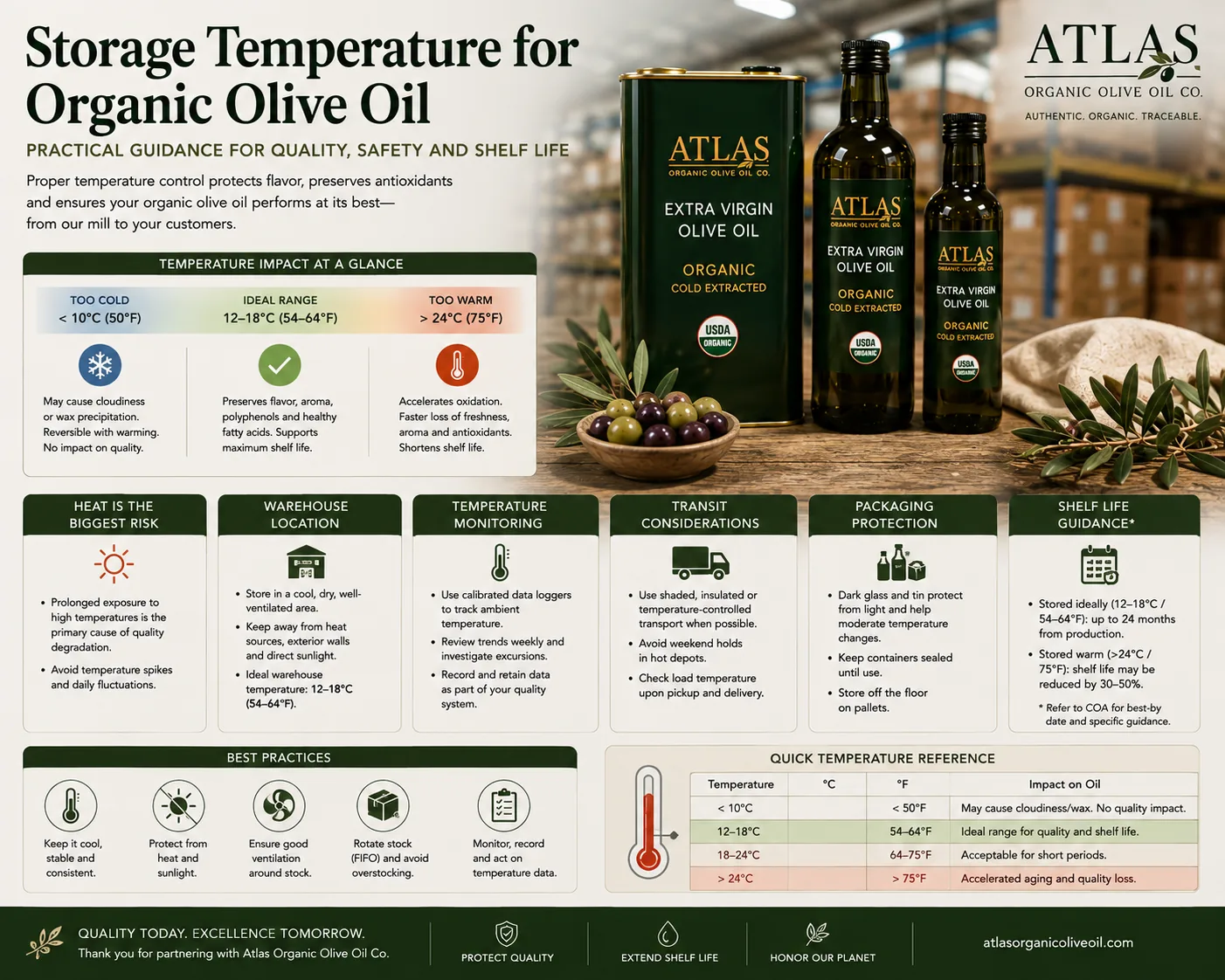
Olive oil should be protected from unnecessary heat and large temperature swings. A UC Davis literature review describes dark storage around 16–18 °C as an ideal condition for shelf stability, while real facilities should set practical controls for their climate and logistics.
Warehouse and transit conditions influence oxidative quality. Temperature control should be practical, monitored where risk is meaningful, and paired with protection from light and repeated oxygen exposure. The objective is not to maintain one perfect number under every circumstance, but to reduce avoidable exposure that can accelerate quality loss during storage and distribution.
The practical objective is not to find an abstract “best” oil; it is to define the oil, package, inventory practice and handling system that remain fit for the intended food, channel and shelf life. A premium lot can still lose quality if storage conditions after receipt are poorly controlled.
1. Start with the decision framework
Before requesting samples, write down the commercial job the oil must perform. That brief should state the finished product or service application, target market, annual and trial volumes, expected pack format, sensory role, process exposure, storage conditions and required organic documentation. If the oil will be named prominently on the label, the sensory target deserves even more attention.
For storage planning, map the conditions the oil is likely to experience from supplier dispatch through final use. A temperature-controlled warehouse may still receive containers that have spent hours in a hot yard, while a moderate climate may not justify the same controls as a long route through high ambient heat. The important question is where meaningful exposure can occur and how it will be managed.
- Keep warehouse locations away from roofs, boiler rooms, hot loading areas and direct sun.
- Identify seasonal hot spots in warehouses rather than assuming every pallet position experiences the same conditions.
- Record temperature when long-distance freight, hot climates or extended dwell times create material exposure risk.
- Minimize unnecessary time in hot containers, loading bays, yards or unconditioned staging areas.
- Avoid treating cold-induced cloudiness as automatic damage; assess quality after the oil returns to normal handling temperature.
A useful specification separates the legal or category baseline from tighter internal targets. It should also distinguish between a preferred storage condition, an operating range and an excursion that requires investigation. This makes the requirement more practical than simply stating “store cool” without defining how the buyer will respond to real-world variation.
2. Practical workflow
Move from sample evaluation to commercial storage approval in controlled steps. First, screen candidate lots against the intended use. Second, identify the actual storage and logistics conditions the oil will experience. Third, confirm that the packaging and handling system provide appropriate protection. Finally, define receiving and monitoring checks so future lots are managed consistently.
- Write a one-page brief. Include category, organic status, harvest or filtration preference if relevant, sensory profile, pack, volume, destination, expected storage conditions and timing.
- Sample in context. Taste the oil neat for defects and style, then evaluate it in the actual food, process or service condition so the accepted sensory reference reflects real use.
- Map the temperature route. Review supplier storage, loading, ocean or road freight, port or terminal dwell, receiving docks, warehouse positions and any onward distribution where heat exposure may become material.
- Review documents. Confirm lot identity, analytical results, organic status, traceability and any import, temperature or label records required by the market or commercial program.
- Pilot the system. Use commercial-equivalent transport, transfer, filling, storage or service conditions rather than relying only on laboratory handling.
- Define excursion review. Decide which temperature events require documentation, sensory review, analytical testing or quality approval before the affected lot is released.
- Define release and change control. Decide who approves a new harvest, new lot, new pack component, new storage site or material logistics change.
Temperature loggers can be useful on higher-risk routes, but the data should have a defined purpose. Before using them, decide what will be reviewed, who will review it and what action follows an unusual exposure pattern. Collecting temperature data without an interpretation rule can create records without improving control.
3. Quality controls that belong in the conversation
Extra virgin olive oil is defined through more than free acidity. Buyers should use the current applicable category standard, appropriate laboratory methods and—where required—organoleptic assessment. For commercial programs, add internal criteria that describe the sensory style your brand or formulation actually needs.
Storage controls should support those quality targets. Temperature is only one variable: light, oxygen, headspace, container closure and inventory age also influence how well the incoming oil retains its original characteristics. Good storage management therefore combines several practical controls rather than relying on temperature alone.
- Avoid unnecessary heat and direct sunlight during storage and staging.
- Record exposure for hot-climate, long-duration or otherwise higher-risk transport routes.
- Use inventory age limits and first-expiring-stock logic where applicable.
- Keep pallets and containers away from known warehouse heat sources.
- Review package condition and seals at receipt as well as temperature history where relevant.
- Investigate significant excursions in the context of sensory, analytical and packaging evidence rather than temperature alone.
For bulk storage, repeated oxygen exposure can become especially important after a container or tank is opened. Turnover, headspace and transfer practices should therefore be considered alongside temperature. Holding a partially empty container for an extended period under otherwise moderate conditions may still reduce quality.
Cold conditions can also change appearance. Depending on composition and temperature, olive oil may become cloudy or partially crystallized. That visible change should not automatically be interpreted as oxidation or permanent quality loss. Allow the oil to return gradually to normal handling conditions before evaluating appearance and sensory quality.
4. Common failure modes
Most storage problems are not caused by the absence of a stated temperature target. They arise when the target is too generic, when the highest-risk parts of the route are ignored, or when no action is defined for an actual temperature excursion.
- Using one generic ambient-storage specification in every climate and logistics route.
- Leaving pallets in hot containers, trailers, yards or loading bays after arrival.
- Placing stock next to roofs, heaters, boiler rooms or sun-exposed warehouse walls.
- Collecting logger data without defining excursion limits, review responsibility or corrective action.
- Confusing appearance changes caused by cold conditions with oxidation or irreversible spoilage.
- Ignoring oxygen exposure and inventory age because warehouse temperature appears acceptable.
- Allowing slow-moving stock to remain in unsuitable locations simply because it is still within coded shelf life.
Another common error is focusing only on average temperature. A shipment with an acceptable average may still experience short periods of severe heat during container dwell, unloading or local transport. Where those peaks matter commercially, review the exposure pattern rather than relying on a single average value.
Build corrective-action triggers around objective evidence: out-of-spec results, sensory defects, damaged seals, broken traceability, material temperature excursions, packaging failures or documented process deviations. This makes supplier and warehouse decisions faster and fairer because affected lots are reviewed against defined evidence rather than assumption.
5. What to put in the purchase specification
The purchase specification should define the oil and the storage or logistics expectations that are material to the commercial program. Temperature language should be realistic enough to implement and specific enough to guide receiving decisions when conditions depart from normal expectations.
6. Reference framework
For category definitions, analytical methods and organoleptic assessment, use the current International Olive Council trade standard and methods together with destination-market rules. Storage literature should be used as a practical reference for controlling avoidable heat, light and oxygen exposure rather than as a substitute for product-specific shelf-life validation.
Packaging and storage literature consistently emphasizes limiting light, oxygen and unnecessary heat. Commercial shelf life still requires lot- and package-specific validation because oil composition, package protection, distribution route and expected storage conditions all influence the finished result.
Next step
Turn this guide into a sourcing brief by listing your application, annual volume, destination, desired format, target launch date and the quality attributes that matter most. Add expected warehouse conditions, logistics route, climate risk and any temperature-monitoring requirements.
Atlas can then compare suitable organic olive-oil programs on the same commercial basis, including product quality, packaging, storage assumptions, shipment configuration and documentation requirements rather than evaluating the oil independently from the conditions it will experience after dispatch.