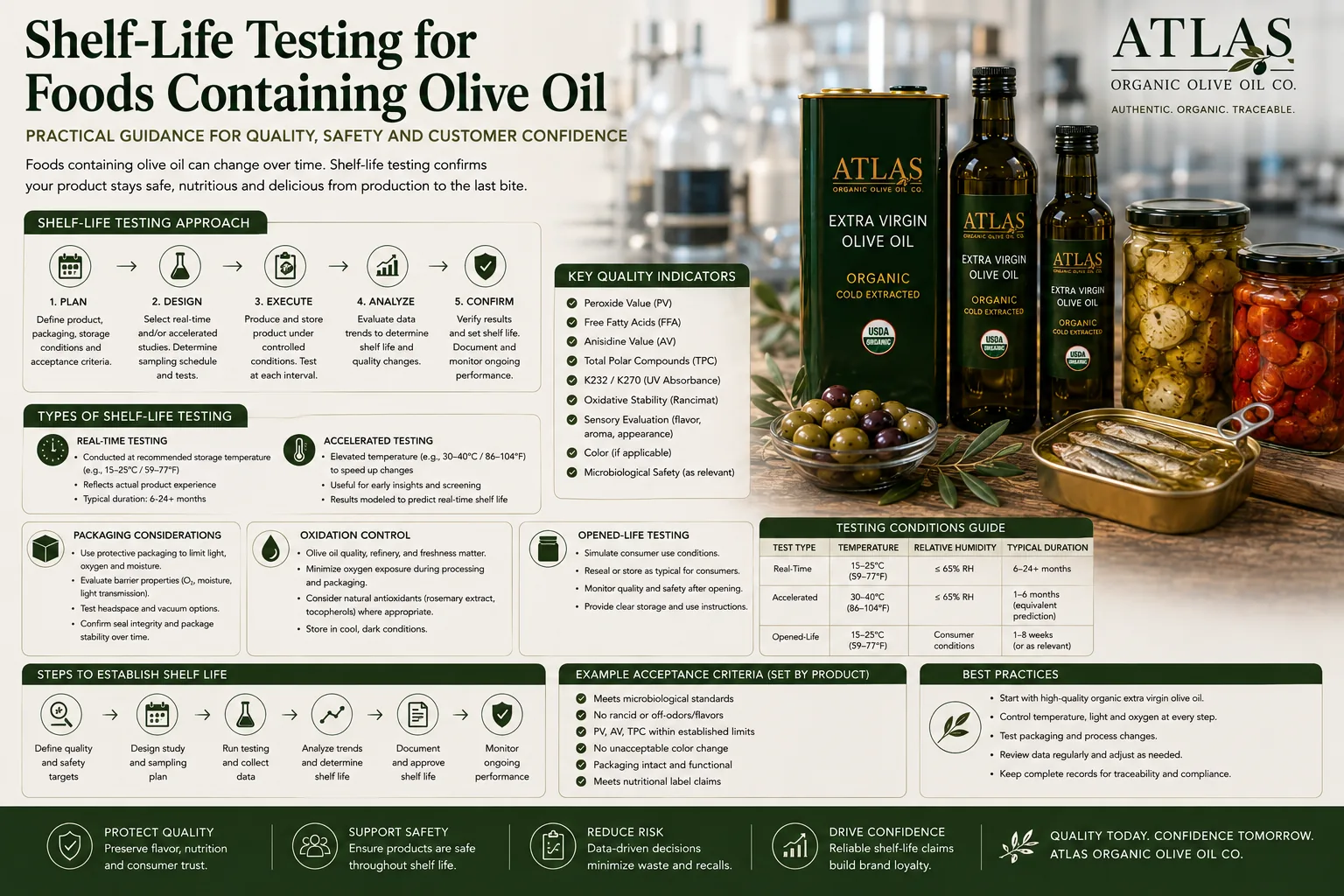
The shelf life of an olive-oil-containing food belongs to the finished product, not the ingredient. Water activity, metals, herbs, proteins, package oxygen and process conditions can all change oxidation behavior, even when the same incoming oil is used.
Quality is preserved through the complete product system, not created by a certificate alone. Oxygen, light, heat, age and the finished-product matrix determine how the oil changes after blending, processing and packing. A certificate of analysis can describe the incoming lot, but it cannot predict every interaction that takes place once that oil becomes part of a sauce, spread, snack, dressing or other food.
The practical objective is not to find an abstract “best” oil. It is to define the oil, formulation, process, package and handling system that remain fit for the intended food, channel and declared shelf life. Shelf-life validation should therefore be designed around the commercial product the customer will actually receive.
1. Start with the decision framework
Before requesting samples, write down the commercial job the oil must perform. That brief should state the finished product or service application, target market, annual and trial volumes, expected pack format, sensory role, process exposure, storage conditions and required organic documentation. If the oil will be named prominently on the label, the sensory target deserves even more attention.
For shelf-life work, add the intended life of the finished food, expected distribution conditions, package configuration, storage instructions and likely consumer-use pattern. A product that is opened once and consumed immediately presents a different exposure pattern from a container that is repeatedly opened over several weeks.
- Use the actual formula, process and commercial package in validation.
- Define expected storage and distribution conditions before starting the study.
- Track sensory quality and appropriate chemical or physical indicators over real-time storage.
- Use accelerated work carefully and confirm important conclusions against real-time behavior.
- Include opened-life testing when the consumer or kitchen repeatedly exposes the product to air.
A useful specification separates the legal or category baseline from tighter internal targets. It also makes clear which values are guaranteed at release, which are typical, and which are only reference data from a particular origin or harvest. The finished-product shelf-life protocol should make the same distinction between acceptance limits, trend information and exploratory measurements.
2. Practical workflow
Move from bench evaluation to shelf-life approval in controlled steps. First, select an oil that fits the intended formulation and sensory profile. Second, produce the food using representative processing conditions. Third, pack it in commercial-equivalent material. Finally, follow the finished product over time using defined sensory, analytical and physical checkpoints.
- Write a one-page brief. Include category, organic status, harvest or filtration preference if relevant, sensory profile, pack, volume, destination, target shelf life and expected storage conditions.
- Sample in context. Taste the oil neat for defects and style, then evaluate it in the actual formulation. Ingredients such as herbs, spices, acids, proteins, emulsifiers or trace metals can alter the way oxidation is perceived or develops.
- Define the test design. Set storage conditions, sampling intervals, target end date, sensory criteria and relevant analytical or physical indicators before testing begins.
- Review documents. Confirm lot identity, analytical results, organic status, traceability and any import or label records required by the market. Record which oil lot entered each shelf-life batch.
- Pilot the system. Use commercial-equivalent processing, mixing, transfer, filling, headspace, sealing and storage conditions rather than relying only on carefully handled laboratory samples.
- Test the commercial package. Use the intended bottle, pouch, tub, closure or other pack whenever possible. Package oxygen and light protection can materially change the result.
- Include opened life when relevant. Simulate realistic opening frequency, serving practices, headspace growth and storage after opening when these conditions form part of consumer or foodservice use.
- Define release and change control. Decide who approves a new harvest, oil lot, formula adjustment, process change or pack component that could affect the validated shelf-life basis.
Retained samples from pilot and commercial runs can help establish trends across lots and production dates. When a complaint or unexpected deterioration occurs, retained samples also provide a useful comparison point for determining whether the issue developed before or after distribution.
3. Quality controls that belong in the conversation
Extra virgin olive oil is defined through more than free acidity. Buyers should use the current applicable category standard, appropriate laboratory methods and—where required—organoleptic assessment. For commercial programs, add internal criteria that describe the sensory style your brand or formulation actually needs.
Shelf-life studies should also define what “end of life” means for the finished food. Depending on the product, failure may be driven by rancid flavor, loss of desired freshness, texture change, emulsion instability, package deterioration, color shift or another product-specific attribute. One test result rarely tells the whole quality story.
- Define critical exposure points during processing, filling, storage and use.
- Use retained samples and shelf-life trending across representative lots.
- Link each study batch to the actual olive-oil lot and commercial package used.
- Use sensory evaluation alongside relevant analytical or physical measurements.
- Tie corrective actions to measurable deterioration, package failure or process deviations.
For storage and distribution, protect oil-containing foods from unnecessary heat, direct light and repeated oxygen exposure where those conditions matter to the product. A strong incoming oil can deteriorate faster if the finished product has high oxygen exposure, unsuitable packaging or a distribution route that repeatedly exposes it to elevated temperatures.
Process history can be equally important. Mixing intensity, thermal treatment, holding time, filling temperature, headspace and contact with equipment surfaces may all influence the starting condition of the finished product. The shelf-life study should therefore represent normal commercial processing rather than an unusually gentle prototype run.
4. Common failure modes
Most shelf-life problems are not caused by a lack of testing. They arise when the study does not represent the actual commercial system, when one accelerated result is treated as definitive, or when changes are introduced after validation without considering their effect on stability.
- Adding the oil supplier's best-before period directly to the finished food.
- Relying only on accelerated tests without confirming important findings under realistic storage.
- Testing a prototype package that differs from the commercial material or closure.
- Producing shelf-life samples under unusually gentle laboratory conditions that do not represent commercial processing.
- Ignoring opened-life exposure for products that are repeatedly opened during use.
- Changing the oil, package, formula or processing conditions without reviewing the existing validation.
- Using a single analytical result as the only definition of finished-product quality.
Another common mistake is treating a study as a one-time event disconnected from production. Shelf-life confidence becomes stronger when commercial complaints, retained samples, routine sensory observations and analytical trends are reviewed against the original validation assumptions.
Build corrective-action triggers around objective evidence: out-of-spec results, sensory defects, damaged seals, broken traceability, temperature excursions, packaging failures, unexpected trend changes or documented process deviations. This makes investigations more focused and helps distinguish ingredient issues from formulation, processing, package or distribution problems.
5. What to put in the purchase specification
The olive-oil purchase specification should support the finished-product shelf-life program without pretending to replace it. Define the incoming oil characteristics that matter to the application, then manage finished-product stability through the formulation, process, packaging and validation system.
6. Reference framework
For category definitions, analytical methods and organoleptic assessment, use the current International Olive Council trade standard and methods together with destination-market rules. These references define the incoming olive-oil category; they do not establish the shelf life of the finished food containing that oil.
Finished-product validation should instead reflect the complete commercial system: formulation, processing, packaging, storage, distribution and expected use. Accelerated studies can support development and comparison, but real-time observations remain important when establishing or confirming commercial shelf life.
Next step
Turn this guide into a sourcing brief by listing your application, annual volume, destination, desired format, target launch date and the quality attributes that matter most. Add the intended finished-product shelf life, packaging format, process conditions and any incoming-oil characteristics that your validation work identifies as important.
Atlas can then compare suitable organic olive-oil programs on the same commercial basis, aligning product quality, sensory profile, documentation, pack format and repeat-supply requirements with the needs of your finished-product shelf-life program.