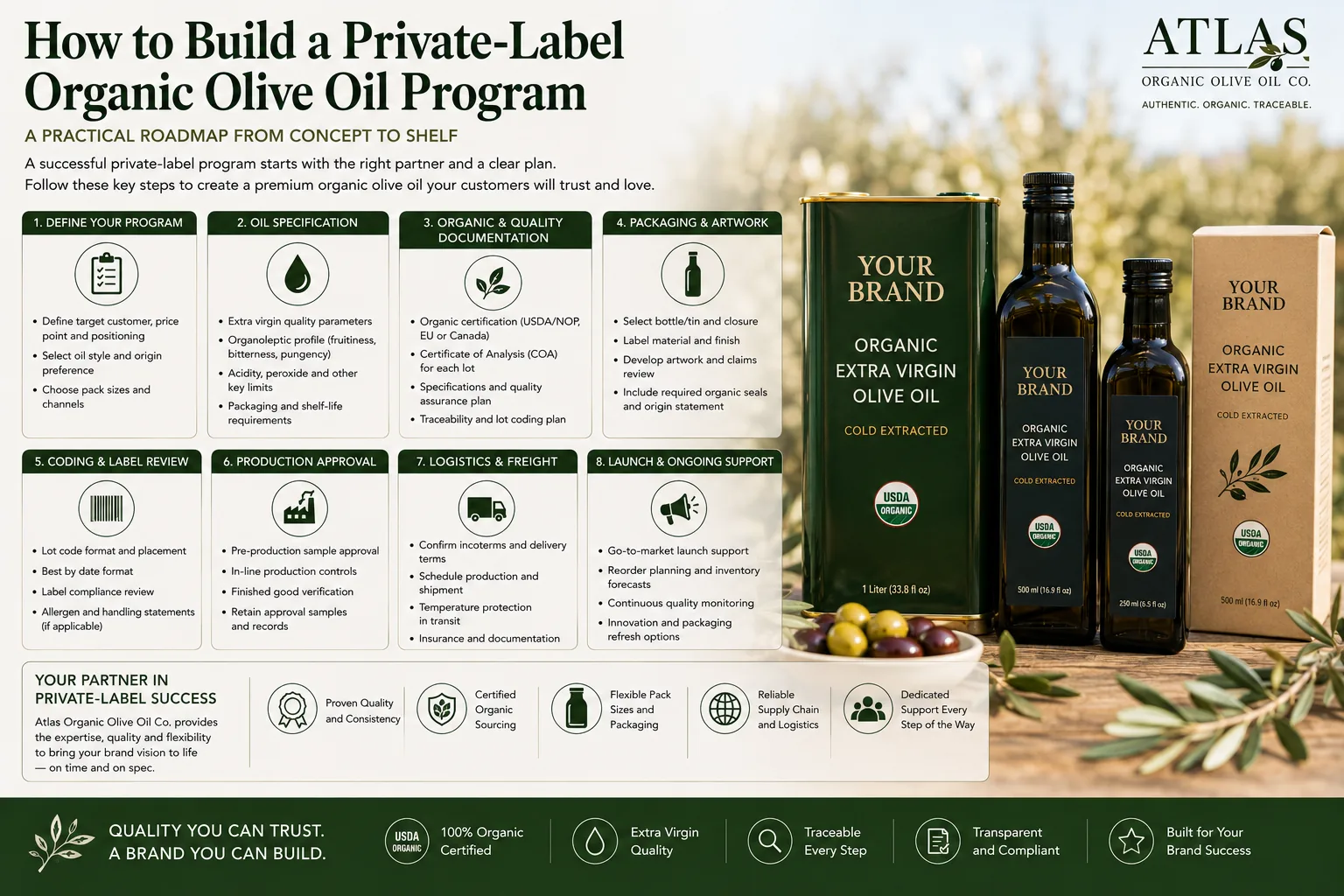
Private label is a systems project: oil specification, organic certification, bottle, closure, artwork, case pack, coding, compliance, freight and forecast all have to converge before launch. A successful program depends on those elements being developed as one controlled commercial system.
Private label succeeds when liquid, packaging, artwork, organic status, coding and logistics are developed together rather than as separate workstreams. A bottle can look excellent but still create problems if the closure is not compatible, the label is approved too late, the case configuration is inefficient or the destination-market documentation is incomplete.
The practical objective is not to find an abstract “best” oil. It is to define the liquid, packaging, documentation and supply system that remain fit for the intended channel, customer expectations and shelf life, while giving purchasing, quality, marketing and operations teams clear approval points before production begins.
1. Start with the decision framework
Before requesting samples, write down the commercial job the oil must perform. That brief should state the target market, annual and launch volumes, intended retail or foodservice channel, pack size, sensory role, storage conditions, target price architecture and required organic documentation.
For private label, the brief should also identify who owns each major decision: liquid approval, organic documentation, regulatory review, artwork, barcode or coding data, bottle and closure approval, case configuration, freight assumptions and final production release. Missing ownership is one of the easiest ways for a launch schedule to become dependent on late approvals.
- Freeze the liquid specification and destination-market label brief before final artwork.
- Define pack size, bottle style, closure type, case count and pallet expectations early enough to confirm availability and lead time.
- Qualify bottle, closure, label adhesive, case and pallet pattern together rather than as isolated components.
- Build approval gates for pre-production sample, label proof, lot COA, organic documentation and finished case.
- Identify which changes require buyer approval after launch, including oil profile, bottle, closure, artwork or packing-site changes.
A useful specification separates the legal or category baseline from tighter internal targets. It also makes clear which values are guaranteed at release, which are typical and which are only reference data from a particular origin or harvest. Private-label programs should apply the same discipline to packaging: approved components, acceptable alternates and changes requiring written authorization should be clearly distinguished.
2. Practical workflow
Move from concept to commercial production in controlled steps. First, define the liquid and pack architecture. Second, review organic and destination-market requirements. Third, qualify the physical package and artwork. Finally, approve a commercial-equivalent packed unit before routine production begins.
- Write a one-page brief. Include olive-oil category, organic status, harvest or filtration preference if relevant, sensory profile, bottle size, expected volume, destination, launch date and target price position.
- Approve the liquid. Taste candidate oils neat and, where relevant, compare them against the intended brand positioning. Record the approved sensory profile and the analytical or documentary requirements that belong to it.
- Confirm the pack architecture. Select bottle, closure, label format, case count and pallet pattern together so component availability, line compatibility, freight efficiency and shelf presentation can be evaluated early.
- Review documents. Confirm lot identity, analytical results, organic status, traceability and any destination-market, import, certification or label records required by the program.
- Develop artwork against the approved brief. Use the correct product identity, organic information, net quantity, required company information, coding space and destination-specific content before final proof approval.
- Test the physical package. Check bottle and closure compatibility, label application, coding legibility, case fit, pallet stability and the ability of the package to protect the oil through expected distribution.
- Run a commercial-equivalent pilot. Use realistic filling, capping, labeling, coding, case packing and palletizing conditions rather than approving the program from loose components or digital artwork alone.
- Approve the finished packed unit. Review the actual bottle, closure, label, code, case and documentation together before authorizing routine production.
- Define release and change control. Decide who approves a new harvest, new lot, revised artwork, new bottle, closure, label stock, case or production-site change.
A launch calendar should work backward from the required delivery date rather than from the date artwork is started. Component manufacturing, artwork approval, organic or compliance review, filling-slot availability, finished-goods inspection and freight all consume time. The longest lead-time component often determines the practical launch path.
3. Quality controls that belong in the conversation
Extra virgin olive oil is defined through more than free acidity. Buyers should use the current applicable category standard, appropriate laboratory methods and—where required—organoleptic assessment. For commercial programs, add internal criteria that describe the sensory style the private-label brand actually needs.
Private-label quality control should extend beyond the liquid. The packed product is what reaches the customer, so quality approval should include fill condition, closure performance, label placement, code readability, case integrity and traceability as well as the oil itself.
- Freeze the approved liquid specification before final artwork and routine production.
- Build organic, regulatory, artwork and packaging approval gates into the launch timeline.
- Link finished-goods codes to the actual olive-oil lot and production run.
- Approve the finished packed unit, not only the oil sample or digital label proof.
- Retain appropriate reference samples or finished units for complaint and change-control comparison.
For storage and distribution, protect oil from direct light, unnecessary heat and repeated oxygen exposure. A premium incoming lot can deteriorate if it is held too warm, exposed during filling or packed in a format that provides insufficient protection for the expected channel and turnover.
Packaging should therefore be evaluated as part of product preservation, not only branding. Bottle material, color, closure, headspace, seal integrity and secondary packaging can all affect how well the finished unit protects the oil during warehouse storage, freight and retail display.
4. Common failure modes
Most private-label failures are not caused by the concept itself. They arise when one workstream moves ahead before upstream decisions are stable, or when a component is approved independently from the finished system.
- Starting artwork before regulatory, organic and certification review is sufficiently complete.
- Ignoring bottle, closure, label-stock or printed-case lead times until the launch date is already fixed.
- Approving the oil but not the finished packed product.
- Changing a bottle or closure late without rechecking line compatibility and case fit.
- Using label artwork that leaves insufficient space for coding or production information.
- Finalizing case counts without checking pallet efficiency, customer requirements or freight impact.
- Failing to define approval authority when a supplier proposes a material component or specification change.
Another common mistake is treating first production as routine production. The first commercial run should be managed as an approval event because it is the first time the oil, filling process, packaging components, artwork, coding and case system are all combined at scale.
Build corrective-action triggers around objective evidence: out-of-spec results, sensory defects, damaged seals, incorrect artwork, coding errors, broken traceability, packaging failures, quantity discrepancies or documented production deviations. This creates a clearer basis for hold, rework or release decisions.
5. What to put in the purchase specification
A private-label specification should describe both the oil and the finished commercial configuration. Keeping these requirements together reduces the risk that a correct liquid is packed into an unapproved format or that the right package is used with an unapproved lot.
6. Reference framework
For category definitions, analytical methods and organoleptic assessment, use the current International Olive Council trade standard and methods together with destination-market rules. Organic certification, labeling and finished-pack requirements should also be checked against the specific market and certification framework used for the private-label program.
Internal project controls should then define artwork approval, component qualification, production release, traceability and change control. The objective is to make the first production run predictable because the key commercial and technical decisions have already been closed.
Next step
Turn this guide into a sourcing brief by listing your annual and launch volume, destination, bottle size, desired sensory profile, target launch date, artwork status and required organic documentation. Add any retailer-specific case, pallet, barcode or delivery requirements that could affect pack design.
Atlas can then compare suitable organic olive-oil programs on the same commercial basis, aligning liquid quality, bottle and closure options, documentation, coding, case configuration and logistics requirements rather than evaluating the oil independently from the private-label system around it.