
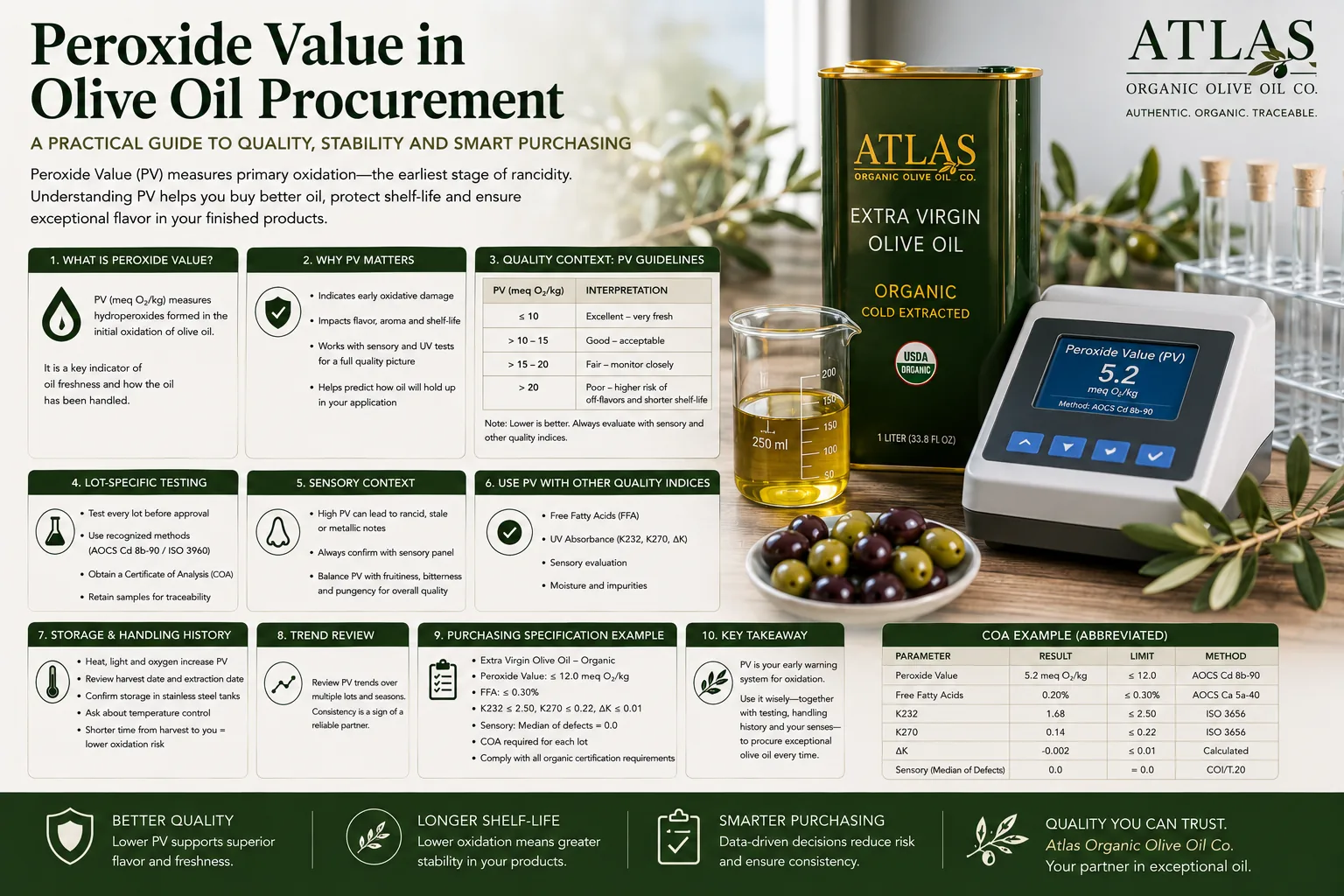
Peroxide value is a measure associated with primary oxidation products. It can be useful at receiving and during lot comparison, but oxidation is dynamic, so one value never tells the whole shelf-life story.
Analytical numbers are meaningful only in context: lot identity, sampling, method, category standard, sensory condition and storage history all matter. Peroxide value can support a quality decision, but it should not be treated as an independent score of overall freshness or expected remaining commercial life.
The practical objective is not to find an abstract “best” number. It is to define the oil, analytical profile and handling system that remain fit for the intended food, channel and shelf life. Procurement teams should therefore combine peroxide value with the broader quality picture rather than purchasing against one isolated laboratory result.
1. Start with the decision framework
Before requesting samples, write down the commercial job the oil must perform. That brief should state the finished product or service application, target market, annual and trial volumes, expected pack format, sensory role, process exposure, storage conditions and required organic documentation. If the oil will be named prominently on the label, the sensory target deserves even more attention.
For peroxide value, define what decision the number is intended to support. A category-compliance limit, an internal receiving target and a supplier-trending target may serve different purposes. The specification should make that distinction clear so buyers do not interpret an internal freshness objective as if it were the same thing as the legal category threshold.
- Set the limit against the applicable category standard and a tighter internal freshness target if justified.
- State the analytical method or accepted method framework used for the result.
- Review peroxide together with UV indices, sensory condition, age, packaging and storage history.
- Link every result to the exact commercial lot represented by the certificate or sample.
- Trend results by lot and over time when shelf-life assurance or supplier consistency is important.
A useful specification separates the legal or category baseline from tighter internal targets. It also makes clear which values are guaranteed at release, which are typical, and which are only reference data from a particular origin or harvest. That distinction is particularly useful for analytical values that naturally vary between lots and across storage time.
2. Practical workflow
Move from candidate evaluation to commercial approval in controlled steps. First, screen the oil against the intended category and application. Second, review peroxide value as part of the broader analytical profile. Third, confirm that sensory condition and storage history are consistent with the analytical picture. Finally, define receiving checks so future lots are judged using the same logic.
- Write a one-page brief. Include category, organic status, harvest or filtration preference if relevant, sensory profile, pack, volume, destination, analytical expectations and timing.
- Sample in context. Taste the oil neat for defects and style, then evaluate it in the actual food, process or service condition. Analytical freshness and application suitability are related but not identical questions.
- Review the full analytical set. Compare peroxide value with the other applicable category parameters and any internal quality targets rather than treating it as a stand-alone approval result.
- Confirm lot identity. Make sure the reported peroxide value belongs to the same commercial lot being offered, sampled or shipped. Generic product COAs should not replace lot-specific evidence when the specification requires it.
- Review storage context. Consider harvest or production timing, packaging, warehouse conditions, shipment route and any unusual heat, light or oxygen exposure that could affect the interpretation of the analytical result.
- Pilot the system. Use commercial-equivalent processing, transfer, filling, storage or service conditions rather than relying only on carefully handled laboratory samples.
- Trend future lots. Where the program justifies it, compare peroxide and related quality indicators across shipments to identify changes in incoming condition before they become repeated commercial problems.
- Define release and change control. Decide who approves a new harvest, new lot, pack component, source or material specification change.
Trend data can be more informative than an isolated result when the sampling and methods are comparable. A buyer may learn more from repeated lot behavior over several shipments than from trying to interpret minor numerical differences between unrelated samples tested under different conditions.
3. Quality controls that belong in the conversation
Extra virgin olive oil is defined through more than free acidity or peroxide value. Buyers should use the current applicable category standard, appropriate laboratory methods and—where required—organoleptic assessment. For commercial programs, add internal criteria that describe the sensory style your brand or formulation actually needs.
Peroxide value is associated with primary oxidation, but the oxidation process does not stop at that stage. For this reason, a low result should not automatically be interpreted as proof of long remaining shelf life, especially when storage history, secondary oxidation indicators or sensory condition raise other concerns.
- Link every analytical result to the actual tested and shipped lot.
- Use recognized current methods and laboratories appropriate to the procurement decision.
- Review peroxide value together with other applicable analytical and sensory information.
- Trend multiple quality indicators instead of relying on one number.
- Retain samples or receiving records where they support complaint investigation and lot comparison.
For storage and distribution, protect oil from direct light, unnecessary heat and repeated oxygen exposure. A premium incoming lot can deteriorate if it is held too warm, transferred turbulently, stored in a partly empty container for too long or packed in a format that does not suit turnover.
This means the condition of the oil after purchase still matters. A peroxide result obtained at supplier release describes one point in time; handling after that point can change the quality picture. Procurement, logistics and warehouse controls should therefore support the freshness assumptions behind the specification.
4. Common failure modes
Most analytical-control problems are not caused by the absence of laboratory data. They arise when one number is given more meaning than it can support, when the reported result cannot be tied to the delivered lot, or when storage and sensory evidence are ignored.
- Using peroxide value as a standalone freshness score.
- Assuming a low value automatically guarantees long remaining shelf life.
- Ignoring secondary oxidation indicators and sensory change.
- Comparing results produced with different sampling or testing conditions as if they were directly equivalent.
- Accepting a generic COA without confirming that the result belongs to the shipped commercial lot.
- Ignoring heat, light, oxygen exposure or storage age because the original release result was acceptable.
- Setting an internal analytical target without defining what action follows when it is exceeded.
Another common mistake is treating analytical values as static characteristics of the oil. Oxidation evolves during storage and distribution, so a result should be interpreted as part of a time, lot and handling context rather than as a permanent property of the product.
Build corrective-action triggers around objective evidence: out-of-spec results, sensory defects, material trend changes, damaged seals, broken traceability, temperature excursions, packaging failures or documented process deviations. This gives procurement and quality teams a clearer basis for hold, investigation, supplier discussion or additional testing.
5. What to put in the purchase specification
The purchase specification should identify the applicable analytical requirements while making clear how peroxide value fits into the broader quality program. The goal is a repeatable decision framework, not a single headline number.
6. Reference framework
For category definitions, analytical methods and organoleptic assessment, use the current International Olive Council trade standard and methods together with destination-market rules. Peroxide value should be interpreted within that complete category framework rather than used independently from the other applicable requirements.
Internal procurement targets can then sit inside the commercial specification where they are justified by the buyer's application, desired incoming condition and shelf-life objectives. Those targets should have clear methods, lot linkage and defined actions when results fall outside the agreed range.
Next step
Turn this guide into a sourcing brief by listing your application, annual volume, destination, desired format, target launch date and the quality attributes that matter most. Add any peroxide-value target, related analytical parameters and lot-specific documentation required by your quality program.
Atlas can then compare suitable organic olive-oil programs on the same commercial basis, aligning peroxide value, broader analytical condition, sensory profile, packaging, storage expectations and documentation rather than evaluating oils from a single number alone.