
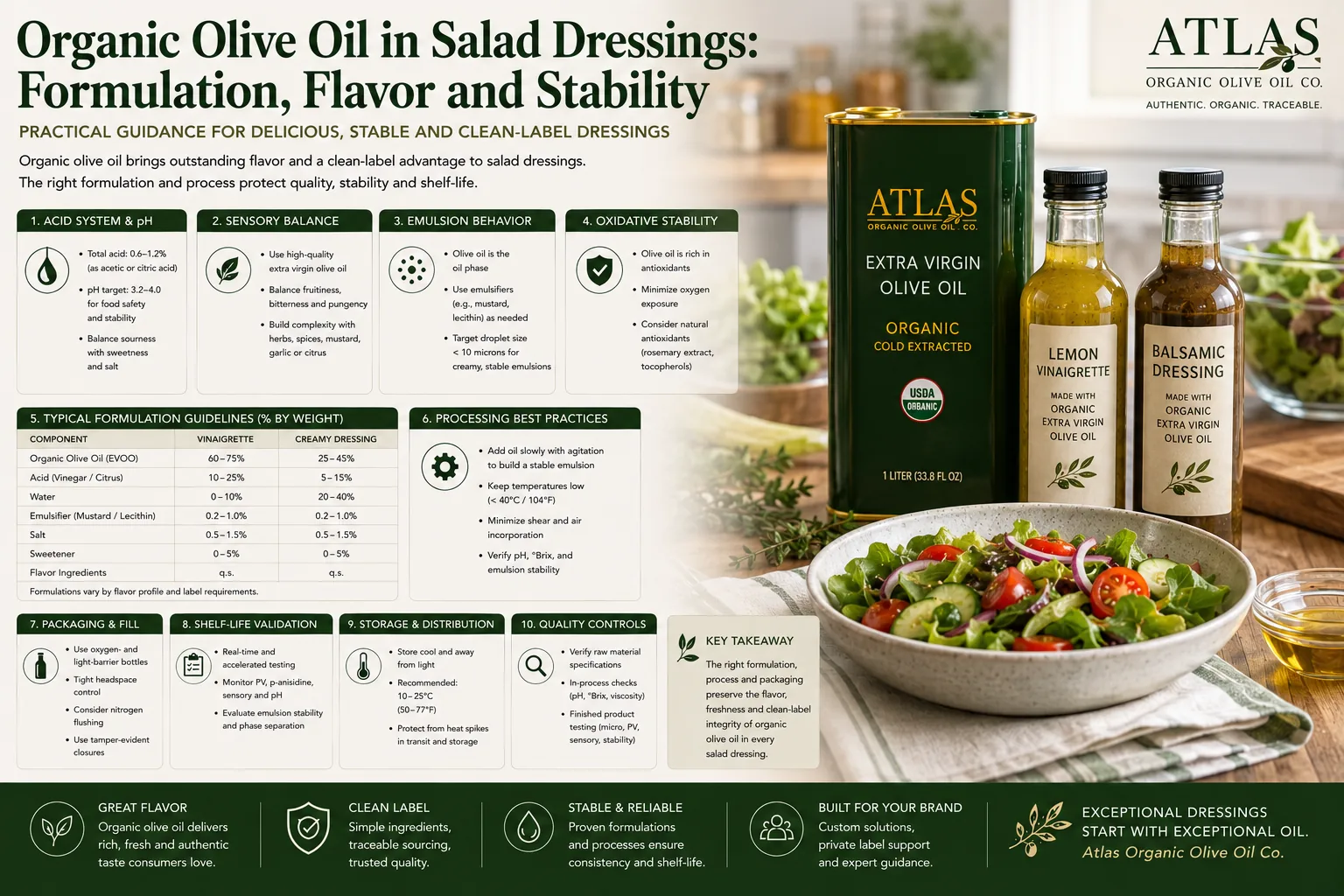
In a dressing, olive oil is both a structural fat phase and a major flavor contributor. Acidity from vinegar or citrus can amplify bitterness and pungency, so bench work should evaluate the complete formula rather than neat oil alone.
Treat the oil as part of the full food system. Acids, herbs, proteins, water, emulsifiers, trace metals, heat and package oxygen can change both flavor and oxidative behavior. An oil that tastes balanced on its own can become much more pronounced once acid, salt and aromatic ingredients are introduced.
The practical objective is not to find an abstract “best” oil. It is to define the oil, formulation, processing and packaging system that remain fit for the intended dressing style, channel and shelf life. For commercial development, flavor fit and physical stability should be considered alongside oxidative quality rather than evaluated as separate projects.
1. Start with the decision framework
Before requesting samples, write down the commercial job the oil must perform. That brief should state the dressing style, target market, annual and trial volumes, expected pack format, oil use level, sensory role, process exposure, storage conditions and required organic documentation.
Define whether the olive oil should be a leading flavor, a supporting note behind herbs and spices, or a relatively neutral fat-phase contributor. This decision affects the suitable fruitiness, bitterness and pungency range and can prevent teams from choosing an attractive neat oil that becomes too dominant after acidification.
- Screen oils in the finished acid system at target oil, salt, sugar and emulsifier levels.
- Include representative herbs, spices, mustard, proteins or other flavor-active ingredients during final selection.
- Decide whether olive flavor should lead, support other ingredients or remain in the background.
- Evaluate physical emulsion behavior separately from oxidative and sensory stability.
- Run oxidative and physical stability checks in the intended bottle, including realistic headspace and light exposure.
A useful specification separates the legal or category baseline from tighter internal targets. It also makes clear which values are guaranteed at release, which are typical, and which are only reference data from a particular origin or harvest. For dressings, the internal sensory target should reflect the oil's performance in the complete formula rather than a neat-tasting description alone.
2. Practical workflow
Move from bench screening to commercial approval in controlled steps. First, compare candidate oils in the intended acid system. Second, confirm flavor balance at realistic ingredient concentrations. Third, test emulsion and oxidative behavior under the commercial process. Finally, validate the finished product in the intended package and distribution conditions.
- Write a one-page brief. Include olive-oil category, organic status, target use level, desired sensory profile, acid system, pack, volume, destination, shelf-life objective and timing.
- Taste the oil neat. Screen for defects and understand its basic fruitiness, bitterness and pungency before formulation. This gives the development team a useful baseline for interpreting changes in the finished dressing.
- Sample in the complete formula. Evaluate the oil at target vinegar or citrus level together with salt, sugar, herbs, spices, emulsifiers and other major ingredients rather than testing in a simplified model system only.
- Check emulsion behavior. Observe separation, creaming, viscosity and re-dispersibility under the conditions appropriate to the product. A dressing can appear physically stable while still developing oxidative flavor changes.
- Review documents. Confirm lot identity, analytical results, organic status, traceability and any import, label or destination-specific records required by the market.
- Pilot the process. Use commercial-equivalent mixing order, shear, time, temperature, holding and filling conditions. Process intensity can influence both emulsion structure and the amount of oxygen incorporated into the product.
- Validate the intended package. Use the commercial bottle, closure and fill conditions, and include realistic light, headspace, distribution and storage exposure in shelf-life work.
- Define release and change control. Decide who approves a new harvest, new lot, oil-use level, emulsifier system, process condition or pack component that could affect the validated dressing profile.
When several oils appear suitable, compare them at the actual use level rather than assuming that the most intense or highest-priced sample will create the strongest finished product. In some formulas, a medium-intensity oil may provide clearer balance because the acid system already increases perceived bitterness or pungency.
3. Quality controls that belong in the conversation
Extra virgin olive oil is defined through more than free acidity. Buyers should use the current applicable category standard, appropriate laboratory methods and—where required—organoleptic assessment. For commercial dressing programs, add internal criteria that describe the sensory style the finished formula actually needs.
The finished dressing introduces additional quality questions. Physical stability, oxidative stability and flavor stability should be evaluated separately because they do not necessarily move together. An emulsion can remain visually stable while its aroma and flavor deteriorate, and a product with acceptable flavor can still show unacceptable phase separation.
- Evaluate candidate oils in the complete formula at the target commercial use level.
- Run pilot processing with representative time, temperature, shear and filling conditions.
- Track physical stability and sensory or oxidative quality as separate but related outcomes.
- Link shelf-life and pilot samples to the actual olive-oil lot used.
- Validate the finished product in the intended package and expected distribution conditions.
For storage and distribution, protect the oil-containing dressing from unnecessary heat, direct light and repeated oxygen exposure where those variables are relevant. A premium incoming lot can still perform poorly if processing introduces excessive air or the finished package does not provide suitable protection.
Ingredient interactions also deserve attention. Acids, herbs, spices, proteins and trace metals can influence oxidation or sensory perception, so shelf-life behavior should be established using the complete formulation rather than inferred directly from the incoming oil's best-before period.
4. Common failure modes
Most formulation problems are not caused by a lack of good ingredients. They occur when the oil is selected outside the finished system, when physical stability is mistaken for total stability, or when the commercial process and package differ from what was evaluated during development.
- Choosing an oil neat and discovering that it becomes too dominant after acidification.
- Evaluating a simplified acid-and-oil system but not the final salt, sugar, herb, spice and emulsifier levels.
- Assuming emulsion stability automatically means oxidative or sensory stability.
- Using bench-scale shear or mixing conditions that do not represent the commercial process.
- Using clear packaging without a realistic light-management plan.
- Changing the oil-use level or emulsifier system without reviewing the validated sensory and physical profile.
- Applying the incoming oil's shelf-life period directly to the finished dressing.
Another common weakness is evaluating only the day-one product. Some flavor interactions become more apparent during storage, while separation or viscosity changes may develop gradually. A useful shelf-life program should therefore include repeated observations at defined intervals rather than a single initial approval.
Build corrective-action triggers around objective evidence: out-of-spec results, sensory defects, emulsion failure, viscosity drift, damaged seals, broken traceability, temperature excursions, packaging failures or documented process deviations. This creates a clearer basis for troubleshooting ingredient, process and packaging causes.
5. What to put in the purchase specification
The olive-oil specification should support the dressing formulation without attempting to replace finished-product validation. Define the incoming oil characteristics that matter to flavor and quality, then manage the dressing's physical and oxidative stability through the complete formulation and process.
6. Reference framework
For category definitions, analytical methods and organoleptic assessment, use the current International Olive Council trade standard and methods together with destination-market rules. These references establish the incoming olive-oil category; they do not define the physical or oxidative stability of the finished dressing.
Finished-product validation should reflect the complete commercial system, including oil use level, acid system, emulsifier, other ingredients, processing, package, storage and expected distribution. Sensory and physical stability should both be monitored because acceptable performance in one area does not guarantee acceptable performance in the other.
Next step
Turn this guide into a sourcing brief by listing your dressing style, annual volume, destination, target olive-oil use level, desired pack format, launch date and the sensory attributes that matter most. Add the acid system, major flavor ingredients, emulsifier approach and any shelf-life constraints already known.
Atlas can then compare suitable organic olive-oil programs on the same commercial basis, aligning category, sensory profile, formulation fit, packaging, documentation and repeat-supply requirements with the finished dressing rather than evaluating the oil independently from the food system.