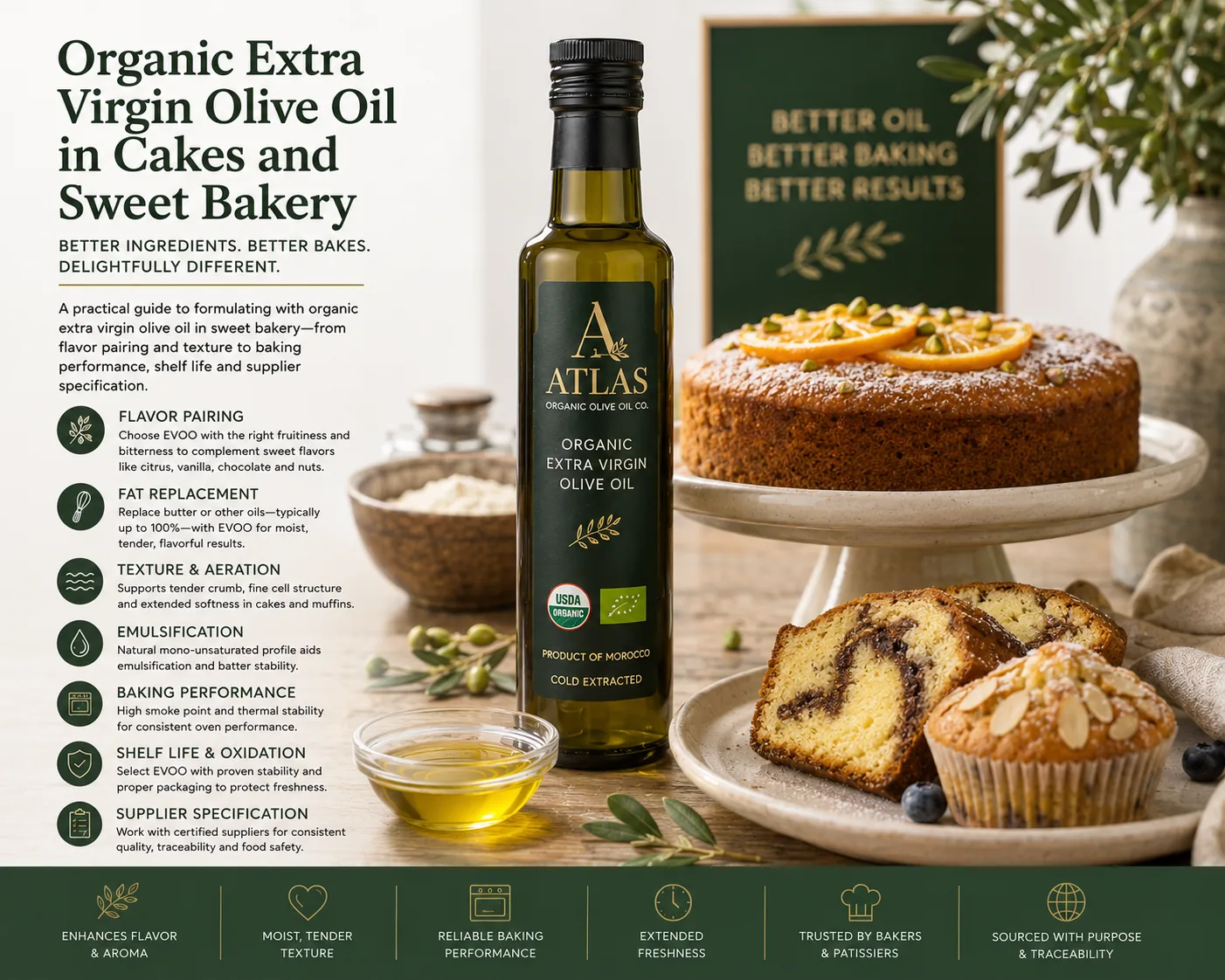
Olive oil can replace or complement other fats in cakes and sweet bakery products, but its fruitiness, bitterness and pungency interact strongly with chocolate, citrus, nuts, vanilla and spices. Formula development should be sensory-led, texture-aware and based on the actual finished product.
Bakery trials should separate the oil's functional role from its aroma and flavor. Heat can reduce some volatile character, while the replacement of a solid fat with a liquid oil can alter aeration, batter viscosity, crumb structure, tenderness and moisture perception. The practical objective is not to find an abstract “best” oil; it is to define the oil, formula and handling system that remain fit for the intended bakery product, channel and shelf life.
The right approach also depends on the product format. A loaf cake, muffin, brownie, snack cake or citrus cake can place different demands on the fat system. In some formulas olive oil is a defining flavor ingredient; in others it should contribute moisture and richness without becoming the dominant sensory note.
1. Start with the decision framework
Before requesting samples, define the commercial and technical job the oil must perform. The brief should state the finished bakery format, target market, annual and trial volumes, oil inclusion level, whether another fat is being replaced, expected sensory role, process exposure, package format, storage conditions and required organic documentation.
- Screen oils at the actual use level with the intended chocolate, citrus, nut, vanilla, fruit or spice system.
- Decide whether olive oil is a signature flavor, a supporting flavor or primarily a functional liquid fat.
- Rebalance aeration, emulsification and moisture where necessary if replacing butter, shortening or another solid fat.
- Validate flavor carry-through and oxidative stability in the final package over the intended shelf life.
The inclusion level deserves particular attention. An oil that tastes pleasantly assertive when used at a low percentage may become dominant at a higher inclusion rate. Conversely, delicate olive-oil aromas may be significantly muted by baking or masked by cocoa, roasted nuts, coffee or strongly flavored inclusions.
A useful specification separates the applicable legal or category baseline from tighter internal purchasing targets. It should also identify which values are guaranteed at release, which are agreed commercial targets, which are typical characteristics and which are reference information linked to a particular harvest, origin or production lot.
2. Practical workflow
Move from sample evaluation to commercial approval in controlled stages. Begin by screening oils for category quality and sensory style, then formulate at the intended inclusion rate. After that, evaluate mixing behavior, baking performance, finished-product texture, packaging and shelf-life performance before setting routine receiving criteria.
- Write a one-page brief. Include bakery format, organic status, olive-oil category, intended inclusion level, sensory profile, pack, trial volume, annual volume, destination and timing.
- Screen the supplier and documents. Confirm organic certification, traceability, commercial packaging options and the ability to provide agreed analytical information for each commercial lot.
- Sample in context. Taste candidate oils neat for defects and style, then evaluate them at the actual inclusion level with the complete flavor system.
- Measure batter or dough behavior. Record meaningful changes in viscosity, emulsification, aeration, density, depositability or handling when the oil source or inclusion level changes.
- Pilot the complete process. Use commercial-equivalent mixing order, mixing energy, resting time, depositing, baking, cooling and packaging conditions.
- Evaluate fresh product. Compare crumb, tenderness, moisture perception, aroma, flavor balance and overall eating quality after the product has fully cooled.
- Evaluate aged product. Review texture, aroma and signs of oxidative deterioration through realistic packaged storage rather than judging only day-one quality.
- Define release and change control. Decide who approves a new harvest, new oil lot, new pack component or material formulation change before routine production.
3. Understand liquid oil versus solid fat
Olive oil is liquid at normal bakery processing temperatures, so it does not necessarily perform the same structural role as butter, shortening or other solid fats. This distinction becomes especially important in formulas that rely on creaming to incorporate air or on crystalline fat to help build structure.
A direct weight-for-weight substitution may therefore change batter density, volume, crumb openness, tenderness or spread. The correct response is usually to evaluate the whole formula and process rather than assuming the oil itself is unsuitable.
Mixing sequence can also matter. Depending on the product, the oil may be incorporated into an emulsified phase, blended with liquid ingredients or introduced in another controlled step. The goal is repeatable dispersion without unnecessary overmixing or instability.
Where olive oil is only replacing part of the original fat system, the remaining solid fat can still contribute structure and aeration while the olive oil contributes fluidity, tenderness and flavor. Partial replacement can therefore provide a useful formulation route when complete replacement changes the product too dramatically.
4. Quality controls that belong in the conversation
Extra virgin olive oil is defined through more than free acidity. Buyers should use the current applicable category standard, appropriate laboratory methods and, where required, organoleptic assessment. Commercial bakery programs can then add internal criteria describing the sensory style and consistency needed by the formula.
- Measure dough or batter handling when oil source or inclusion level changes.
- Taste both fresh product and aged product after realistic packaging.
- Match oil intensity to the finished flavor system rather than choosing the strongest oil by default.
- Maintain lot traceability and appropriate retained samples for future comparison.
- Define incoming oil criteria separately from finished-bakery release criteria.
Lot-to-lot sensory consistency can be particularly important in branded bakery products. Agricultural variation is normal, but the purchasing program can define an acceptable range for fruitiness, bitterness and pungency so that a new harvest does not unexpectedly change the finished product.
5. Build the oil around the flavor system
Sweet bakery products can either reveal or mask olive-oil character depending on their flavor profile. Citrus and some fruit systems can complement fresh, aromatic olive-oil notes, while cocoa, coffee, toasted nuts and spices may support a more robust profile. Vanilla-forward or delicately flavored cakes may require tighter control over bitterness and pungency.
The relationship should always be tested at the real use level. A neat tasting is valuable for detecting defects and understanding style, but it does not show how sweetness, salt, cocoa, dairy ingredients, eggs, nuts or flavorings will alter perception in the finished crumb.
Baking itself can change the balance. Some volatile aromas may decrease during heating, while bitterness or other persistent characteristics can remain more noticeable. A buyer should therefore avoid setting a sensory target based only on unbaked batter or incoming oil.
6. Plan shelf life around fat, oxygen and packaging
Shelf-life performance depends on the complete bakery system. High-fat formulas, porous crumb structures, exposed surfaces, oxygen in the package and warm storage conditions can all influence oxidative change. The finished product should therefore be evaluated in its actual commercial package.
Incoming oil should be protected from direct light, unnecessary heat and repeated oxygen exposure before use. A high-quality lot can deteriorate if it is held too warm, transferred repeatedly or stored for too long in a partly empty container. Pack size should match actual bakery turnover so opened oil is consumed within a practical period.
Packaging requirements depend on the finished product. Some cakes are sold in highly protective sealed formats, while others use trays, wraps or cartons with different oxygen barriers. Shelf-life trials should reproduce the actual package and expected distribution conditions rather than relying on uncovered or laboratory storage.
Sensory evaluation over time is especially valuable because early oxidative changes may appear first as a loss of freshness or a stale fat note rather than an obvious failure. The bakery's own release and shelf-life criteria should define what constitutes unacceptable change.
7. Common failure modes
Most problems are not caused by a lack of descriptive language on the specification. They usually result from a missing formulation or operational control, or from assuming one incoming measurement predicts every aspect of finished-product performance.
- Treating liquid olive oil as a one-for-one functional replacement for solid fat.
- Selecting an assertive oil that clashes with delicate vanilla or fruit flavors.
- Choosing oil from neat tasting without evaluating the actual use level.
- Ignoring changes in batter density, aeration or emulsification after fat replacement.
- Evaluating only freshly baked product and not aged packaged product.
- Ignoring package oxygen in a high-fat bakery item.
- Using bulk oil formats that are too large for actual production turnover.
- Changing harvest or sensory profile without a defined reapproval procedure.
Corrective-action triggers should rely on objective evidence: out-of-specification analytical results, unexpected sensory changes, damaged packaging, broken traceability, unusual batter behavior, unacceptable texture, temperature excursions or documented process deviations.
It is also useful to define what happens after a deviation is found. Depending on the issue, an oil lot or finished-product batch may be placed on hold, investigated, compared with retained samples or subjected to additional approved evaluation before a release decision is made.
8. What to put in the purchase specification
A practical purchasing specification should connect incoming oil requirements directly to the bakery application. It should be detailed enough to prevent ambiguity while remaining usable by procurement, quality, product development and production teams.
9. Validate the finished bakery product
Supplier approval establishes whether the incoming oil meets the purchasing specification. It does not guarantee that a cake, muffin or other sweet bakery item will deliver the required texture, flavor or shelf life.
Finished-product validation should use the actual formula, mixing procedure, deposit weight, baking conditions, cooling process, package and intended storage environment. If olive oil is replacing another fat, comparisons should also consider volume, crumb structure, tenderness, moisture perception and processing behavior.
Scale-up can reveal issues that are not obvious in small laboratory batches. Larger mixers, different shear, longer holding times, automated depositing and production-scale cooling can all change batter behavior. Commercial-equivalent trials are therefore important before a new oil or reformulated fat system is released into routine production.
10. Questions to ask a potential olive-oil supplier
Supplier discussions should cover both oil quality and the supplier's ability to maintain a repeatable bakery program. Sensory consistency, documentation, packaging and lead time can be as commercially important as the initial sample.
- Which organic certification and shipment documents accompany each lot?
- Which analytical parameters are reported on the commercial certificate of analysis?
- How is lot traceability maintained through storage, transfer, packing and shipment?
- Which sensory profiles can be supplied consistently from harvest to harvest?
- Can oils be screened against a defined bakery sensory target?
- What bulk and packaged formats are available for trials and routine production?
- How are harvest, origin, processing or specification changes communicated?
- What lead times and minimum quantities apply to the required format?
The objective is a repeatable sourcing program rather than a one-time sample approval. Clear specifications, traceable lots, reference samples and agreed change-control procedures allow the buyer and supplier to work from the same definition of acceptable oil.
Next step
Turn this guide into a sourcing brief by listing your bakery application, current fat system, intended olive-oil inclusion level, annual volume, trial requirement, destination, desired format, sensory target, target launch date and required organic or quality documentation.
Atlas can then compare suitable organic extra virgin olive-oil programs on the same commercial basis, coordinate samples for bakery trials and help align sensory style, packaging, documentation and supply planning with the requirements of your cakes or sweet bakery program.