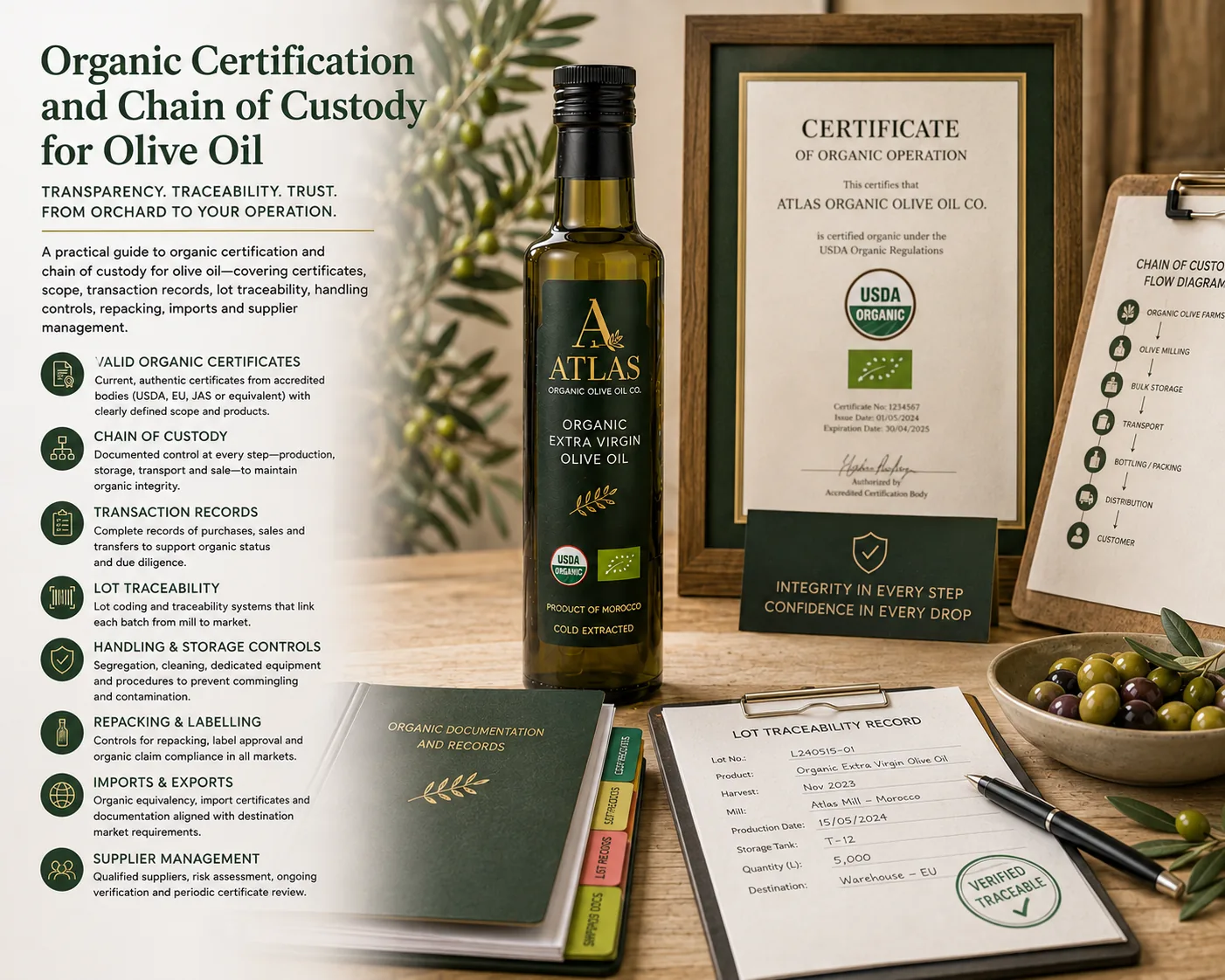
Organic integrity depends on both production requirements and documented handling through the supply chain. Buyers should know which operations require certification and how lot identity connects to transaction records from origin through final delivery.
Organic identity must remain connected to certified operations, transaction records and lot traceability through handling, trading, importing, exporting, storing, transferring and packing as required by the destination market. A certificate alone is not the entire chain of custody; the commercial records must also allow the physical oil to be followed through each relevant stage.
The practical objective is to build a sourcing program in which the organic claim, product identity and physical lot remain aligned. Buyers should be able to understand where the oil came from, which operations handled it, when ownership or custody changed and how the lot delivered to the plant relates back to supporting certification and transaction records.
1. Start with the decision framework
Before requesting samples or approving a supplier, define the commercial and compliance pathway the oil will follow. The brief should state the product category, destination market, trial and annual volumes, expected pack format, importer or consignee structure, storage and repacking steps, organic documentation requirements and any destination-specific transaction records.
- Verify current certificates, certification scope and product listings for the relevant operations.
- Confirm that the certification information corresponds to the legal entities and facilities actually involved in the transaction.
- Keep purchase, shipping, receiving, inventory and transfer records linked to unique lot or shipment identifiers.
- Review certification obligations for handlers, traders, importers, exporters, storage locations and packing operations in the relevant market.
Certificate review should go beyond checking whether a PDF contains the word “organic.” Buyers should review the certificate holder, certifier, validity, applicable scope, listed activities and any product or facility information needed to support the intended transaction.
A useful purchasing specification also separates the organic-compliance requirements from the olive-oil quality requirements. Category, analytical and sensory criteria describe the oil itself, while certification, traceability and transaction records support the organic claim and chain of custody.
2. Read certificates for scope, not just validity
A current certificate is an important starting point, but buyers should confirm what the certificate actually covers. Certification may apply to specific operations, activities, sites or products, so the relevant commercial flow should fit within the documented scope.
The name on the certificate should be compared with purchase orders, invoices, packing lists and other commercial documents. Where several legal entities or facilities are involved, the buyer should understand which entity is certified for which role.
Certificate expiry and renewal should be monitored as part of supplier approval. A certificate that was valid during the original qualification process should not simply be assumed current for future shipments.
If a supplier changes certifier, facility, legal entity or processing arrangement, the purchasing program should define when updated documentation and reapproval are required.
3. Build traceability around the physical lot
Strong chain of custody depends on the ability to connect the physical oil to documentary evidence. A lot number, tank number, shipment identifier or other unique reference should follow the oil through the buyer's receiving and inventory system.
Traceability records may include purchase orders, supplier invoices, packing lists, bills of lading, certificates, transaction documents, receiving records, tank logs, transfer records and finished-pack lot codes. The exact record set varies by program, but the links between records should be clear.
When one incoming lot is divided into several downstream lots, the system should preserve a parent-child relationship. Likewise, when multiple approved lots are combined, the records should show which source lots contributed to the resulting lot.
Good traceability does not require every team member to understand the entire supply chain. It does require a documented system that allows an authorized reviewer to reconstruct that chain when needed.
4. Practical workflow
Move from supplier screening to commercial approval in controlled steps. Start with certificates and scope, then map the commercial chain, review lot-specific records and confirm how identity will be maintained after receiving. Finally, define routine checks so future shipments are reviewed consistently.
- Write a one-page compliance brief. Include product category, organic status, origin if relevant, destination, pack format, volume, importer structure, handling steps and required documents.
- Verify certification. Confirm certificate holder, certifier, validity, scope, listed activities and relevant product information.
- Map the chain of custody. Identify the producer, processor, trader, exporter, importer, warehouse, packer and other relevant operations involved in the commercial flow.
- Review shipment documents. Confirm that lot identifiers, product description, organic status, quantities and commercial records are consistent across the shipment file.
- Check receiving controls. Verify lot identity, seals or container condition, quantity, documentation and the receiving location's internal lot assignment where applicable.
- Control transfers and repacking. Maintain parent-child traceability through tanks, intermediate containers, repacking operations and finished-product lots.
- Reconcile inventory. Ensure purchases, transfers, production use, losses and closing inventory remain explainable within the operation's documented system.
- Define change control. Decide who approves changes involving certifiers, legal entities, facilities, supply routes, packers, importers or other relevant chain-of-custody elements.
5. Control storage, transfer and repacking
Chain of custody can be broken after a compliant shipment arrives if internal handling is poorly controlled. Storage tanks, intermediate bulk containers, drums and packing lines should preserve both product identity and documentary linkage.
Where organic and non-organic oils are handled at the same operation, the facility's approved procedures should address identification, segregation, cleaning and the prevention of unintended mixing or substitution.
Tank transfers deserve special attention because the original supplier container may no longer be visible after unloading. Internal tank numbers and transfer records should preserve the connection between the receiving lot and the storage location.
Repacking creates a similar requirement. New retail or foodservice lots should remain traceable to the source lot or lots used in production, together with the relevant packaging date and quantity records.
6. Keep transaction records aligned
Certification supports the status of an operation, while transaction records support a particular commercial movement of product. Buyers should therefore review both the standing certification documents and the shipment-specific records.
Product description should remain reasonably consistent across purchase orders, invoices, packing lists, shipping records and receiving documents. Unexplained changes in product naming, lot coding, quantity or organic designation should be investigated before routine release.
Quantity reconciliation is also useful. The amount received should make sense in relation to the shipment documents, and downstream transfers or repacking quantities should remain explainable after normal process losses or adjustments.
For international programs, import and export records should be incorporated into the compliance file where required by the destination market and supply-chain structure.
7. Quality controls that belong in the conversation
Organic certification does not replace olive-oil quality control. Extra virgin olive oil is defined through more than free acidity, and buyers should still use the current applicable category standard, appropriate laboratory methods and, where required, organoleptic assessment.
- Verify current certificates, scope and relevant product information.
- Link nonretail containers and tanks to audit-trail records.
- Review certification obligations for relevant handlers in the chain.
- Keep lot-level analytical documentation separate but connected to the shipment file.
- Maintain parent-child traceability through transfers, blending or repacking where applicable.
This separation is important because an organically certified oil is not automatically extra virgin, and an analytically compliant extra virgin olive oil is not automatically eligible for an organic claim. Both sets of requirements need their own evidence.
8. Make receiving a document-and-product checkpoint
Receiving is where the supplier's documentation becomes part of the buyer's internal control system. The receiving team should confirm that the physical shipment and the paperwork describe the same product and lot.
Depending on the program, receiving checks can include container count, net quantity, lot code, seal condition, organic designation, certificate linkage, certificate of analysis and any shipment-specific transaction records.
If the plant assigns a new internal lot number, that identifier should remain linked to the supplier lot rather than replacing it without a cross-reference. This allows downstream production records to be traced back to the original shipment.
Discrepancies should be resolved before the oil is released into unrestricted inventory whenever practical.
9. Common failure modes
Most organic chain-of-custody failures are not caused by a lack of paperwork. They usually arise because records are outdated, inconsistent or disconnected from the physical lot they are supposed to describe.
- Relying on an expired supplier certificate.
- Checking certificate validity without reviewing scope or listed activities.
- Using “organic” on nonretail containers without required identification.
- Breaking the audit trail during repacking or tank transfer.
- Assigning new internal lot codes without preserving the supplier-lot link.
- Accepting inconsistent quantities or product descriptions without investigation.
- Failing to review certification obligations when a new trader or handler enters the chain.
- Keeping quality documents and organic documents in unrelated systems with no lot linkage.
Corrective-action triggers should be based on objective evidence: expired certification, missing transaction documents, broken lot links, unexplained inventory differences, incorrect labeling, damaged seals, inconsistent shipment records or documented handling deviations.
The purchasing program should also define who places a lot on hold, who contacts the supplier or certifier and what evidence is required before the product can be released.
10. What to put in the purchase specification
A practical purchase specification should combine the olive-oil quality requirements with the organic and traceability requirements needed for the actual commercial program.
11. Prepare for audit-trail review
A strong chain-of-custody system should allow the organization to move both backward and forward through the records. From a finished pack, reviewers should be able to identify the source lot; from an incoming lot, they should be able to identify where that oil was stored, transferred or packed.
Periodic internal trace exercises can help reveal missing links before an external audit or customer review. These exercises are most useful when they include quantities as well as document references.
The goal is not to create unnecessary paperwork. It is to maintain enough structured evidence that product identity, organic status and inventory movement remain understandable throughout the chain.
12. Reference framework
Organic certification and labeling requirements should be reviewed against the rules applicable to the destination market and the operations involved in the supply chain. Requirements can differ by jurisdiction, commercial role and product flow.
For olive-oil category definitions, analytical methods and organoleptic assessment, use the current International Olive Council trade standard and methods together with applicable destination-market rules and the buyer's own purchasing specification.
Buyers operating across several markets should avoid assuming that one certificate, transaction document or compliance workflow automatically satisfies every destination. The supply route should be reviewed market by market.
13. Questions to ask a potential organic olive-oil supplier
Supplier qualification should cover both oil quality and the ability to support the complete organic audit trail. A strong supplier should be able to explain how certification, lot identity and commercial records connect from source to shipment.
- Which legal entity holds the organic certificate for this transaction?
- What activities and products are included in the relevant certification scope?
- How is lot identity maintained through storage, transfer, packing and shipment?
- Which transaction or shipment documents accompany each organic lot?
- How are parent-child lots documented after transfer, repacking or consolidation?
- Which handlers, warehouses, traders or exporters participate in the supply route?
- How are certification, facility or supply-chain changes communicated to buyers?
- How long are traceability and transaction records retained under the supplier's system?
The objective is a repeatable compliance program rather than a one-time document collection exercise. Current certificates, clear lot coding, consistent transaction records and defined change control make future shipments easier to review and approve.
Next step
Turn this guide into a sourcing brief by listing your destination market, required organic standard, product category, annual volume, pack format, importer or consignee structure, supply route and documentation requirements.
Atlas can then compare suitable organic olive-oil programs on the same commercial basis and help align certification, lot traceability, shipment records, pack format and supplier documentation with the requirements of your sourcing program.