
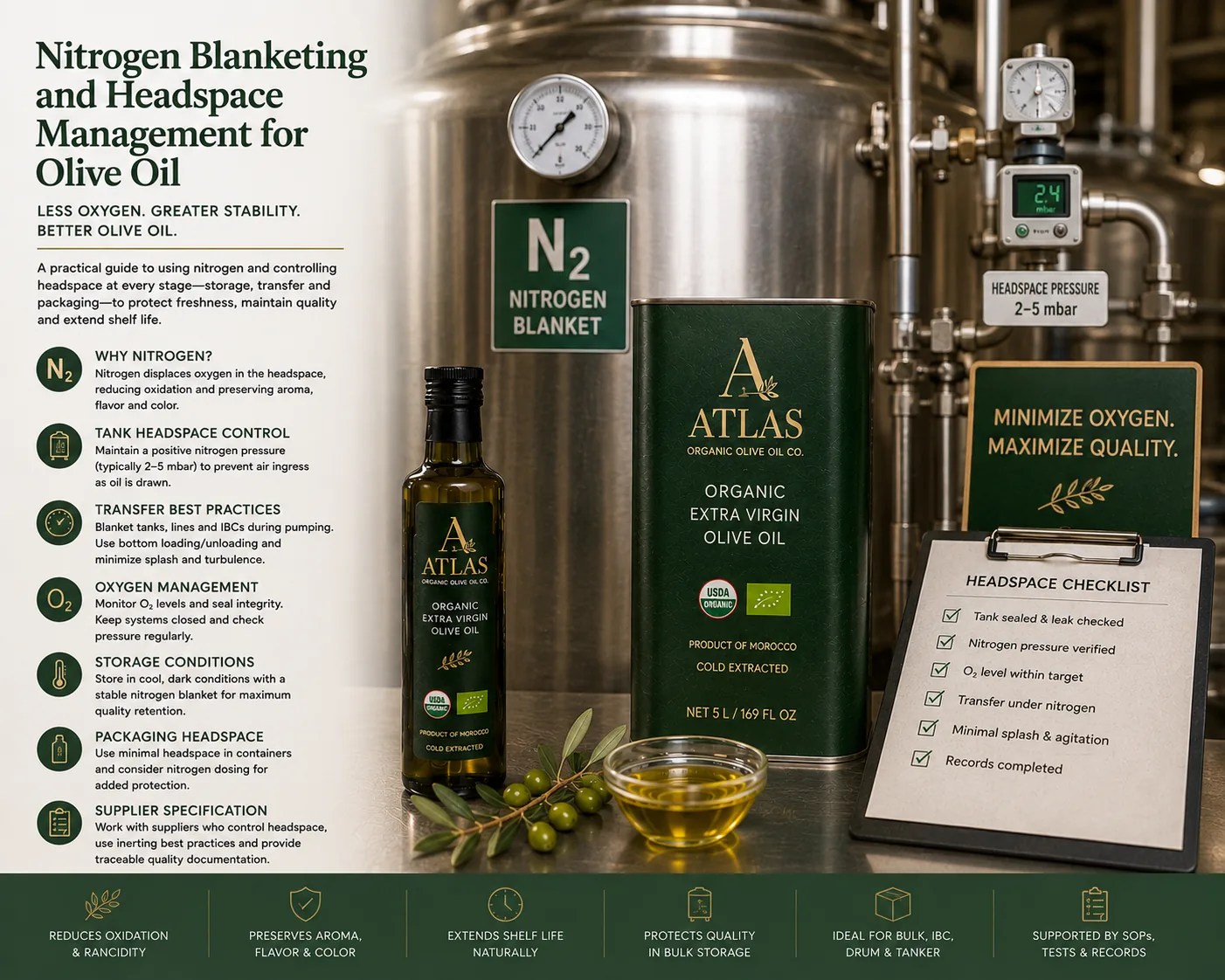
Inert-gas practices can reduce oxygen contact in tanks and packages, but they only work as part of a controlled system. Leaks, turbulent transfers, repeated tank opening and large headspace changes can reduce or erase part of the benefit.
Tank management should minimize unnecessary oxygen contact while maintaining worker safety, sanitation, lot identity and operational practicality. Nitrogen blanketing is therefore one control among several—not a substitute for appropriate storage temperature, sound equipment, controlled transfers or good inventory turnover.
The practical objective is to understand where oxygen can enter the oil-handling system and to reduce those exposures where they are commercially meaningful. Storage tanks, day tanks, pumps, hoses, intermediate containers and filling equipment should be considered together rather than managed as unrelated steps.
1. Start with the decision framework
Before designing or approving a nitrogen-blanketing program, map the actual storage and transfer system. The brief should state tank capacities, typical fill levels, expected turnover, transfer frequency, package format, storage temperature, nitrogen supply, pressure-control equipment, food-contact requirements and facility safety procedures.
- Define nitrogen purity, regulator, piping and food-contact practices within the facility's approved safety and maintenance procedures.
- Identify which tanks or filling operations justify inert-gas control based on storage time, headspace and commercial quality objectives.
- Manage transfer velocity and oil entry into tanks to limit unnecessary splashing and oxygen pickup.
- Verify headspace or oxygen-control performance where it is critical instead of assuming that a nominal gas dose is automatically effective.
Tank size and turnover should be considered together. A very large tank that remains partly empty for long periods creates a different headspace-management challenge from a tank that cycles quickly between receipt and use.
A useful operating specification also distinguishes between supplier requirements and facility controls. The supplier can define incoming oil quality and shipment conditions, while tank pressure, nitrogen supply, transfer procedures and internal storage management remain the responsibility of the receiving operation.
2. Understand what nitrogen blanketing is meant to do
The primary purpose of an inert-gas blanket is to reduce the amount of oxygen contacting the oil surface in the tank headspace. This can be useful when oil remains in storage for meaningful periods or when tank level changes repeatedly.
Blanketing should not be interpreted as removing every source of oxygen. Oxygen may already be dissolved in the oil, enter through transfer operations, be introduced when equipment is opened or leak into systems that are not adequately controlled.
The program should therefore focus on reducing cumulative exposure rather than expecting one gas application to solve every oxidative risk. Good storage practice combines inert-gas control with appropriate temperature, low-splash transfer, suitable tank turnover and sound equipment maintenance.
3. Manage changing tank headspace
Headspace volume changes as oil enters or leaves a tank. When oil is withdrawn, additional gas volume is required above the liquid surface. If that changing volume is not managed, air can enter and increase oxygen exposure.
Tank systems should therefore be designed and operated with the actual drawdown pattern in mind. Frequent small withdrawals can create a different gas-demand profile from occasional large transfers.
Headspace management is especially important when tanks remain partially filled for extended periods. In these situations, a large gas space may be repeatedly disturbed by transfer, sampling, inspection or maintenance activities.
Tank-level records can help operations teams understand how long oil spends under different headspace conditions and whether storage practices match the intended quality-control strategy.
4. Practical workflow
Move from incoming-oil approval to storage-system control in defined steps. First, confirm oil quality and lot identity. Second, review the tank and gas system. Third, control unloading and transfer. Finally, verify storage records, headspace practices and downstream filling conditions.
- Write a one-page storage brief. Include oil category, organic status, incoming pack format, tank capacity, typical residence time, transfer frequency, nitrogen system and destination use.
- Review incoming documents. Confirm lot identity, analytical results, organic status, traceability and agreed shipment documentation.
- Inspect the receiving system. Confirm tank readiness, lot status, cleaning status, valves, hoses, fittings and nitrogen equipment before transfer.
- Control unloading. Use an appropriate closed or low-exposure transfer method and avoid unnecessary splashing or prolonged open transfer.
- Establish the headspace condition. Apply the facility's approved inert-gas procedure after filling or tank-level change where the program requires it.
- Monitor storage. Maintain tank identity, quantity, temperature, status and relevant gas-system records during the storage period.
- Control downstream transfer. Avoid introducing unnecessary air when pumping oil to day tanks, blending systems or filling equipment.
- Define change control. Decide who approves changes to tank configuration, gas supply, regulators, piping, pumps, transfer procedures or other material parts of the system.
5. Limit oxygen pickup during transfer
Nitrogen blanketing can be undermined if large amounts of air are introduced during unloading or internal transfer. Splashing, free-fall filling and highly turbulent movement can increase the contact between oil and air.
Where practical, transfer lines should deliver oil in a controlled manner that reduces unnecessary agitation. Pump selection, flow rate, hose condition and the location of the discharge point can all influence transfer behavior.
Empty hoses and lines may also contain air before a transfer begins. Facilities should account for startup and shutdown conditions in their operating procedures rather than focusing only on steady-state pumping.
Transfer controls should remain compatible with sanitation, food-contact and equipment-safety requirements. Oxygen reduction should never be pursued in a way that compromises hygienic handling or safe operation.
6. Quality controls that belong in the conversation
Extra virgin olive oil is defined through more than free acidity. Buyers should use the current applicable category standard, appropriate laboratory methods and, where required, organoleptic assessment. Storage controls then help preserve the quality of the approved incoming lot.
- Use closed or low-exposure transfer practices where practical.
- Control tank headspace with an appropriate inert-gas system where justified.
- Maintain tank identity, status, quantity, temperature and cleaning records.
- Keep nitrogen equipment within the facility's approved maintenance and safety program.
- Investigate unexpected oxygen exposure, leaks or prolonged warm storage.
Storage records should remain connected to lot traceability. If one supplier lot is transferred between tanks, the parent-child relationship should remain clear so that analytical results, organic documentation and retained samples still correspond to the oil being used.
7. Blanketing does not replace temperature control
Nitrogen reduces oxygen contact in the headspace, but it does not protect oil from excessive heat. Warm storage can accelerate quality deterioration even when the tank atmosphere is well managed.
Tanks should therefore be located and operated to avoid unnecessary heat from direct sunlight, hot process areas or poorly controlled warehouse conditions. Temperature expectations should reflect the facility, climate and intended storage period.
Temperature excursions should be recorded and evaluated within the facility's quality system. A nitrogen blanket should not be used as a reason to ignore extended warm holding.
8. Verify critical gas-management performance
Where headspace control is important to the commercial quality program, facilities should use an appropriate verification approach. The exact method depends on the tank, package and operating system.
Useful checks may include confirmation of regulator settings, gas supply status, pressure behavior, system integrity and other facility-defined indicators showing that the inert-gas system is operating as intended.
For critical packaging operations, headspace or residual-oxygen verification may be more informative than relying only on gas-flow settings. A setpoint confirms what the equipment was instructed to do; verification helps show what the package or headspace actually received.
Verification records are also useful when investigating shelf-life variation, equipment failures or changes in package performance.
9. Apply the same principle to package headspace
Headspace control does not end at the bulk tank. Bottles, tins, bag-in-box formats and other packages can contain different amounts of residual air depending on filling method, fill level and gas-management practice.
Where inert-gas flushing or other headspace-management techniques are used during packing, the process should be validated with the actual package, closure, line speed and fill conditions.
Package headspace is only one part of shelf-life performance. Container light protection, oxygen transmission, closure integrity and downstream storage temperature still matter.
The practical goal is to minimize avoidable oxygen exposure throughout the chain, from bulk storage through final package, without assuming that any single step guarantees shelf life.
10. Keep gas handling inside the safety system
Nitrogen is useful as an inert gas, but gas systems must be managed within the facility's approved occupational safety, ventilation, confined-space and equipment procedures.
Regulators, piping, connections and gas cylinders or bulk-supply systems should be installed, maintained and used by trained personnel according to the facility's applicable requirements.
Storage tanks and enclosed work areas should never be treated casually simply because the gas is used for food-contact purposes. Product-quality controls and personnel-safety controls should operate together.
11. Common failure modes
Most problems are not caused by the absence of nitrogen itself. They usually arise because the inert-gas system is expected to compensate for weak handling, poor maintenance or uncontrolled storage conditions.
- Using nitrogen without approved gas-handling and confined-space safety procedures.
- Assuming blanketing compensates for prolonged warm storage.
- Introducing air through splashing, free-fall filling, pumps or hoses.
- Allowing large tank headspaces to cycle repeatedly without a defined control strategy.
- Relying on gas-flow settings without verifying critical headspace performance.
- Ignoring leaks, damaged regulators or inconsistent gas supply.
- Breaking lot traceability when oil is transferred between tanks.
- Using an oversized tank that remains partly empty much longer than the program anticipated.
Corrective-action triggers should be based on objective evidence: out-of-specification results, sensory defects, broken traceability, temperature excursions, suspected air ingress, gas-system failure, pressure abnormalities, packaging problems or documented transfer deviations.
The facility should also define who places affected oil on hold, who evaluates the deviation and what evidence is required before the lot returns to normal use.
12. What to put in the purchase specification
A practical purchasing and storage specification should connect incoming olive-oil requirements with the bulk-handling environment in which that oil will be stored and transferred.
13. Maintain tank and transfer records
Tank records should allow the operation to reconstruct which oil was stored, where it was held and how it moved through the system. At minimum, the relevant records should support lot identity and operational traceability.
Depending on the program, useful records can include tank number, lot number, quantity, receipt date, transfer date, destination tank, temperature observations, cleaning status and relevant nitrogen-system checks.
These records become especially valuable when more than one lot is handled in the same facility or when oil is transferred repeatedly before packaging.
14. Reference framework
For olive-oil category definitions, analytical methods and organoleptic assessment, use the current International Olive Council trade standard and methods together with applicable destination-market requirements.
Packaging and storage literature consistently emphasizes limiting unnecessary exposure to oxygen, light and heat. Nitrogen blanketing can support that strategy, but commercial shelf life still requires lot-, process- and package-specific validation.
Facility gas systems, tank entry and confined-space activities should also be managed under the applicable occupational safety, engineering and maintenance requirements for the operating location.
15. Questions to ask a potential olive-oil supplier
Supplier discussions should cover both incoming oil quality and how the shipment will integrate with the buyer's storage system. Bulk format, unloading method, traceability and expected turnover can influence the practical handling plan.
- Which analytical and traceability documents accompany each lot?
- Which bulk formats are available for the required volume and turnover?
- How is the oil protected from unnecessary oxygen exposure before shipment?
- How are bulk containers or tankers identified and sealed?
- What unloading and transfer conditions should the receiving facility plan for?
- How are parent-child lots documented if material is consolidated or repacked?
- How are harvest, origin, processing or specification changes communicated?
- Can retained or pre-shipment samples support the buyer's release program?
The objective is a repeatable storage and sourcing program rather than a one-time delivery. Clear specifications, traceable lots, controlled transfers and defined tank-management procedures help preserve incoming quality through downstream use.
Next step
Turn this guide into a sourcing and storage brief by listing your annual volume, incoming bulk format, tank capacity, expected residence time, transfer pattern, nitrogen system, destination use, final package and required organic or quality documentation.
Atlas can then compare suitable organic extra virgin olive-oil programs on the same commercial basis and help align bulk format, documentation, lot traceability and supply planning with the requirements of your storage and packing system.