
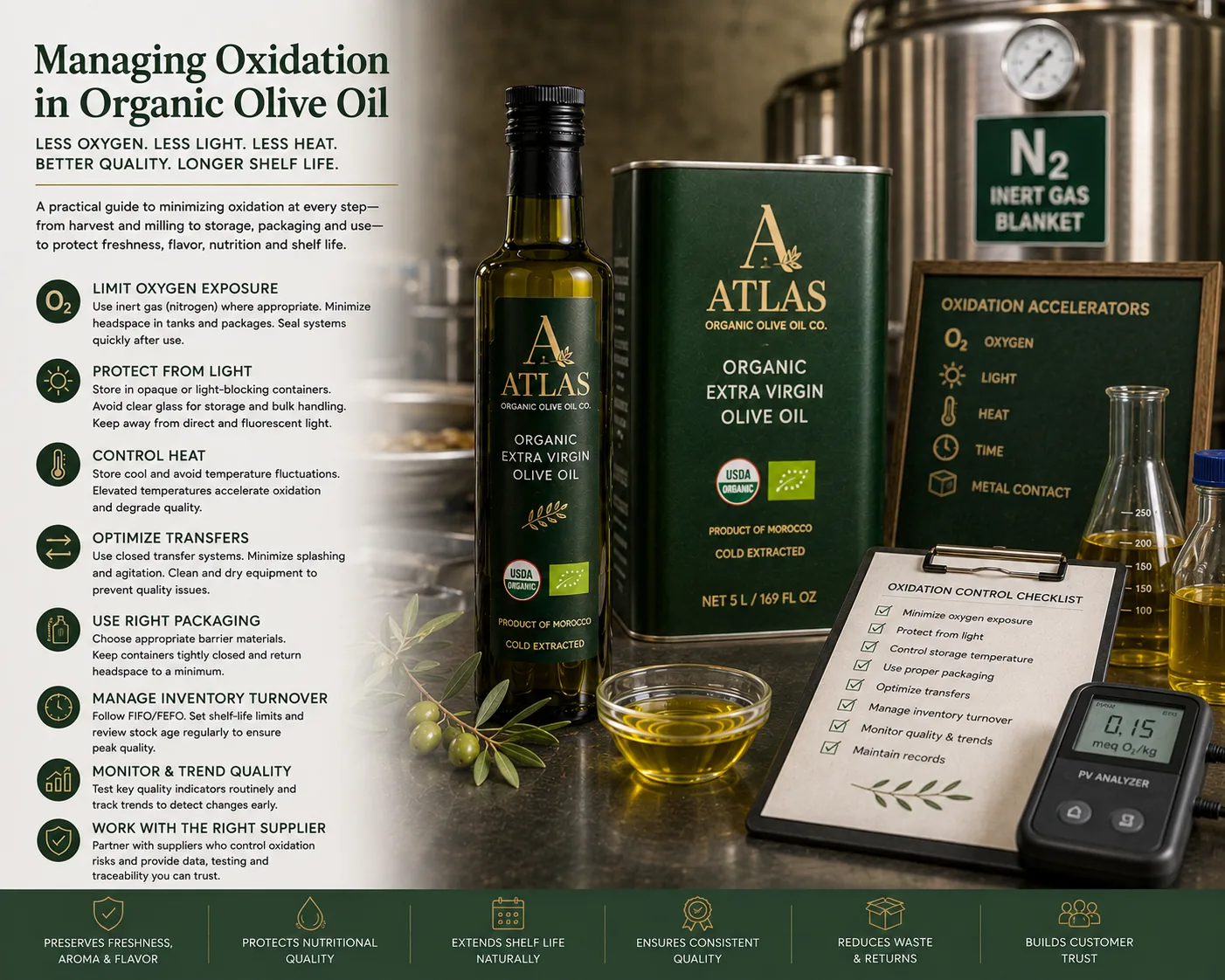
Oxidation is one of the central quality risks in olive oil. Exposure to oxygen, light and elevated temperature can accelerate deterioration, while packaging, storage discipline and appropriate turnover can slow the process.
Quality is preserved through the complete system, not created by a certificate alone. Oxygen exposure, light, heat, age, transfer conditions, packaging and the finished-product matrix all influence how the oil changes over time. The practical objective is not to identify an abstract “best” oil; it is to define an incoming specification and handling system that remain fit for the intended product, distribution channel and shelf-life target.
Oxidation management is therefore a chain of controls. A strong incoming lot can still deteriorate through poor storage or packaging, while careful handling cannot restore quality that has already been lost. Supplier qualification and downstream operations should be treated as connected parts of the same quality program.
1. Start with the decision framework
Before requesting samples, map the commercial pathway the oil will follow. The brief should state the intended application, destination, annual and trial volumes, incoming format, storage period, transfer steps, final package, sensory role and required organic or quality documentation.
- Identify major oxygen-exposure points during unloading, transfer, filling and repeated container opening.
- Use light-protective packaging and suitable storage for programs sensitive to retail or warehouse light exposure.
- Control unnecessary heat throughout warehousing, production and distribution.
- Track age and inventory turnover because premium oil is not improved by extended storage.
The acceptable risk profile depends on the intended use. A bulk ingredient that turns over quickly in a protected manufacturing environment may require different controls from a premium retail oil expected to spend months in distribution and on shelf.
A useful specification separates the applicable category baseline from tighter internal targets. It should also make clear which values are guaranteed at release, which are commercial targets, which are typical characteristics and which are reference data associated with a particular harvest or origin.
2. Understand the major oxidation drivers
Oxygen is a central driver of oxidative deterioration, but exposure is rarely limited to one event. Oil can contact air during unloading, pumping, tank filling, sampling, repacking and repeated opening of partially used containers.
Light can add another source of quality pressure, particularly in transparent or lightly protected packages. Retail display, warehouse lighting and direct sunlight should therefore be considered when package and storage systems are selected.
Temperature influences the rate at which quality changes occur. Unnecessary heat in warehouses, production areas, transport or foodservice storage can reduce the value of otherwise careful oxygen management.
Time connects all of these factors. A modest exposure repeated over a long storage period can become commercially meaningful, which is why inventory age and turnover belong in the oxidation-control program.
3. Practical workflow
Move from incoming-lot approval to operational control in defined stages. First, establish the baseline quality of the oil. Second, map exposure points. Third, verify that storage, transfer and packaging controls are appropriate. Finally, trend retained samples and finished-product performance over time.
- Write a one-page quality brief. Include category, organic status, incoming format, sensory profile, storage duration, transfer steps, final pack, volume, destination and timing.
- Review incoming documents. Confirm lot identity, analytical results, organic status, traceability and any destination-specific records required by the program.
- Establish a sensory baseline. Evaluate incoming oil for category condition and agreed sensory style so later changes can be compared with a meaningful reference.
- Map oxygen, light and heat exposure. Identify tanks, hoses, pumps, open containers, filling lines, transparent packages and warm storage locations that could affect quality.
- Pilot the real handling system. Use commercial-equivalent unloading, transfer, storage, filling and packaging rather than relying only on laboratory handling.
- Retain representative samples. Keep samples under defined conditions where they can support later comparison or investigation.
- Trend shelf-life performance. Review sensory, analytical or finished-product changes at planned intervals appropriate to the commercial program.
- Define release and change control. Decide who approves a new harvest, packaging format, storage condition, transfer system or other material change.
4. Control oxygen pickup during handling
Oxygen exposure is often introduced during movement rather than static storage. Splashing, free-fall filling, turbulent pumping and repeated transfer can increase contact between the oil and air.
Where practical, facilities should use controlled or closed transfer practices that limit unnecessary agitation. Pump settings, hose layout, discharge point and transfer velocity can all influence the amount of air incorporated during handling.
Partly empty tanks and containers deserve special attention because increasing headspace can create more opportunity for oxygen contact. For programs where storage time is significant, headspace-management practices may be justified.
Repeated opening of small containers can also matter. Foodservice and manufacturing pack sizes should therefore match realistic turnover so the same container does not remain in use for an unnecessarily long period.
5. Reduce avoidable light exposure
Packaging choice should reflect the product's actual route to market. A package that looks attractive on shelf should also be evaluated for the level of light protection needed by the intended distribution and display conditions.
Bulk and ingredient programs should similarly avoid direct sunlight and unnecessary bright exposure during storage. Transparent intermediate containers should be managed with their actual location and holding time in mind.
Light protection should be considered together with oxygen and temperature rather than treated as an isolated specification. Good performance comes from the combination of these controls.
6. Keep unnecessary heat out of the system
Warm storage can accelerate quality deterioration even when packaging and oxygen controls are otherwise strong. Warehouses, tank rooms, production areas and transport conditions should therefore be reviewed for avoidable heat exposure.
Oil should not be held near hot processing equipment, steam lines, ovens or direct solar load without a clear operational reason. Working quantities and reserve inventory may require different storage locations.
Temperature excursions should be documented and evaluated within the quality system. The response should reflect the duration, severity, lot history and intended use rather than relying on a single generic rule.
7. Treat inventory age as a quality variable
Even under good storage conditions, olive oil does not become fresher with time. Purchasing programs should therefore align order quantities, pack formats and delivery frequency with realistic consumption.
Large economical formats can be appropriate for high-turnover operations, but they may work against quality if partially used containers or tanks remain in service much longer than expected.
Receiving date, production lot, harvest information where relevant and internal stock rotation should be visible enough for procurement and quality teams to identify aging inventory before it becomes an operational problem.
First-in, first-out or another approved stock-rotation approach can help prevent newer material from being consumed while older lots remain unnecessarily in storage.
8. Quality controls that belong in the conversation
Extra virgin olive oil is defined through more than free acidity. Buyers should use the current applicable category standard, appropriate laboratory methods and, where required, organoleptic assessment. Oxidation management then focuses on preserving the quality established at incoming release.
- Define the most important oxygen, light, heat and time exposure points.
- Use retained samples and planned shelf-life trending.
- Connect analytical data to the specific commercial lot.
- Keep packaging and storage conditions inside the change-control program.
- Tie corrective actions to measurable deterioration or documented process deviations.
No single analytical value tells the entire oxidation story. Commercial decisions are stronger when analytical results, sensory evaluation, lot history and process information are considered together.
9. Use retained samples as a reference point
Retained samples can help distinguish between an incoming-quality issue and a downstream handling problem. When a later complaint or sensory change occurs, the retained sample provides a point of comparison with the oil as originally received.
Sample identity should remain linked to the commercial lot, and storage conditions for retained material should be defined so the comparison remains meaningful.
For longer programs, buyers may also retain samples at selected downstream stages, such as after packing, to help separate bulk-storage effects from packaging or distribution effects.
10. Make packaging part of the oxidation strategy
Packaging influences how much oxygen and light the oil encounters after filling. Container material, closure, headspace, seal integrity and downstream storage should therefore be evaluated as one system.
Different formats may be appropriate for different channels. Retail bottles, tins, foodservice packs, bag-in-box systems, drums and bulk containers each create different combinations of exposure, turnover and handling.
Where headspace flushing or inert-gas techniques are used, the process should be validated with the actual line and package. A gas setting by itself does not prove final package performance.
Commercial shelf-life validation should use the actual package intended for sale or production use rather than assuming that good bulk-oil data automatically transfers to the finished pack.
11. Evaluate the finished product matrix
When olive oil is used as an ingredient, the finished food may introduce additional oxidative factors. Other fats, proteins, minerals, seasonings, moisture, processing and package atmosphere can all influence the complete system.
Incoming olive-oil quality remains important, but the final food must still be validated under its actual processing, packaging and storage conditions.
This distinction is particularly important in products with long shelf life, large exposed lipid surfaces or substantial interaction between the oil and other ingredients.
12. Common failure modes
Most oxidation-management failures are not caused by one missing specification number. They usually result from several small exposures that are not controlled across the full system.
- Relying on antioxidants or natural composition as a substitute for good handling.
- Storing oil near heat or in direct light.
- Keeping large partly empty containers in service for extended periods.
- Using turbulent transfers that introduce unnecessary air.
- Ignoring inventory age because the original incoming lot was high quality.
- Selecting packaging without considering light, oxygen and real turnover.
- Failing to retain reference samples for important commercial lots.
- Treating one analytical measurement as a complete predictor of shelf life.
Corrective-action triggers should be based on objective evidence: out-of-specification analytical results, sensory defects, unexpected age, broken traceability, temperature excursions, packaging failures, damaged seals or documented process deviations.
The quality system should also define who places a lot on hold, who investigates the event and what evidence is required before the oil or finished product can be released.
13. What to put in the purchase specification
A useful purchasing specification should connect incoming oil quality with the storage, packaging and turnover conditions expected in the commercial program.
14. Trend shelf-life performance instead of relying on one snapshot
Oxidation is a time-dependent process, so a single incoming result provides only one point in the product's history. Trending helps buyers understand how a lot behaves under the actual storage and packaging system.
Depending on the program, trending may combine sensory evaluation, selected analytical measurements, package observations and inventory records at planned intervals.
The purpose is not to generate data without a decision. Each monitored attribute should connect to a release criterion, investigation trigger, shelf-life decision or process-improvement question.
15. Reference framework
For olive-oil category definitions, analytical methods and organoleptic assessment, use the current International Olive Council trade standard and methods together with applicable destination-market requirements.
Packaging and storage guidance consistently emphasizes limiting unnecessary oxygen, light and heat exposure. Commercial shelf life, however, still requires validation with the actual lot, handling system, package and finished-product conditions.
16. Questions to ask a potential olive-oil supplier
Supplier discussions should cover both incoming quality and the information needed to manage that quality after receipt. Lot documentation, pack format, retained samples and change control can all support a stronger oxidation-management program.
- Which analytical parameters are reported on each commercial certificate of analysis?
- How is lot identity maintained through storage, packing and shipment?
- Which pack formats are available for the buyer's expected turnover?
- What storage and handling conditions are recommended for the supplied format?
- Can retained or pre-shipment samples support the buyer's quality program?
- Which sensory profiles are realistically available from harvest to harvest?
- How are harvest, origin, process or specification changes communicated?
- What lead times and delivery patterns can support fresher inventory turnover?
The objective is a repeatable quality program rather than a one-time sample approval. Clear specifications, traceable lots, suitable pack formats and coordinated inventory planning can help preserve quality through downstream use.
Next step
Turn this guide into a sourcing and quality brief by listing your application, annual volume, incoming pack format, storage period, transfer pattern, final package, destination, target shelf life and required organic or quality documentation.
Atlas can then compare suitable organic extra virgin olive-oil programs on the same commercial basis and help align sensory style, pack format, documentation, lot traceability and supply planning with your oxidation-management requirements.