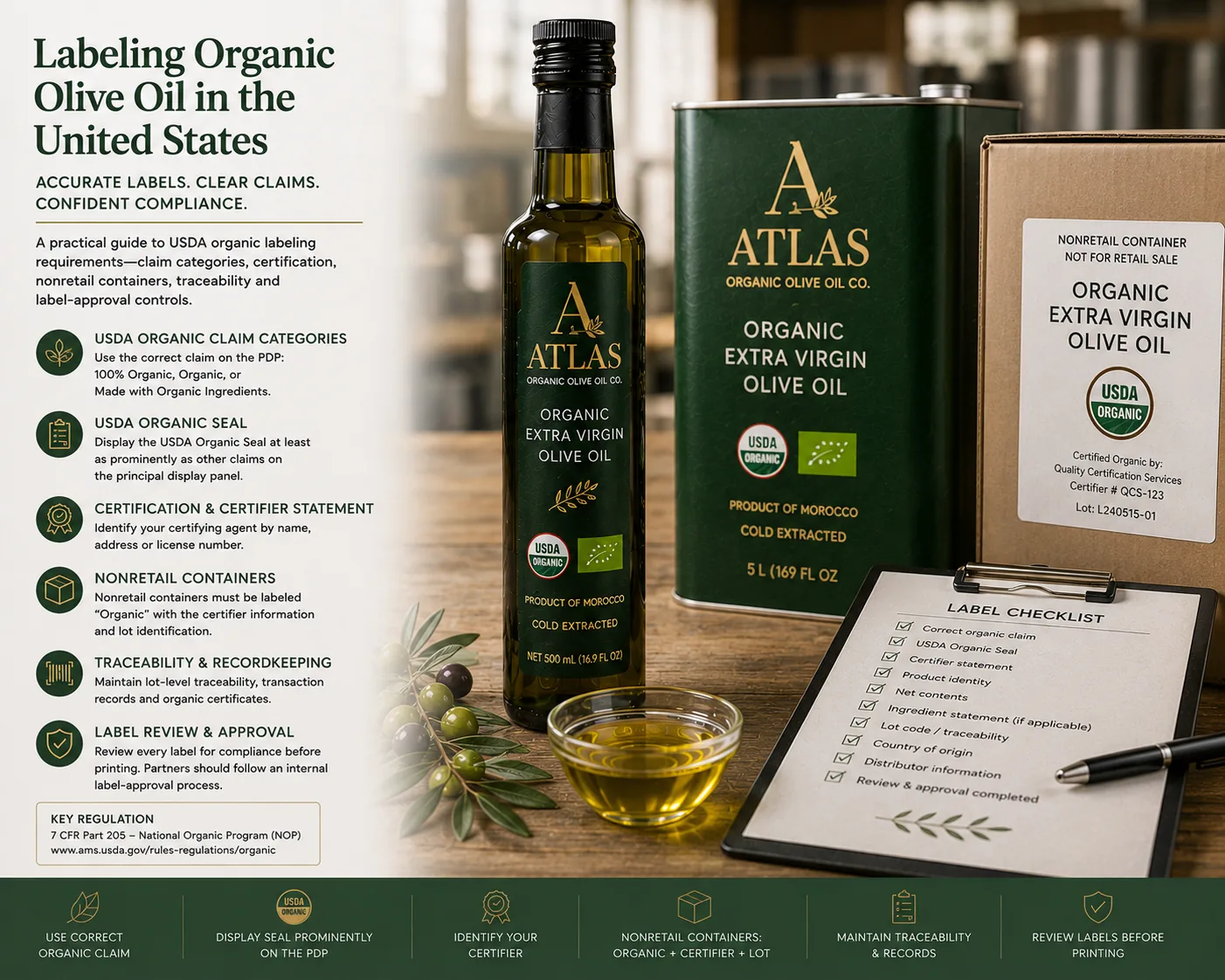
U.S. organic labeling depends on product composition, certification status and container type. USDA organic rules can affect both consumer-facing labels and nonretail containers used to ship or store certified organic agricultural products.
Regulatory status is jurisdiction-specific and can change over time. Use current primary rules and competent certification, regulatory or legal review before printing labels, approving claims or publishing health-related statements. This guide is intended as commercial sourcing guidance rather than legal advice.
The practical objective is to keep three questions aligned: what the product actually is, which organic claim it is eligible to make and what the final label or container communicates. Supplier documentation, certification, artwork and physical lot traceability should all support the same product identity.
1. Start with the decision framework
Before artwork development begins, define the product and commercial pathway. The brief should state whether the item is a single-ingredient olive oil or a multi-ingredient food, the intended organic claim, U.S. destination, retail or nonretail pack format, responsible brand owner, certification structure and required supporting documents.
- Confirm the correct USDA organic labeling category before artwork approval.
- Confirm the required certifier statement and any approved use of organic seals or marks with the responsible certification body.
- For nonretail organic containers, include the required organic identification and information that connects the container to audit-trail documentation.
- Review general U.S. food-label requirements separately because organic certification does not replace broader food-label compliance.
Product composition matters because the organic claim available to a finished product depends on the formulation and applicable certification rules. A single- ingredient certified organic olive oil presents a different review pathway from a flavored oil, dressing or prepared food containing olive oil alongside other ingredients.
Artwork should not be treated as a purely graphic-design step. Organic terminology, ingredient statements, certifier information, seals, net quantity, product identity and other mandatory information should be reviewed together before files are released for printing.
2. Confirm the organic claim category first
The wording used on the package should match the product's actual eligibility under the applicable organic program. Teams should avoid deciding on a marketing phrase first and trying to fit the certification evidence around it later.
For a straightforward certified organic olive oil, the product and certification pathway may be relatively simple. For multi-ingredient products, however, the formulation should be reviewed ingredient by ingredient so the appropriate organic labeling category can be determined before artwork is finalized.
The claim category can influence what wording, seal use, ingredient identification and certifier information belong on the label. Buyers and brand owners should therefore have the certifier or responsible regulatory reviewer confirm the proposed presentation.
3. Match the label to the certification record
A label should reflect the actual certified product and operation. Buyers should confirm the legal entity, certified facility where relevant, product listing, certifier and certification status that support the organic claim.
A supplier certificate by itself may not answer every artwork question. The brand owner should verify that the particular product, pack configuration and labeling presentation are consistent with the certification pathway used for the U.S. market.
Certification changes should be included in change control. A new certifier, legal entity, packing site, formulation or supply route can create a need to review label files even when the front-panel design otherwise appears unchanged.
4. Practical label-approval workflow
A controlled workflow helps keep procurement, quality, certification and design teams aligned. The objective is to approve the claim and evidence before production quantities of packaging are ordered.
- Define the product. Record product identity, formulation, organic status, pack format, U.S. destination, brand owner and intended claim.
- Confirm certification. Review the current certificate, relevant scope, product information and certifier requirements for the intended commercial program.
- Determine the label category. Confirm which organic wording and seal treatment are appropriate for the product.
- Build the artwork checklist. Include organic wording, certifier statement, product identity, net quantity, ingredient information and other applicable label elements.
- Review non-organic requirements separately. Confirm that general food-label obligations are being handled by the responsible regulatory team rather than assumed to be covered by organic certification.
- Submit artwork for required approval. Obtain certification, regulatory, customer or legal approval appropriate to the program before printing.
- Approve the physical proof. Check that the printed or production-ready version matches the approved artwork, including small certifier text, lot areas and mandatory statements.
- Control future changes. Re-review artwork when formulation, certification, pack format, legal entity, claim wording or applicable rules materially change.
5. Review the complete retail label
Organic wording is only one part of a retail olive-oil label. The final package may also need product identity, net quantity, responsible business information, ingredient and nutrition information where applicable, lot coding and other mandatory or program-specific statements.
The organic review should therefore be integrated with the general food-label review rather than handled in isolation. A label can be correct from an organic perspective and still require changes for another labeling requirement.
Font size, placement, contrast and panel location may also matter for mandatory information. Artwork teams should preserve sufficient space for compliance text before visual design becomes locked.
6. Do not overlook nonretail organic containers
Organic labeling controls are not limited to consumer-facing bottles. Bulk containers used to transport or store certified organic agricultural products also require appropriate identification under the applicable organic framework.
For drums, totes, IBCs, tank shipments or other nonretail formats, the container and accompanying records should allow the receiving operation to identify the product as organic and connect it to the relevant audit trail.
Internal warehouse labels and tank assignments should preserve this linkage after receipt. If the buyer assigns a new internal lot number, the supplier lot should remain cross-referenced rather than disappearing from the traceability system.
Repacking and transfer steps can create additional labeling and recordkeeping responsibilities, particularly when the original supplier container is no longer physically present.
7. Connect label claims to lot traceability
A compliant-looking label is not enough if the physical product cannot be linked to the certification and transaction records supporting the claim. Lot traceability should connect purchasing, shipment, receiving, inventory and packing records.
Where one incoming lot becomes several packed lots, the system should preserve parent-child relationships. Where more than one source lot contributes to a packed lot, the records should identify the relevant source material.
This linkage is useful not only for organic audits but also for complaints, recalls, customer documentation and quality investigations.
8. Separate organic compliance from general food labeling
Organic certification answers whether and how the organic claim may be made. It does not replace the broader review of U.S. food-label requirements.
The responsible regulatory team should separately review the statement of identity, net quantity, ingredient declaration where applicable, nutrition labeling, manufacturer or distributor information and other required elements for the specific product.
Olive-oil category terminology should also be used carefully. Product naming should remain consistent with the oil's actual category and supporting quality documentation rather than using organic certification as evidence for category status.
9. Treat nutrition and health claims as a separate review
Marketing claims about nutrition, health or other product benefits should be reviewed independently from organic certification. The fact that an oil is certified organic does not automatically substantiate another label or advertising claim.
Teams should archive the evidence and regulatory basis used for any claim approval, together with the version of the artwork on which the claim appears.
If a claim changes materially, the review should be repeated rather than assuming that a previous approval covers the new wording.
10. Quality controls that belong in the conversation
Organic labeling and olive-oil quality are related commercially but remain separate compliance questions. Extra virgin olive oil is defined through more than free acidity, and buyers should use the applicable category standard, appropriate laboratory methods and, where required, organoleptic assessment.
- Identify the exact destination market and responsible label owner.
- Separate organic, food-label, category and marketing-claim reviews.
- Maintain current certification and lot-specific quality documentation.
- Archive approved artwork and the supporting review record.
- Include label and certification changes in formal change control.
This separation prevents a common misunderstanding: organic certification does not establish that an oil qualifies as extra virgin, and olive-oil category compliance does not establish eligibility for an organic claim.
11. Build a controlled artwork file
The approved label should have a clear version number or other controlled identifier so production, procurement and printers know which file is current.
The approval record can include the artwork version, date, responsible reviewers, certifier approval where applicable and any conditions that must be maintained for the approval to remain valid.
When packaging is received, quality or packaging teams can compare the printed material against the approved master rather than relying on visual memory.
12. Common failure modes
Labeling failures often result from disconnected workflows rather than lack of effort. Marketing, procurement, certification and regulatory teams may each have part of the information while no one verifies the complete final package.
- Using the USDA organic seal when the product is not eligible for that presentation.
- Approving artwork before confirming the applicable organic claim category.
- Treating a foreign certification code as a complete U.S. label solution.
- Omitting required organic identification or audit-trail linkage from nonretail containers.
- Assuming organic approval also confirms general food-label compliance.
- Changing certifier, packer or formulation without reviewing existing artwork.
- Using outdated artwork after certification or regulatory requirements change.
- Allowing the physical lot to become disconnected from the documents supporting the organic claim.
Corrective-action triggers should be based on objective evidence: expired certification, incorrect claim wording, unapproved artwork, missing traceability, inconsistent product identity, printing errors or documented regulatory-review deviations.
The program should also define who has authority to place packaging or product on hold and what approvals are required before use resumes.
13. What to put in the purchase specification
A strong purchasing specification should support both the physical olive oil and the documentation needed for the U.S. organic labeling program.
14. Re-review labels when the program changes
Label approval should not be treated as permanent. Commercial and certification programs evolve, and material changes can affect whether an existing artwork file is still appropriate.
Triggers for re-review can include a new formulation, new certifier, new packing facility, new brand owner, new package size, changed organic claim, revised ingredient declaration or updated regulatory requirement.
A controlled change process reduces the risk that old packaging continues to be ordered after the underlying product or certification structure has changed.
15. Reference framework
For U.S. organic labeling, certification and nonretail-container requirements, use the current USDA National Organic Program rules, official guidance and the requirements of the responsible certifier for the specific product.
General U.S. food labeling should be reviewed separately under the requirements of the responsible U.S. food authority for the specific product and commercial situation.
For olive-oil category definitions, analytical methods and organoleptic assessment, use the current applicable olive-oil standards and destination-market requirements.
Because regulatory requirements and interpretations can change, final artwork should always be reviewed against current primary sources rather than relying on a static web article as the sole basis for approval.
16. Questions to ask a potential organic olive-oil supplier
Supplier qualification should cover the documentation needed to support both the organic claim and the oil's commercial identity. This is especially important for private-label programs where the buyer owns the final artwork.
- Which legal entity and facility support the organic certification for this product?
- Which certifier and certification scope apply to the commercial lot?
- What product information can be supplied for U.S. artwork review?
- How is lot identity maintained through packing and shipment?
- What identification appears on nonretail organic containers?
- Which documents accompany each commercial shipment?
- How are certifier, facility, formulation or supply-route changes communicated?
- Can the supplier support private-label artwork and documentation review before launch?
The objective is a repeatable approval process rather than a one-time label check. Current certification, controlled artwork, traceable lots and defined change notifications make future production and shipment review more consistent.
Next step
Turn this guide into a sourcing and labeling brief by listing the product type, intended organic claim, U.S. destination, retail or nonretail format, annual volume, responsible brand owner, certification structure, launch date and required supporting documents.
Atlas can then compare suitable organic olive-oil programs on the same commercial basis and help align product identity, certification, lot traceability, pack format and supplier documentation with the requirements of your U.S. program.