
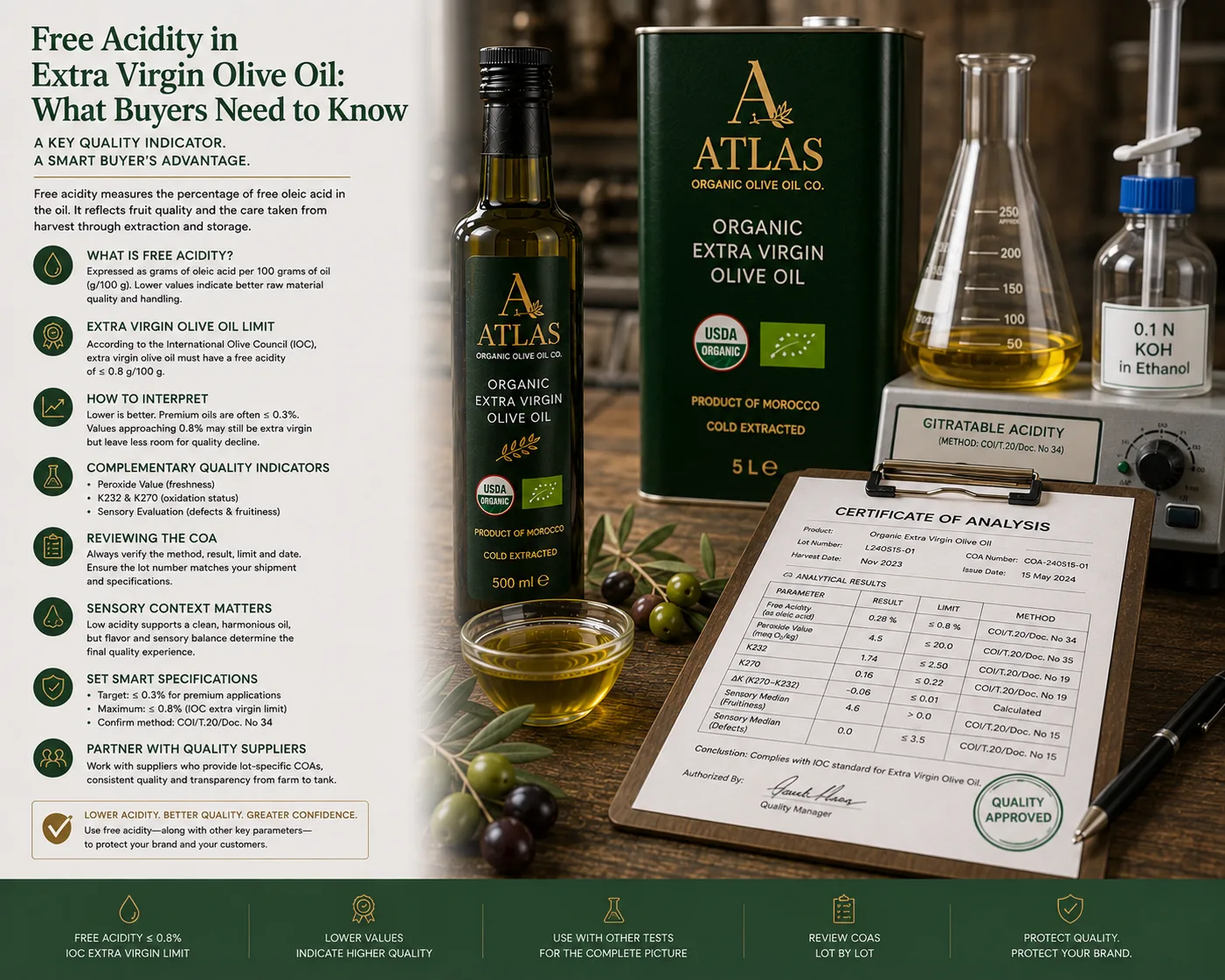
Free acidity measures free fatty acids, expressed as oleic acid, and reflects hydrolytic breakdown of triglycerides. It is not a taste of sourness and it is not the only test of extra-virgin quality.
Analytical numbers are meaningful only in context: lot identity, sampling, method, category standard, sensory condition and storage history. A buyer should therefore read free acidity as one element of the complete quality profile rather than treating it as a universal ranking system for olive oil.
The practical objective is to confirm that a commercial lot meets the required category and buyer specification, then evaluate whether its sensory profile, documentation, packaging and handling are appropriate for the intended food, channel and shelf life.
1. Start with the decision framework
Before comparing supplier samples or certificates of analysis, define the commercial requirement. The brief should state the required olive-oil category, organic status, destination market, annual and trial volumes, pack format, sensory profile, internal analytical targets and required documentation.
- For IOC extra virgin olive oil, the source page identifies free acidity of no more than 0.8 g per 100 g, while destination-market rules and the full category standard also require other criteria.
- Use tighter internal free-acidity targets only when they serve a defined quality, consistency or positioning objective.
- Link the reported free-acidity result to the actual commercial lot being purchased.
- Never translate a low acidity number into medical, nutritional or sensory claims that the measurement itself does not support.
A useful purchasing specification separates the applicable category limit from tighter contractual targets. If a buyer chooses an internal target below the category maximum, that should be described clearly as a commercial requirement rather than as a new definition of extra virgin olive oil.
Specifications should also distinguish between guaranteed release values, internal targets, typical supplier values and reference information associated with a particular origin or harvest.
2. What free acidity actually measures
In olive-oil analysis, free acidity refers to the amount of free fatty acids present in the oil and is commonly expressed as oleic acid. These free fatty acids arise when triglycerides are hydrolyzed.
The result therefore provides useful information about the condition and handling history associated with the oil, but it does not directly describe aroma, bitterness, pungency or fruitiness.
Buyers should avoid the common mistake of interpreting the word “acidity” in the same way they would describe the sour taste of an acidic food or beverage. Free acidity in olive oil is an analytical measurement rather than a sensory perception of sourness.
3. Understand the category limit without oversimplifying it
The source page states that, under the IOC extra-virgin category referenced there, free acidity is no more than 0.8 g per 100 g. That number is important, but it is only one part of the complete category definition.
An oil does not become extra virgin merely because its free acidity is below the applicable maximum. Other chemical criteria and organoleptic requirements also need to be satisfied under the governing standard.
Destination-market rules should always be checked before a buyer turns the category limit into a commercial specification. Current regulatory requirements, methods and terminology should take precedence over values copied from an old COA or historical supplier document.
4. Lower is not automatically “better”
Buyers often encounter commercial claims centered on very low acidity numbers. A low result can be a useful part of the quality profile, but it should not be treated as a complete ranking of oils.
For example, an oil with 0.3% free acidity should not automatically be described as twice as good as an oil with a higher but still compliant result. Category compliance, sensory quality, oxidation-related parameters, authenticity controls, packaging and storage history all matter.
A lower internal target may still be commercially useful if it supports a defined sourcing objective or gives the buyer additional operating margin. The reason for the target should be documented rather than assumed.
5. Practical workflow
A disciplined review process helps prevent buyers from overemphasizing one familiar number. Start with identity and specification, then interpret free acidity alongside the rest of the lot-specific evidence.
- Write a one-page brief. Include category, organic status, destination, sensory profile, pack, volume, internal targets and timing.
- Confirm the commercial lot. Make sure the COA and free-acidity result are tied to the lot being sampled, shipped or received.
- Check the method and test date. Confirm that the analytical result was generated using the appropriate method and is current enough for the commercial decision.
- Review the complete COA. Evaluate free acidity together with peroxide value, UV absorbance and other required category or authenticity parameters.
- Review sensory conformity. Confirm organoleptic requirements where they form part of the commercial category.
- Evaluate the oil in context. Taste candidate oils in the actual product, foodservice or retail application where sensory style matters.
- Trend future lots. Compare successive COAs to identify unusual movement rather than relying only on a pass-or-fail check.
- Define release and change control. Decide who approves new harvests, new lots, analytical changes or material specification revisions.
6. Read free acidity in the COA context
A free-acidity result is commercially useful only if the buyer knows which sample was tested. The certificate should therefore identify the lot, sample, test date, laboratory and analytical method clearly enough to support the release decision.
A low value on an old certificate should not automatically be assumed to describe the current shipment if significant storage, transfer or repacking occurred after testing.
Buyers should also avoid comparing two suppliers solely from one highlighted acidity value when the certificates differ in method, timing, sample basis or the other parameters reported.
7. Review complementary quality parameters
Free acidity provides one kind of information. Other analyses provide different, complementary information about the commercial lot and its conformity with the applicable category standard.
Peroxide value and specific UV absorbance measurements can contribute information related to oxidation and other chemical changes, while additional authenticity or purity parameters may be required by the governing standard or buyer program.
These values should be evaluated as a group rather than used to replace one another. A compliant free-acidity result cannot cancel a nonconforming result elsewhere in the required analytical profile.
8. Keep analytical acidity separate from sensory quality
Consumers do not taste a laboratory free-acidity percentage directly. Sensory evaluation addresses a different part of the product's quality profile.
Where required, organoleptic assessment is part of category conformity and can identify sensory defects that chemical numbers alone do not describe.
Commercial buyers may also define a preferred range for fruitiness, bitterness and pungency so the oil fits the intended brand or formulation even when several candidate lots all meet the analytical category limits.
9. Sampling affects the value of the result
The laboratory measures the submitted sample, so the buyer should understand how that sample relates to the commercial lot. This is especially important for bulk tanks, tankers, flexitanks or other large-volume programs.
Lot identification, sample date and sampling location should be documented where the purchasing decision warrants it. A poorly identified sample can make even an accurate laboratory result less useful.
Retained samples can support later comparison if buyer and supplier laboratories report different values or if quality changes during downstream storage.
10. Quality controls that belong in the conversation
Extra virgin olive oil is defined through more than free acidity. Buyers should use the current applicable category standard, appropriate laboratory methods and, where required, organoleptic assessment.
- Link every analytical result to the actual shipped or stored lot.
- Use recognized current methods and laboratories appropriate to the decision.
- Trend multiple quality indicators rather than relying on one number.
- Keep analytical and sensory requirements distinct but connected.
- Maintain retained samples where commercially justified.
- Separate category limits from tighter buyer-specific internal targets.
Organic certification should also remain separate from the olive-oil category decision. An oil can be organically certified without that certification alone proving extra-virgin status, and extra-virgin analytical conformity does not by itself establish organic status.
11. Storage history still matters after the test
A laboratory result describes a sample at a particular point in time. Downstream heat, light, oxygen exposure and extended storage can alter the quality profile after the certificate is issued.
Buyers should therefore consider the interval between testing and shipment, especially when the COA is historical or the oil has undergone additional bulk storage or transfer.
Good storage practices protect the overall quality of the oil, but they should not be presented as a way to improve a nonconforming incoming lot.
12. Use tighter internal targets deliberately
Some buyers choose free-acidity targets below the applicable category maximum. This can be a reasonable commercial decision when the tighter limit supports supplier consistency, positioning or internal quality strategy.
The target should nevertheless be practical for the supply program and supported by a clear reason. An unnecessarily aggressive specification can reduce sourcing flexibility without producing a meaningful advantage in the finished product.
Internal targets should also be reviewed alongside other analytical and sensory criteria so procurement teams do not optimize one number at the expense of the complete quality profile.
13. Trend results instead of looking only at pass or fail
Successive certificates can reveal changes in supplier consistency, harvest profile or storage history even when every individual result still passes the formal specification.
A sudden movement in free acidity should be reviewed with the other analytical values, sample history and production context. The purpose of trending is to identify unusual change, not to reject normal agricultural variation.
Method and laboratory consistency matter when trends are compared. If either changes, the event should be documented so it is not mistaken for a real shift in the oil.
14. Common failure modes
Most free-acidity mistakes result from giving one familiar number more meaning than the analytical method actually supports.
- Calling 0.3% or another low value a universal definition of extra virgin.
- Equating analytical free acidity with sour flavor.
- Ignoring peroxide, UV, authenticity and sensory results.
- Comparing different supplier COAs without checking methods and test dates.
- Accepting an acidity result that cannot be linked to the shipped lot.
- Treating a historical certificate as proof of current storage condition.
- Turning a low analytical number into unsupported nutritional or health claims.
- Setting extremely tight internal targets without a defined commercial purpose.
Corrective-action triggers should be based on objective evidence: out-of-specification results, sensory defects, broken traceability, conflicting laboratory findings, unusual trends, temperature excursions or documented sampling and handling deviations.
The quality system should also define who places a lot on hold, when repeat sampling or independent testing is appropriate and what evidence is required before final release.
15. What to put in the purchase specification
A practical specification should place free acidity inside the complete commercial quality framework rather than presenting it as a stand-alone definition of the oil.
16. Questions to ask a potential olive-oil supplier
Supplier qualification should cover the system behind the acidity result as well as the numerical value printed on the COA.
- Is free acidity reported on every commercial lot certificate of analysis?
- Which analytical method and laboratory are used?
- How is the tested sample linked to the production or shipment lot?
- Which complementary category and authenticity parameters are routinely reported?
- Is sensory conformity documented where required by the category?
- Are retained samples maintained for shipped lots?
- How are unusual or conflicting analytical results investigated?
- How are method, harvest, origin or specification changes communicated?
The objective is a repeatable quality-control program rather than a single low-acidity marketing number. Lot-specific analysis, sensory evidence, traceability and consistent methods make future shipments easier to evaluate.
17. Reference framework
For olive-oil category definitions, free-acidity requirements, analytical methods and organoleptic assessment, use the current International Olive Council trade standard and methods together with applicable destination-market requirements.
Buyers should confirm the current rules that apply to the commercial destination before approving specification limits. Historical certificates, marketing claims or old internal documents should not be treated as substitutes for the current governing framework.
Next step
Turn this guide into a sourcing and analytical brief by listing your required olive-oil category, destination market, application, annual volume, pack format, free-acidity target, complementary analytical requirements, sensory profile and organic documentation needs.
Atlas can then compare suitable organic extra virgin olive-oil programs on the same commercial basis and help align lot-specific certificates of analysis, sensory style, traceability, packaging and supplier documentation with your quality-control requirements.