
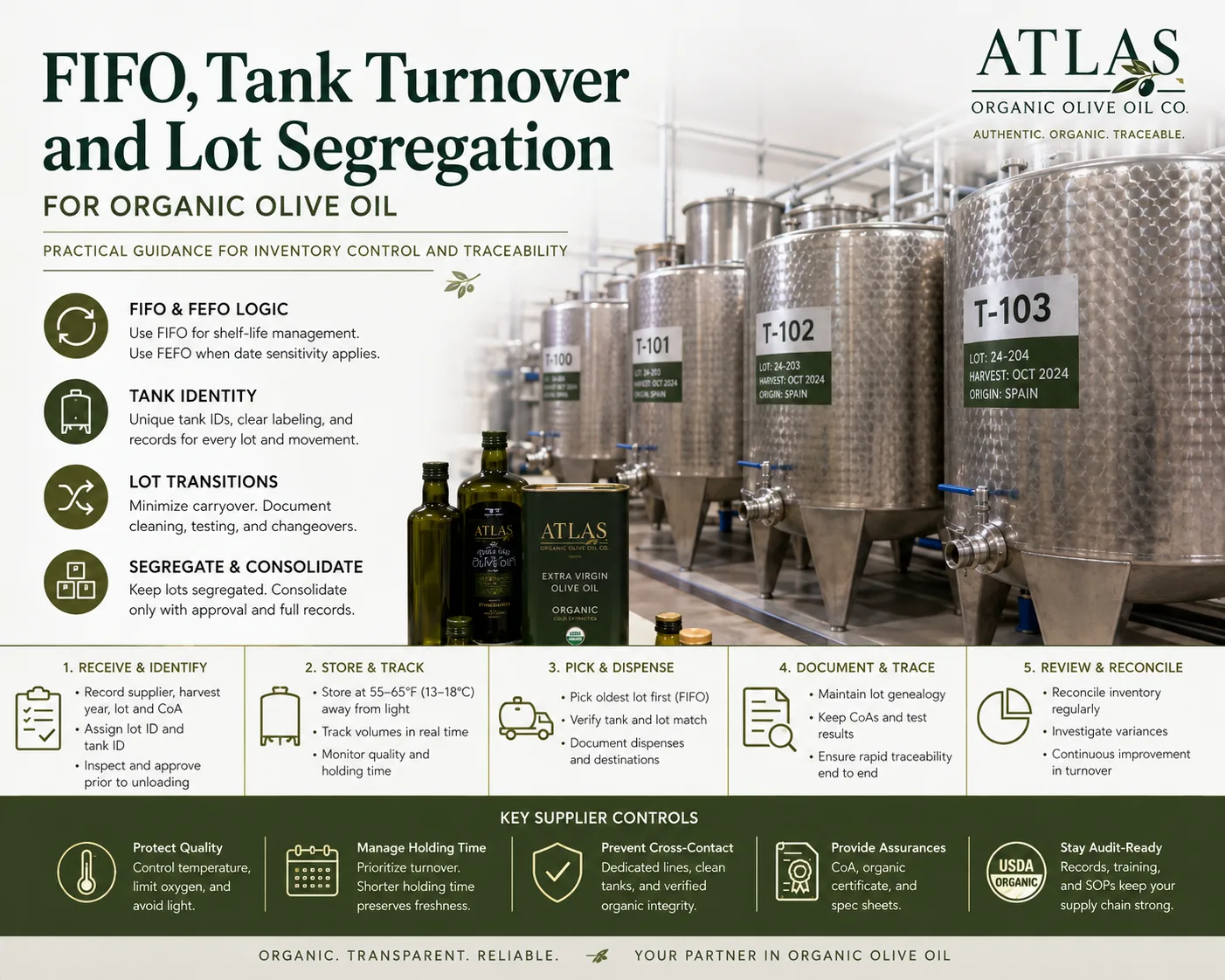
Inventory discipline is a direct olive-oil quality control. First-in, first-out or first-expired, first-out logic, clear tank identity and deliberate lot transitions prevent old oil from being hidden inside new receipts.
Inventory design is a quality control. Slow turnover, uncontrolled consolidation, unclear tank status and poor lot visibility can age oil, complicate release decisions or break traceability. A premium incoming lot does not remain premium indefinitely simply because newer receipts are added around it.
The practical objective is to make the age, identity and release status of every meaningful quantity of oil visible enough that procurement, warehouse, quality and production teams can make the same inventory decision from the same records.
1. Start with the decision framework
Before building inventory rules, define the physical storage and commercial flow. The brief should state annual volume, receipt frequency, tank capacities, typical drawdown, expected holding time, pack format, organic requirements, sensory targets, quality-release criteria and the inventory system used by the facility.
- Assign tank, lot and release status visibly in ERP and on physical equipment.
- Do not combine lots unintentionally; define who can authorize consolidation and how parent-child traceability is preserved.
- Set maximum holding and open-tank targets based on real turnover and quality data.
- Reconcile physical inventory against lot records often enough to detect unexplained differences before they become embedded in production history.
The system should also define what “available inventory” means. Material can be physically present but still be on quality hold, awaiting documentation, reserved for a specific customer or restricted because of organic, origin or sensory requirements.
A useful purchase and storage specification separates category requirements from inventory-management rules. The supplier controls the identity and quality of the delivered lot; the receiving operation controls how that lot is stored, rotated, transferred and consumed after receipt.
2. Choose FIFO or FEFO deliberately
FIFO—first in, first out—prioritizes the oldest received inventory. It is often straightforward where lots have comparable commercial life and the primary goal is to avoid newer receipts being used ahead of older stock.
FEFO—first expired, first out—prioritizes the lot with the earliest applicable expiry, best-before or other approved commercial use priority. It can be useful where different lots enter the system with different remaining shelf-life windows.
The important control is not the acronym itself. The facility should define which rule governs the inventory, what dates or status fields drive that rule and who can override it.
Any override should be deliberate. A customer-specific sensory requirement, certification status or pack program may justify using a newer lot first, but the decision should not allow older stock to become invisible.
3. Make tank status physically visible
ERP data are valuable, but operators also need clear information at the tank. Tank number, product identity, lot or parent lots, organic status and operational status should be identifiable under the site's approved system.
Useful status distinctions may include released, on hold, empty, awaiting cleaning, cleaning complete, reserved, blocked or under investigation.
Physical status and electronic status should agree. A tank shown as available in the inventory system but marked on hold at the equipment creates unnecessary risk during transfer or production scheduling.
4. Design tank size around real turnover
A large tank can provide operational efficiency, but it can also create slow inventory movement if receipts and consumption are not balanced. Tank capacity should therefore be evaluated against actual weekly or monthly drawdown.
If the tank regularly remains partially filled for long periods, the operation should consider both inventory age and quality-management consequences, including prolonged storage and changing headspace.
Smaller or multiple tanks may sometimes provide better lot segregation and turnover control, while higher-volume plants may benefit from larger tanks that cycle quickly. The appropriate configuration depends on the actual program.
5. Define how one lot becomes the next
Lot transition is one of the most important moments in bulk inventory control. The facility should know whether the old lot must be fully emptied before the new lot enters, whether controlled consolidation is allowed or whether a defined residual quantity can remain.
If residual oil is allowed to remain, the resulting tank identity should reflect the actual parent lots rather than automatically taking only the newest supplier lot number.
Where customer, origin, sensory or organic requirements make mixing unacceptable, the transition procedure may require complete segregation and appropriate line or tank clearance before the new lot is introduced.
6. Control consolidation and tank topping
Repeatedly topping a tank with new deliveries can create an inventory system in which the oldest oil is never fully consumed and the analytical history becomes difficult to interpret.
Consolidation should therefore be an authorized inventory action rather than an informal operating habit. The facility should define who can approve it, which lots may be combined and how the resulting lot is identified.
Before combining lots, teams may need to review category, organic status, origin, sensory profile, analytical status, customer restrictions and any other program-specific compatibility requirements.
The resulting consolidated lot should retain traceability to all contributing parent lots and the quantities involved.
7. Practical workflow
Move from receiving to consumption through a controlled inventory sequence. The goal is to maintain lot identity while making age, quality and availability visible throughout storage.
- Write a one-page inventory brief. Include category, organic status, receipt frequency, tank capacity, expected turnover, pack or production use, destination and quality requirements.
- Assign the incoming lot. Match supplier lot, internal lot, receiving documents and intended tank location.
- Set the initial status. Record whether the lot is released, on hold or awaiting quality or document review.
- Update tank records after transfer. Record quantity, parent lot, receiving tank and any new internal lot identity.
- Apply FIFO or FEFO logic. Use the facility's approved inventory rule when allocating oil to production or packing.
- Monitor holding time. Review tank age, inventory age and open-tank duration against internal targets.
- Reconcile physical and electronic inventory. Investigate meaningful discrepancies rather than carrying them forward indefinitely.
- Control lot transitions. Define whether the tank is emptied, consolidated or reassigned before the next receipt.
8. Define maximum holding-time targets
Olive oil does not become fresher through storage. Internal holding-time targets can therefore help teams identify inventory that is aging beyond the commercial assumptions used when it was purchased.
The appropriate target depends on incoming quality, tank conditions, package format, intended use and downstream shelf-life requirements. It should be based on the real program rather than copied from an unrelated operation.
A holding-time target can function as an investigation trigger rather than an automatic rejection point. Older material may require quality review, sensory comparison or additional approval before use.
9. Track open-tank and partial-tank age
The age of the supplier lot is only one useful measure. Facilities can also track how long oil has remained in a particular tank, especially where repeated withdrawals leave the tank partly filled.
Open-tank or partial-tank age can help quality and operations teams identify slow-moving material that may otherwise appear acceptable simply because the original lot is still within its broader commercial life.
When tanks are repeatedly topped, this metric becomes harder to interpret, which is another reason controlled consolidation and clear parent-lot records matter.
10. Protect organic and origin identity during storage
Organic status should remain visible through tank assignment, inventory records and transfers. Mixing organic and non-organic oils unintentionally can create a serious certification and traceability problem even if the oils are otherwise chemically compatible.
Origin or customer-specific identity can require similar controls. A tank released for one sourcing program should not automatically be treated as interchangeable with another simply because both products are extra virgin olive oil.
If consolidation is permitted, the resulting identity and labeling eligibility should remain consistent with the documented source lots and applicable program rules.
11. Reconcile physical tank volume to lot records
Inventory records should reasonably match the physical quantity in the tank. Normal measurement tolerance and process losses may exist, but unexplained discrepancies should not simply accumulate from month to month.
Reconciliation can compare receipts, transfers, production usage, packing output, samples, known losses and closing inventory. The level of precision should fit the facility's measurement system and commercial risk.
Quantity reconciliation supports both financial inventory control and organic or lot-traceability review because it helps demonstrate that documented movements correspond to a plausible physical product flow.
12. Quality controls that belong in the conversation
Extra virgin olive oil is defined through more than inventory age or free acidity. Buyers should use the current applicable category standard, appropriate laboratory methods and, where required, organoleptic assessment.
- Use FIFO or FEFO rules supported by clear ERP status.
- Define consolidation and tank-topping authorization.
- Reconcile physical tank volume to lot records.
- Set practical holding-time and open-tank targets.
- Preserve organic, origin and customer-specific identity through transfers.
- Link analytical and sensory documents to the lot actually stored or consumed.
For storage and distribution, protect oil from direct light, unnecessary heat and repeated oxygen exposure. Good inventory rotation supports quality, but it does not replace proper tank and transfer management.
13. Common failure modes
Inventory problems often develop gradually. The immediate operation may appear efficient while older material, unclear parent lots or unreconciled balances accumulate in the background.
- Topping tanks indefinitely without lot reconciliation.
- Losing organic or origin identity during consolidation.
- Letting slow-moving stock age behind newer receipts.
- Showing one tank status in ERP and another on physical equipment.
- Using a new supplier lot number for a tank that still contains older residual oil.
- Combining lots without reviewing sensory or customer-specific compatibility.
- Allowing unexplained inventory discrepancies to carry forward indefinitely.
- Reordering new inventory while older usable stock remains hidden in another tank.
Corrective-action triggers should be based on objective evidence: broken traceability, unexpected age, physical-to-system inventory differences, out-of-specification results, sensory defects, organic-identity concerns or documented unauthorized consolidation.
The quality system should also define who can block a tank, who investigates the deviation and what review is required before the material returns to normal use.
14. What to put in the purchase specification
A useful purchasing specification should support downstream inventory control by giving the receiving operation enough lot, date and quality information to manage the oil after delivery.
15. Questions to ask a potential olive-oil supplier
Supplier discussions should support the buyer's inventory system as well as the incoming quality specification. Predictable lot coding, shipment documentation and change communication make downstream tank management easier.
- How is each commercial shipment lot identified?
- Which production, tank or harvest references are available to the buyer?
- Which analytical and organic documents accompany each lot?
- Can delivery frequency be aligned with the buyer's real tank turnover?
- How are split shipments or consolidated supplier lots documented?
- Are retained samples maintained for commercial lots?
- How are harvest, origin or specification changes communicated?
- Can shipment planning help avoid excessive inventory age at the receiving site?
The objective is a repeatable inventory and sourcing program rather than simply maintaining full tanks. Clear lot identity, appropriate delivery frequency and disciplined transitions help protect quality and traceability at the same time.
16. Reference framework
Inventory procedures should be based on the receiving site's actual tank system, quality program, organic controls and commercial shelf-life requirements. FIFO or FEFO rules should be documented and supported by reliable lot and status data.
For olive-oil category definitions, analytical methods and organoleptic assessment, use the current International Olive Council trade standard and methods together with applicable destination-market requirements.
Organic inventory management should preserve the traceability and identity required by the applicable certification program through receiving, storage, transfer, consolidation and packing.
Next step
Turn this guide into an inventory and sourcing brief by listing your annual volume, receipt frequency, tank capacities, expected turnover, FIFO or FEFO logic, consolidation policy, destination, quality specification and organic documentation requirements.
Atlas can then compare suitable organic extra virgin olive-oil programs on the same commercial basis and help align shipment size, delivery frequency, lot documentation, sensory requirements and supply planning with your tank-turnover and inventory-control system.