
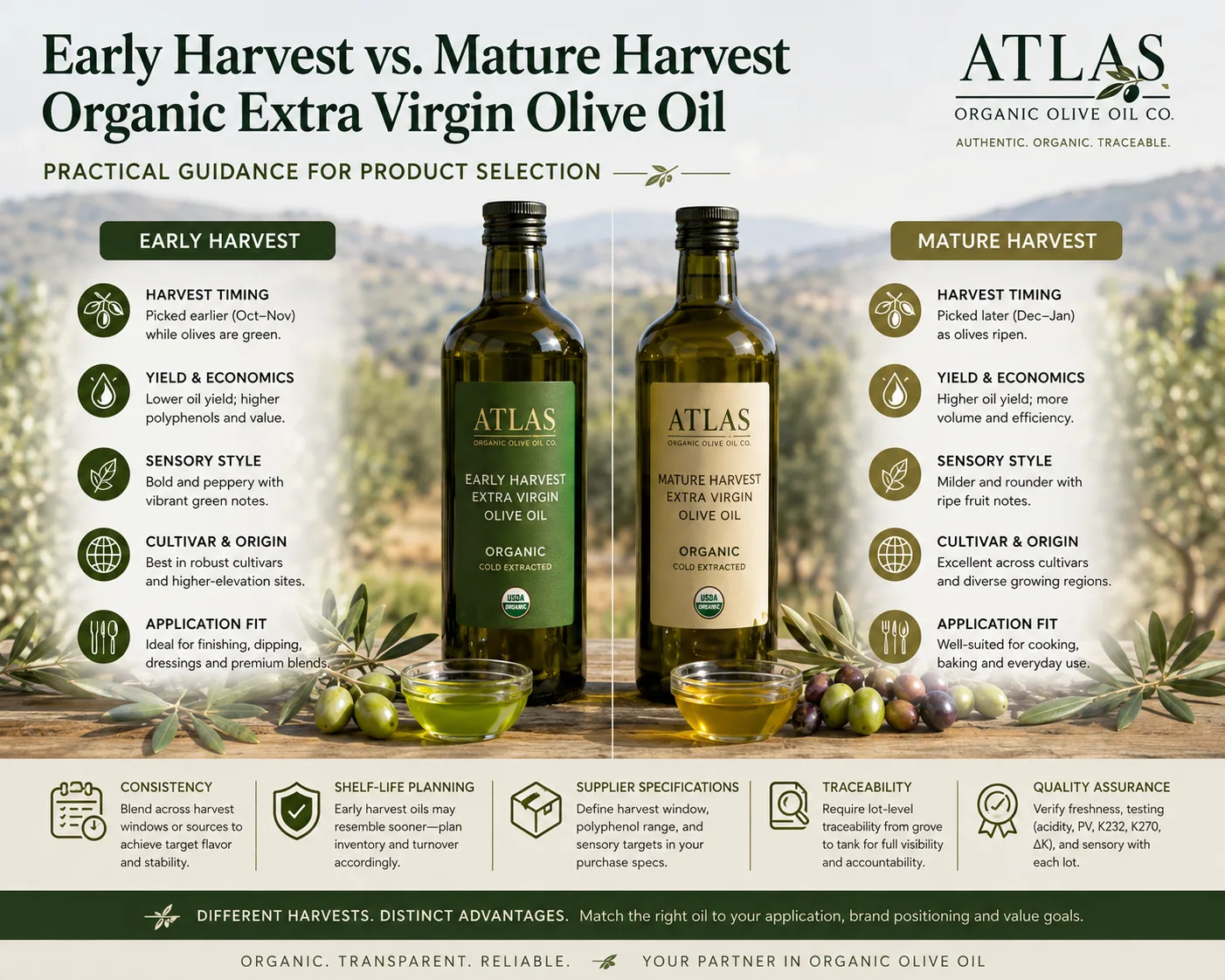
Harvest maturity changes yield economics and often sensory style. Earlier green fruit commonly gives lower oil yield and more robust green character, while later fruit can give more oil and a rounder profile.
Product style is a trade-off among sensory target, yield economics, cultivar, origin, shelf-life plan, channel and turnover—not a simple hierarchy. A brand seeking assertive green notes may prefer an earlier-harvest style, while a broad foodservice or formulation program may value a rounder, more versatile profile.
The practical objective is not to find an abstract “best” harvest stage. It is to define the oil style, quality specification and supply program that remain fit for the intended food, channel, sensory target and commercial economics.
1. Start with the decision framework
Before requesting samples, define the commercial job the oil must perform. The brief should state the finished-product or service application, target market, annual and trial volumes, expected pack format, sensory role, preferred harvest style, origin requirements, storage conditions and required organic documentation.
- Choose maturity based on desired flavor and commercial economics, not prestige alone.
- Evaluate cultivar and origin because harvest stage does not create identical profiles everywhere.
- Plan supply around harvest timing and lot transitions if the brand promises a consistent sensory target.
- Compare yield economics together with finished-product value rather than focusing only on oil cost per kilogram or liter.
If the olive oil will be named prominently on the label or used as a defining flavor ingredient, the sensory target deserves even more attention. A harvest style that works well for dipping or finishing may not be the best fit for a delicate sauce, bakery product or broad-menu foodservice application.
A useful specification separates the legal or category baseline from tighter internal targets. It should also distinguish guaranteed lot-release values from typical harvest characteristics or reference information.
2. What harvest maturity changes
Olives continue to change as they mature. The relationship among fruit maturity, extractable oil, aroma, bitterness, pungency and overall flavor profile can shift over the harvest window.
Earlier fruit is commonly associated with lower oil yield and a greener, more robust sensory style. Later fruit can provide greater oil yield and may produce a softer or rounder profile.
These are useful sourcing tendencies rather than guarantees. Cultivar, climate, fruit condition, processing and storage can all influence the actual commercial oil.
3. When an early-harvest style can fit
Earlier-harvest oils can be attractive when the buyer wants a prominent green aromatic profile, noticeable bitterness or pungency, or a seasonal premium presentation centered on fresh harvest character.
These styles may work particularly well where olive oil is visible to the consumer—such as dipping oils, finishing applications, premium retail programs or formulations where a clear olive-oil signature is intentional.
The commercial trade-off is that earlier fruit may yield less oil, which can affect raw-material economics. Buyers should evaluate whether the sensory benefit creates sufficient value in the actual finished product.
4. When a more mature-harvest style can fit
More mature fruit can offer higher oil yield and a rounder sensory style, depending on cultivar and growing conditions. This can be useful where the application benefits from a softer profile or where olive oil should support rather than dominate other ingredients.
Foodservice, sauces, bakery, prepared foods and other multi-ingredient applications may sometimes favor this kind of versatility, although the preferred profile should still be confirmed by actual product testing.
A more mature harvest should not be treated as a lower-quality category by definition. The actual oil still needs to meet the full applicable extra-virgin requirements and the buyer's sensory specification.
5. Cultivar and origin change the comparison
Harvest maturity does not operate independently of cultivar. Different olive varieties can develop distinct aroma, bitterness, pungency and yield characteristics even when harvested at a broadly similar maturity stage.
Climate, soil, irrigation, crop load and seasonal conditions can also influence the pace of fruit development. An “early harvest” from one origin is therefore not automatically sensory-equivalent to an “early harvest” from another.
Buyers should taste the actual supplier lots and use harvest terminology as a sourcing descriptor rather than as a substitute for sensory evaluation.
6. Evaluate yield economics in the finished product
Lower oil yield can increase the raw-material cost of an early-harvest program, but the correct commercial question is whether that cost produces value in the final product or brand proposition.
A premium retail bottle where harvest character is central to the offer can have a different economic logic from a high-volume ingredient program where the oil is one component of a larger formulation.
Buyers should therefore compare cost per finished unit, portion or recipe rather than relying only on the supplier's price per liter.
7. Practical workflow
Move from sample selection to commercial approval in controlled stages. First, define the target style. Second, compare representative harvest lots. Third, test them in the real application. Finally, build receiving and change-control rules for future harvest transitions.
- Write a one-page brief. Include category, organic status, preferred harvest style, cultivar or origin requirements if relevant, sensory profile, pack, volume, destination and timing.
- Sample side by side. Compare candidate lots for fruitiness, bitterness, pungency, aroma style and overall balance.
- Evaluate in context. Test oils in the actual finished food, retail proposition or foodservice use.
- Review documents. Confirm lot identity, analytical results, organic status, harvest or origin information, traceability and required market documents.
- Review economics. Compare purchase price, expected yield implications, dosage and finished-product value.
- Pilot the commercial system. Use the actual package, storage and distribution plan rather than relying only on a tasting-room decision.
- Plan harvest transition. Define how the next crop year will be sampled and approved before old inventory is exhausted.
- Define release and change control. Decide who approves a new harvest, new origin, new cultivar blend or material sensory shift.
8. Define the sensory target more precisely
“Early” and “mature” are not precise sensory specifications. Buyers should translate those broad descriptors into an acceptable range for fruitiness, bitterness, pungency and overall intensity.
The sensory target can also include qualitative direction such as green, herbaceous, ripe-fruit, mild, robust or balanced, provided the supplier and buyer evaluate those terms against actual approved samples.
A retained reference sample or documented tasting profile can make crop-year transitions easier because future lots can be compared against a known commercial target.
9. Match harvest style to the application
The right oil should be selected in the finished use case. A robust oil can add useful character in dipping, finishing, vegetables, grains or Mediterranean-style foods but may overwhelm delicate flavors if the formulation does not call for it.
A rounder profile may offer greater versatility in sauces, bakery, prepared foods or foodservice applications where olive oil contributes quality without becoming the dominant flavor.
The same buyer may therefore source different sensory profiles for different product lines rather than forcing one harvest style across every application.
10. Plan for crop-year consistency
Olive oil is an agricultural product, so exact sensory repetition from one harvest to the next should not be assumed. Crop conditions, fruit maturity and available blending components can change.
Buyers who need a stable brand profile should define an acceptable sensory range rather than a single idealized tasting note. This gives the supplier enough room to manage normal harvest variation while protecting the intended brand character.
New-harvest approval should occur early enough that procurement has time to compare lots, adjust blends where applicable and avoid emergency acceptance when old stock is nearly exhausted.
11. Preserve the selected style after purchase
Harvest selection has limited value if the oil is poorly stored. Both early- and mature-harvest styles should be protected from direct light, unnecessary heat and repeated oxygen exposure.
Packaging and inventory turnover should fit the channel. A highly expressive early-harvest oil held in warm, slow-moving distribution can lose the sensory characteristics the buyer paid to obtain.
Storage conditions and age should therefore be considered part of the product-style strategy rather than treated as unrelated logistics details.
12. Quality controls that belong in the conversation
Extra virgin olive oil is defined through more than harvest maturity or free acidity. Buyers should use the current applicable category standard, appropriate laboratory methods and, where required, organoleptic assessment.
- Taste candidate lots against the finished use case.
- Define an acceptable sensory range rather than relying only on “early” or “mature.”
- Link harvest and origin information to the actual commercial lot.
- Review analytical and sensory evidence together.
- Align selection with distribution length, storage and pack turnover.
- Include new-harvest transitions in formal change control.
Organic certification should also remain a separate requirement. Organic status, extra-virgin category and harvest maturity are connected commercially but each needs its own supporting evidence.
13. Common failure modes
Most problems arise when harvest language is turned into a prestige claim instead of being managed as one variable in a complete sourcing program.
- Assuming early harvest always means better quality.
- Ignoring the cost impact of lower oil yield.
- Writing sensory claims without tasting the actual commercial lot.
- Assuming the same harvest stage produces identical flavor across cultivars and origins.
- Buying a robust oil for an application that needs a restrained profile.
- Allowing crop-year transitions to occur without buyer reapproval.
- Treating harvest maturity as a substitute for analytical or sensory category compliance.
- Paying for a premium sensory style without protecting it through storage and distribution.
Corrective-action triggers should be based on objective evidence: unexpected sensory change, out-of-specification analytical results, incorrect harvest or origin information, broken traceability, storage deviations or unapproved crop-year transitions.
The quality program should also define who places a lot on hold, who conducts the sensory review and what evidence is required before a new harvest or source is approved.
14. What to put in the purchase specification
A practical purchase specification should convert broad harvest language into measurable and reviewable commercial requirements.
15. Questions to ask a potential olive-oil supplier
Supplier discussions should focus on the repeatability of the desired sensory and commercial profile rather than relying only on broad harvest terminology.
- How does the supplier define early, intermediate and mature harvest for the program?
- Which cultivars and origins contribute to the available sensory profiles?
- How does harvest timing typically affect yield and pricing in the offered program?
- Which sensory profiles can be supplied consistently from crop year to crop year?
- Which analytical and organic documents accompany each lot?
- Are retained samples available for new-harvest comparison?
- How early can new-crop samples be supplied for buyer approval?
- How are harvest, cultivar, origin or specification changes communicated?
The objective is a repeatable sourcing program rather than a one-time preference for early or mature fruit. Clear sensory targets, lot-specific documentation and planned crop-year transitions make future supply more predictable.
16. Reference framework
For olive-oil category definitions, analytical methods and organoleptic assessment, use the current International Olive Council trade standard and methods together with applicable destination-market requirements.
Harvest-maturity language should be treated as a sourcing and product-style descriptor. Commercial quality should still be confirmed through the actual lot's analytical results, sensory condition, traceability and suitability for the intended use.
Next step
Turn this guide into a sourcing brief by listing your required olive-oil category, preferred harvest style, desired sensory profile, cultivar or origin preferences, annual volume, destination, pack format, target price range and organic documentation needs.
Atlas can then compare suitable organic extra virgin olive-oil programs on the same commercial basis and help align harvest style, sensory profile, origin, packaging, traceability and supply planning with your product strategy.