
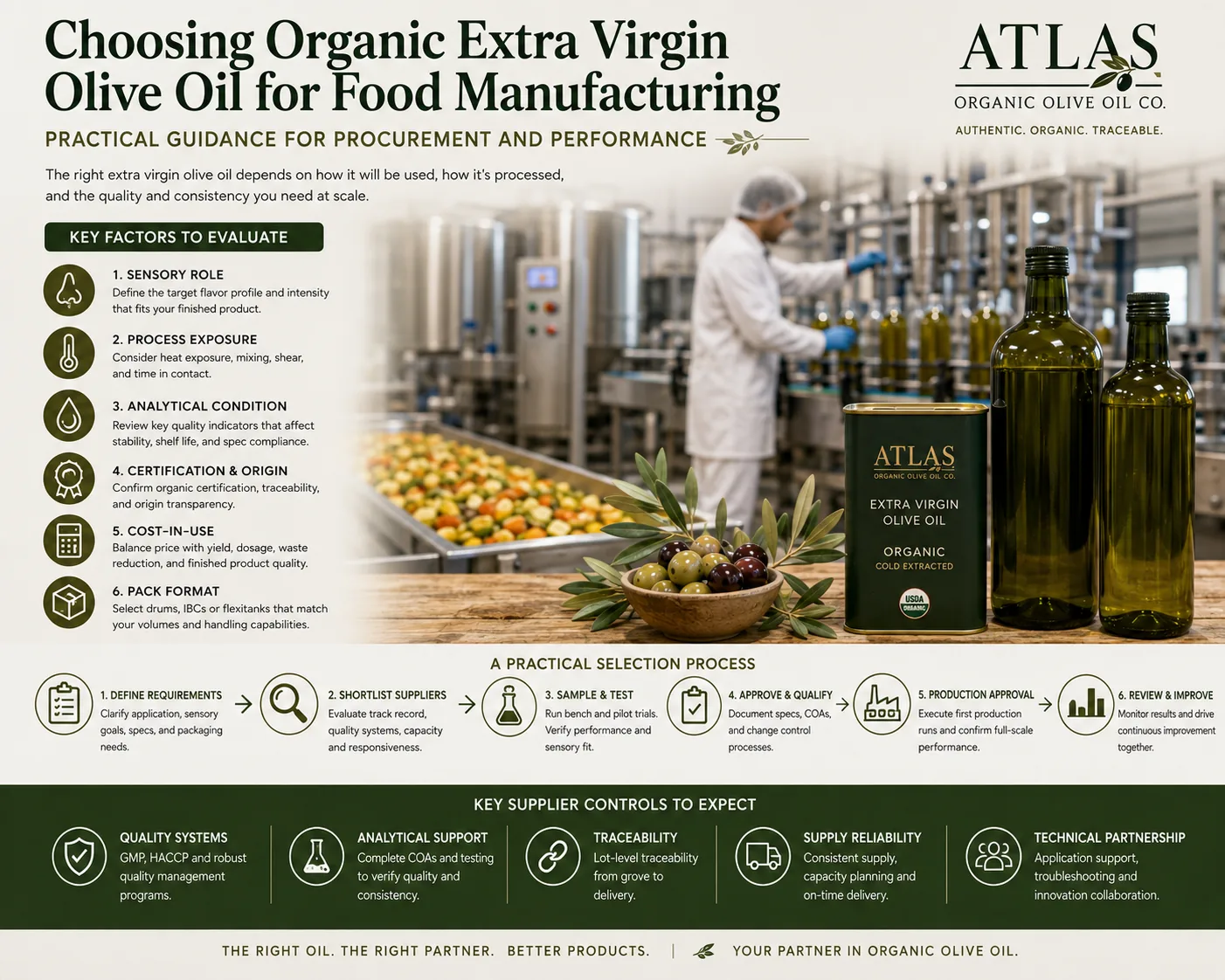
The best manufacturing oil is not necessarily the most aggressive tasting or the lowest-acidity lot. It is the oil whose sensory profile, analytical condition, certification, pack format and cost-in-use match the finished food.
Procurement translates desired quality into a repeatable supply system. Specification, supplier qualification, forecast, documentation, logistics, receiving checks and dispute rules should be decided before scale-up rather than added after the product has already entered commercial production.
The practical objective is not to find an abstract “best” oil. It is to define an olive-oil program that performs the required job in the recipe, remains suitable through the actual manufacturing process and can be sourced, received, stored and released consistently over time.
1. Start with the decision framework
Before requesting samples, write down the commercial job the oil must perform. The brief should state the finished product, target market, annual and trial volumes, inclusion rate where relevant, expected pack format, sensory role, process exposure, storage conditions, shelf-life objective and required organic documentation.
- Write the oil's job in the recipe: flavor carrier, finishing note, fat phase, processing ingredient or brand-signaling component.
- Set sensory acceptance in terms your panel can repeat: green or ripe fruitiness, bitterness, pungency and any attributes that would conflict with the finished food.
- Approve a realistic incoming specification and retained-sample process so harvest-to-harvest changes are managed rather than discovered in production.
- Define pack size and shipment frequency around real consumption, storage capacity and inventory turnover.
If olive oil is named prominently on the product label or forms part of a premium positioning strategy, sensory consistency may need tighter control. If it is primarily a functional fat phase, process compatibility and cost-in-use may carry more weight than an especially assertive tasting profile.
A useful specification separates the applicable category requirements from tighter internal targets. It should also make clear which values are guaranteed at lot release, which are commercial targets and which are only typical information associated with a harvest, cultivar or origin.
2. Define what the oil actually does in the product
The first sourcing question should be functional rather than descriptive. Different manufacturing applications ask olive oil to perform different jobs, and the most suitable sensory profile can change accordingly.
In a dressing or dipping product, olive oil may be a major flavor carrier. In bakery, prepared foods or sauces, it may contribute mouthfeel and fat-phase functionality while remaining less dominant aromatically.
In a premium branded product, the ingredient can also carry marketing value. That may justify tighter origin, organic, sensory or harvest specifications than a formulation where the oil is not consumer-facing.
Writing the intended role clearly helps prevent procurement teams from paying for attributes that disappear in the finished food or, conversely, choosing an oil so mild that it fails to deliver the intended product identity.
3. Build a repeatable sensory target
“Good olive oil” is not a sufficiently precise manufacturing specification. Buyers should define the sensory range that works with the formula and can be repeated by a trained internal or supplier panel.
Useful descriptors can include fruitiness intensity, green or ripe character, bitterness, pungency and any aroma attributes that should be avoided because they conflict with herbs, spices, dairy notes, vegetables, bakery flavors or other ingredients.
The approved target should allow normal agricultural variation while protecting the intended finished-product profile. A narrow sensory specification that cannot be maintained across harvests can create unnecessary supply disruption.
Retained samples or agreed sensory references can make future lot and harvest comparisons more objective.
4. Evaluate the oil in the finished food
Tasting olive oil neat is useful for identifying defects and understanding style, but it does not show the complete manufacturing result.
Acids, herbs, salt, sugar, spices, heat, water activity, emulsifiers and other fats can change how fruitiness, bitterness and pungency are perceived.
Candidate oils should therefore be evaluated in the real formulation or a representative pilot. A robust oil that seems attractive in a tasting glass may overwhelm a delicate recipe, while a moderate oil may become more balanced once incorporated into the finished food.
Where several oils pass the incoming specification, finished-product testing can help select the option with the best combination of flavor fit and cost-in-use.
5. Consider real process exposure
Manufacturing can expose the oil to pumping, mixing, heating, cooling, aeration, holding and contact with other ingredients. The sourcing decision should account for those conditions rather than assuming the incoming profile will remain unchanged.
Heat can alter aroma perception, while high-shear mixing or unnecessary air incorporation can increase oxygen contact. Long intermediate holding times can also affect the condition of the oil before the finished product is packed.
Pilot work should therefore use commercial-equivalent conditions where practical, including realistic mixing order, temperature, hold time and packaging.
The goal is not to identify one universally optimal analytical profile, but to confirm that the selected incoming oil remains fit for the actual process.
6. Compare cost-in-use, not only price per liter
Purchase price is important, but it is not the only economic variable. A stronger-flavored oil may require a different inclusion rate than a milder oil, while a different bulk format can change freight, handling, residual loss and warehouse cost.
Buyers should compare the cost per finished unit, recipe batch or production volume rather than relying only on the headline oil price.
Cost-in-use can also include receiving labor, container disposal, transfer loss, working capital tied up in inventory and the cost of slow-moving stock.
A technically suitable oil with stable supply and predictable handling can be more economical overall than a cheaper lot that creates formulation or operational variability.
7. Practical workflow
Move from bench evaluation to commercial approval in controlled stages. First, define the product requirement. Second, compare representative oils. Third, run them through the actual formulation and process. Finally, establish receiving and change-control rules for future lots.
- Write a one-page sourcing brief. Include category, organic status, application, inclusion rate where relevant, sensory target, pack, annual volume, destination and timing.
- Screen representative samples. Taste neat for defects and style, then identify candidates that fit the intended profile.
- Test in the finished formulation. Evaluate interaction with acids, herbs, spices, heat, other fats and the final serving condition.
- Review lot documents. Confirm analytical results, lot identity, organic status, traceability and destination-specific records.
- Pilot commercial processing. Use representative mixing, transfer, heating, holding, filling and storage conditions.
- Confirm pack and logistics. Match drums, IBCs, flexitanks or other formats to receiving equipment, tank capacity and consumption rate.
- Approve a commercial reference. Retain an appropriate sample or sensory record for comparison with future lots.
- Define release and change control. Decide who approves new harvests, origins, lots, packaging or specification changes.
8. Qualify the handling chain, not only the seller
Supplier approval should extend beyond the commercial company name. The buyer should understand the production, storage, packing and transport steps that influence the actual delivered lot.
Depending on the program, qualification can include organic certification, quality systems, lot traceability, analytical testing, retained samples, packaging controls and the ability to communicate material changes.
Bulk programs should also consider how tankers, flexitanks, IBCs or drums are prepared, identified and transferred. A strong incoming specification cannot compensate for weak transport or receiving control.
The supplier should be able to explain how each certificate of analysis and organic record is linked to the physical lot shipped to the buyer.
9. Quality controls that belong in the conversation
Extra virgin olive oil is defined through more than free acidity. Buyers should use the current applicable category standard, appropriate laboratory methods and, where required, organoleptic assessment.
- Separate legal or category requirements from tighter internal manufacturing targets.
- Qualify the handling chain, not only the seller.
- Build harvest transitions and natural agricultural variation into the contract.
- Tie each certificate of analysis to the actual shipped lot.
- Maintain an approved sensory range and retained-sample process where appropriate.
- Match packaging and inventory turnover to the site's real consumption pattern.
Organic certification should remain a separate but connected control. Organic status does not by itself establish extra-virgin category, and category conformity does not replace the documentation needed to support an organic manufacturing program.
10. Use analytical targets with a clear purpose
Analytical specifications should be based on the applicable olive-oil category, destination requirements and the buyer's actual manufacturing objectives.
Buyers may choose internal targets tighter than the legal or category baseline, but those limits should have a defined purpose such as consistency, quality margin or supplier management rather than being selected because a lower number appears more premium.
Free acidity, peroxide value, UV absorbance and other applicable parameters provide different information and should be interpreted as a group. No single analytical number defines complete manufacturing suitability.
Historical results can be useful for trend analysis, but commercial release should remain linked to the actual lot and current specification.
11. Choose bulk format around consumption and receiving
Pack format affects freight, unloading, warehouse handling, oxygen exposure, residual oil and the time a container may remain partly filled.
Drums can suit lower-volume or segmented use, IBCs can fit medium-volume operations and flexitanks can be efficient for high-volume users with compatible tanks and transfer equipment.
The best format is the one the facility can receive, transfer and consume efficiently while preserving lot identity and protecting the oil.
A lower price in a large format can be offset if the site uses it too slowly or lacks the equipment needed for controlled transfer.
12. Build inventory turnover into the sourcing decision
The annual forecast should be translated into realistic delivery frequency and storage requirements. Buying a larger quantity less often may improve freight efficiency while increasing average inventory age.
FIFO or FEFO rules, tank capacity and open-container use should therefore be considered during procurement rather than left entirely to warehouse operations.
If the oil is stored in bulk tanks, lot transitions and consolidation rules should preserve traceability and prevent old material from being hidden under newer receipts.
Supply planning should balance continuity with turnover so emergency purchases and excessive inventory age are both reduced.
13. Manage harvest-to-harvest variation
Olive oil is an agricultural product, so sensory and analytical profiles can move naturally from one harvest to the next even within an approved supplier program.
A manufacturing contract should define an acceptable range rather than assuming that every future lot will duplicate one original sample exactly.
New-harvest samples should be reviewed early enough to allow formulation, blending or sourcing decisions before existing inventory is exhausted.
Significant changes in origin, cultivar mix, harvest style or sensory profile should follow the agreed change-control process.
14. Define receiving and release criteria
Future lots should be judged consistently. The buyer should decide which checks occur before unloading, which occur before production use and which documents are required for final release.
Typical controls can include lot identity, seal condition, certificate-of-analysis review, organic documentation, sensory assessment where relevant and confirmation of approved pack format.
The procedure should also define who has authority to place material on hold and what investigation or retesting is required before use resumes.
A clear release process helps prevent production schedules from becoming the reason a questionable lot is accepted.
15. Common failure modes
Most procurement problems come from selecting the oil on one attractive attribute while leaving the rest of the manufacturing system undefined.
- Buying only on price or a single acidity number.
- Selecting the strongest-tasting oil without testing it in the recipe.
- Ignoring interaction with herbs, acids, heat or other fats.
- Approving a sample without defining the acceptable future-lot sensory range.
- Selecting a bulk pack that turns too slowly after opening.
- Treating organic certification as proof of complete olive-oil quality.
- Discovering a new harvest or origin change only after production has started.
- Comparing supplier prices without considering freight, handling and cost-in-use.
Corrective-action triggers should be based on objective evidence: out-of-specification results, sensory defects, damaged seals, broken traceability, unapproved material changes, temperature excursions, packaging failures or documented process deviations.
The quality and procurement teams should also agree in advance how disputed lots are handled, including retained samples, repeat testing and final disposition authority.
16. What to put in the purchase specification
A useful manufacturing specification should convert the desired product performance into requirements that can be repeated from lot to lot and supplier to supplier.
17. Questions to ask a potential olive-oil supplier
Supplier discussions should focus on the repeatability of the entire manufacturing program rather than on one impressive sample or certificate.
- Which sensory profiles are available for the intended manufacturing application?
- How is each certificate of analysis linked to the commercial shipment lot?
- Which organic certification and traceability documents accompany each lot?
- Which bulk formats are available and how do they fit the buyer's receiving system?
- How are harvest-to-harvest sensory changes managed?
- Are retained samples maintained for commercial lots?
- How early can replacement or new-harvest samples be supplied for approval?
- How are origin, processing, packaging or specification changes communicated?
The objective is a repeatable supply program in which formulation, quality, certification, logistics and commercial economics remain aligned across future lots.
18. Reference framework
For olive-oil category definitions, analytical methods and organoleptic assessment, use the current International Olive Council trade standard and methods together with applicable destination-market requirements.
Organic status should be supported by the applicable certification and traceability system, while finished-product shelf life should be validated with the actual formulation, process, package, distribution and storage conditions.
Manufacturing suitability is ultimately application-specific. Incoming oil quality, process conditions, packaging and finished-product performance should therefore be evaluated as connected but distinct parts of the commercial program.
Next step
Turn this guide into a sourcing brief by listing your finished product, oil's role in the recipe, annual volume, inclusion rate where relevant, destination, desired sensory range, process exposure, preferred bulk format, target launch date and required organic documentation.
Atlas can then compare suitable organic extra virgin olive-oil programs on the same commercial basis and help align sensory profile, analytical condition, packaging, traceability, logistics and cost-in-use with your manufacturing requirements.